


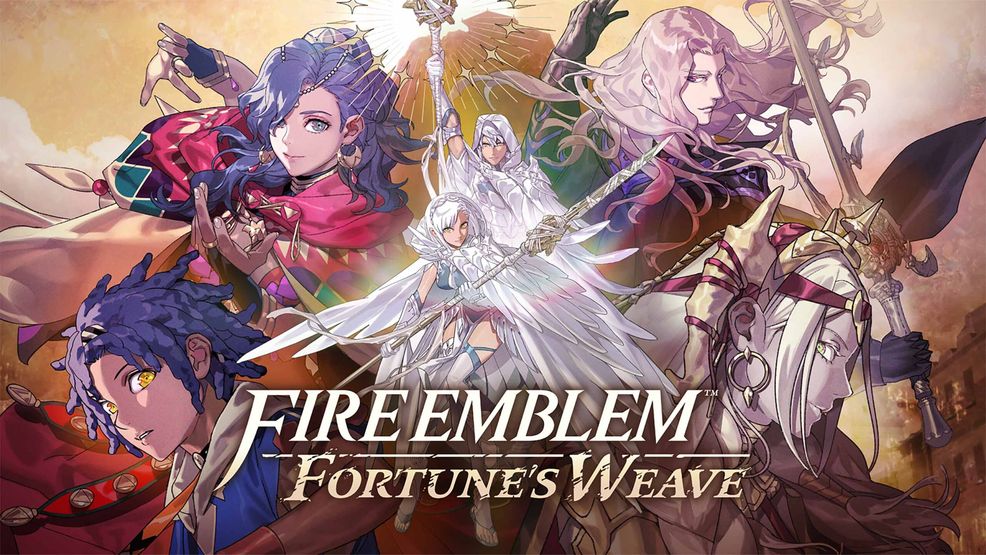
“Ugh… The scale of all this… I’m starting to get a headache.”
Leda, one of the protagonists of Intelligent System’s Fire Emblem: Fortune’s Weave, makes this comment late into the strategy RPG’s campaign. She’s referring to the cataclysmic threat posed by the main villain, the demon king Balor, but incidentally, it’s also the perfect description of how I feel towards Fortune’s Weave as a whole.
While the game has a staggeringly intricate structure that weaves between three distinct arcs, the breadth and depth of all of its content proves to overbearing. The overall gameplay loop and some individual narrative beats certainly shine, but they’re unfortunately bogged down by copious amounts of excess. The end result is an entertaining, but wildly uneven, strategy-RPG experience.
A sprawling, but unfocused, epic
Right off the bat, Fortune’s Weave positions itself as a rather novel entry in the Fire Emblem series. That’s because it’s set in the same universe as 2019’s Three Houses but takes place hundreds of years later in a different land across the sea. Truthfully, it initially feels a bit like dangling keys in front of Three Houses fans, with the game opening with the Progenitor God Sothis (a returning Cassandra Lee Morris) once again teeing up your journey. But otherwise, this is entirely standalone from Three Houses.
That standalone nature is not inherently a bad thing, to be sure, although those inherent connections do make the story here feel comparatively trite. While Three Houses focused on the Game of Thrones-esque conflict between clans and a sympathetic villain who aimed to end this violent, prejudicial cycle, Fortune’s Weave is simply about the world-ending monster Balor. The game begins in this post-apocalyptic future he’s brought about, with protagonist Eshmel being sent back in time five years to change the fate of four “Flame Lords” who will aid in humanity’s last ditch effort to survive.
This is where Fortune’s Weave‘s ambition really comes to bear, as each Flame Lord, quite impressively, has their own full-sized campaign. Leda, the character I started with because of her unique musical abilities, is a minstrel who seeks vengeance for her father’s murder. Theodora, meanwhile, must take over her kingdom once her own father is killed, while Cai, a young boy, seeks to save his father from imprisonment. (Fortune’s Weave really likes paternal motivations, apparently.) And the fourth and final Flame Lord, Dietrich, is simply in it for the love of the game as he roams the land to find worthy opponents.
They all come to Dagda, a bustling Greco-Roman city, to take part in the Heroic Games, a coliseum-style tournament in which the winner is granted one wish by the church of state. And once you complete Part I of a given campaign, that Flame Lord and their allies and gear can be brought into two additional Parts, the middle of which directly segues into the final Balor section. It’s a riveting hook, especially if you play with Permadeath enabled as I did, as it feels genuinely rewarding to have successfully levelled up and guided these characters throughout the entire campaign. (And, similarly, this makes it all the more devastating should you lose any units along the way.)
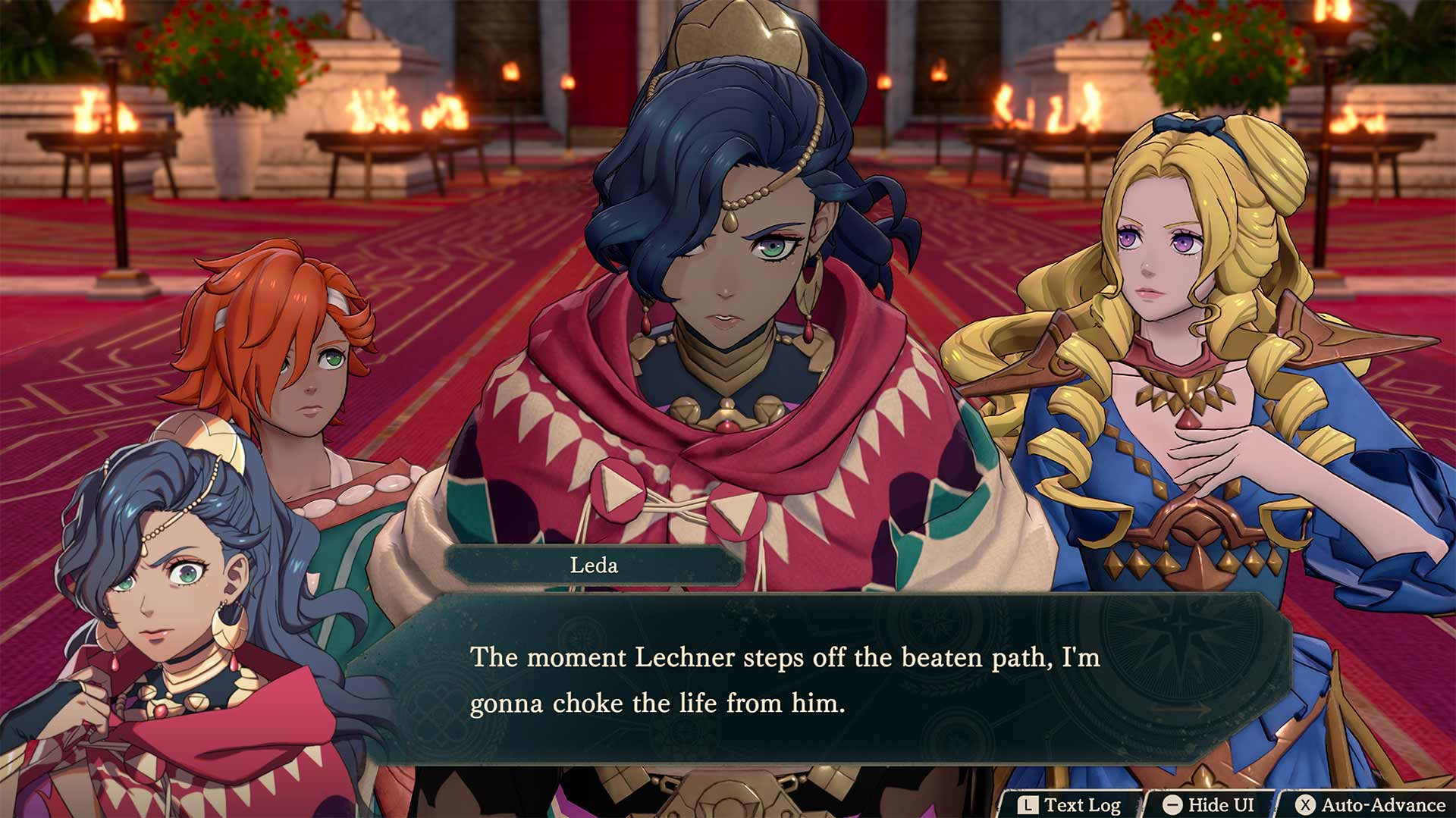
Leda’s story is a pretty rote revenge tale.
There are several weaknesses within this years-spanning epic, however. For one, Balor is the most generic of apocalyptic threats, while Eshmel (who you can customize as male or female) is a practically voiceless avatar with no actual personality or dimension. As such, you simply have no attachment to either character, which causes the late stretch of the game, which took me 20-plus hours, to really suffer. Worse still, their conflict feels so jarringly disconnected from the Heroic Games. You go from a character-driven narrative with relatively low stakes (all while a larger Dagdan conspiracy is teased but never fully fleshed out) to a cataclysmic battle against a dime-a-dozen creature that really has nothing to do with the Flame Lords.
But even ignoring the Eshmel-Balor side of the game, the first two parts that lead into it are inconsistent at best. As Leda, I spent around 40 hours during the Tournament Arc, and this features a pretty rote story about the corrosive, maddening nature of revenge that also unfolds at a glacial pace due to its repetitious “match, break, match, break” structure, with plot developments being slowly drip-fed in between. Worse still, Leda’s campaign in Part II (the “War Arc”) suddenly makes her a supporting character to Theodora as the latter’s people engage in a deadly conflict with another kingdom. It’s a baffling decision to effectively reduce Leda’s role to a glorified cameo in her own story to shift focus for 10 or so hours to another protagonist in whom we have no investment.
This proves especially frustrating because the game’s insistence on making everything so elongated means that switching to going through Theodora’s campaign isn’t something you can quickly do. To be clear, I love the multiple campaigns of games like Nier Automata and Kingdom Hearts Birth by Sleep because they’re manageably sized, taking around 10 hours each and, thus, allowing me to see the bigger narrative picture in a reasonable amount of time. Fortune’s Weave, though, seems to want to punish you for not dedicating another 40 hours at least just to see other highly relevant perspectives. It feels like the Marvel Cinematic Universe at its worst, making you do “homework” with seemingly unrelated stories so you’re properly prepared for the one you actually came to see.
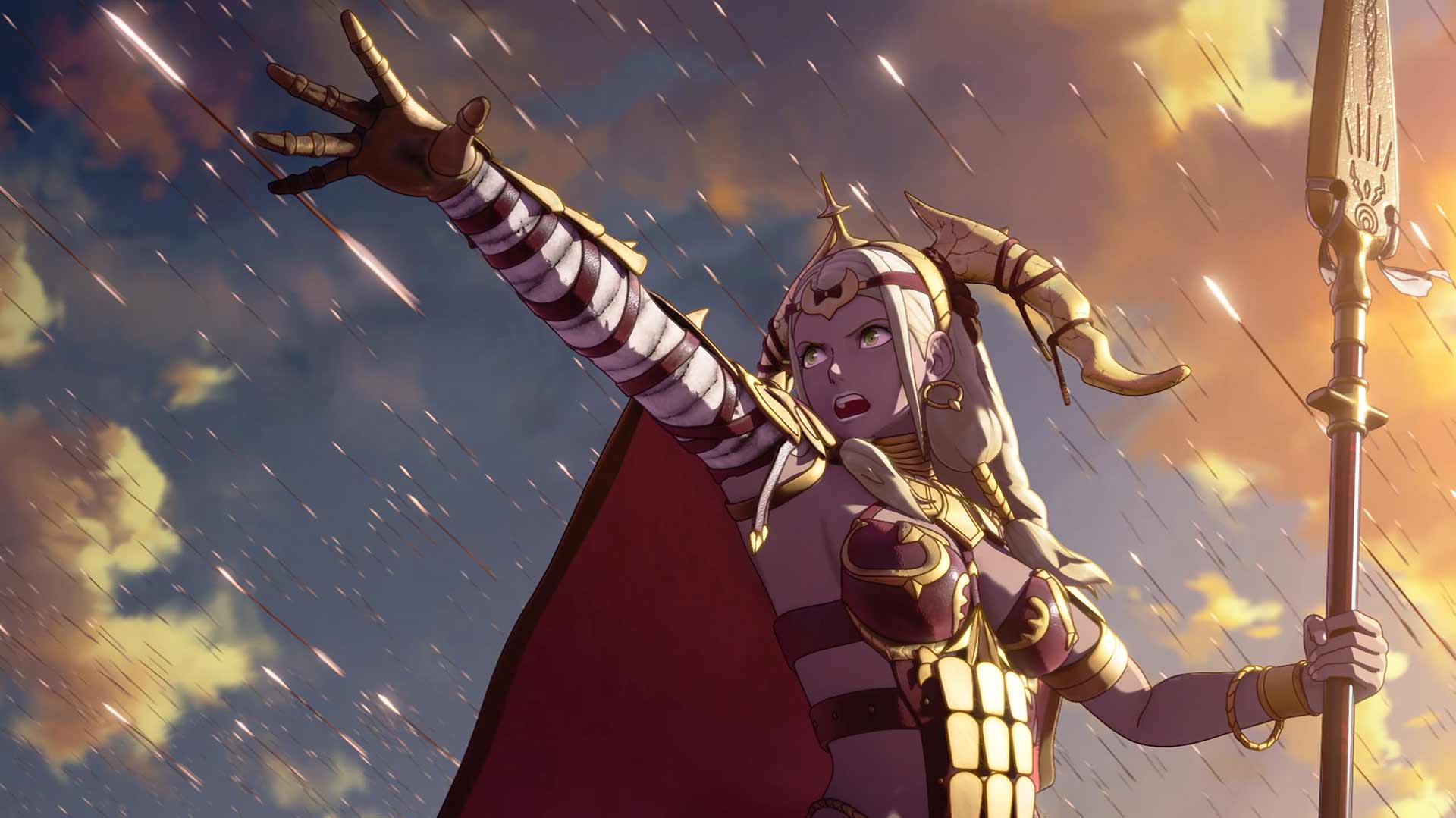
Theodora, I hardly knew you.
And of course, I can really only speak for Leda and the several hours I subsequently played of Theodora’s story, the latter of which did admittedly seem more interesting than simply “vengeance” due to its focus on the religious discrimination experienced by the nascent queen and her people. Given the staggeringly massive scope of Fortune’s Weave, I simply wasn’t able to check out Cai or Dietrich’s individual campaigns, with my only real engagement with them coming instead through incidental appearances they make during Leda’s Tournament Arc.
Perhaps the other three campaigns would have felt more cohesive (either in terms of connecting to Balor or even just standing on their own instead of this heavy MCU-like crossover), but to fully answer that question, I’d have had to play at least 200 hours before writing this review, which is simply ridiculous. Fortune’s Weave simply doesn’t respect your time.
Excellent strategy buried under lots of repetition
This sense of disjointedness extends well beyond narrative, although it takes a while for it to settle in, as Fortune’s Weave does indeed provide a legitimately engrossing gameplay loop at its core. In between tournament matches, you have an allotted number of in-game days to prepare in various ways, including by taking part in Dagdan activities like training or performances to raise stats and Bonds between allies.
The most meaningful element of Fortune’s Weave‘s calendar system, though, is the world map. Rather than being an open-world setting, you can move your character along this grid-like chart a few spaces at a time, with one turn passing along the way to inch you closer to the looming tournament match. At first, this might seem like a limitation, but I quickly came to appreciate just how much more conscientious I became about how I was spending my time.
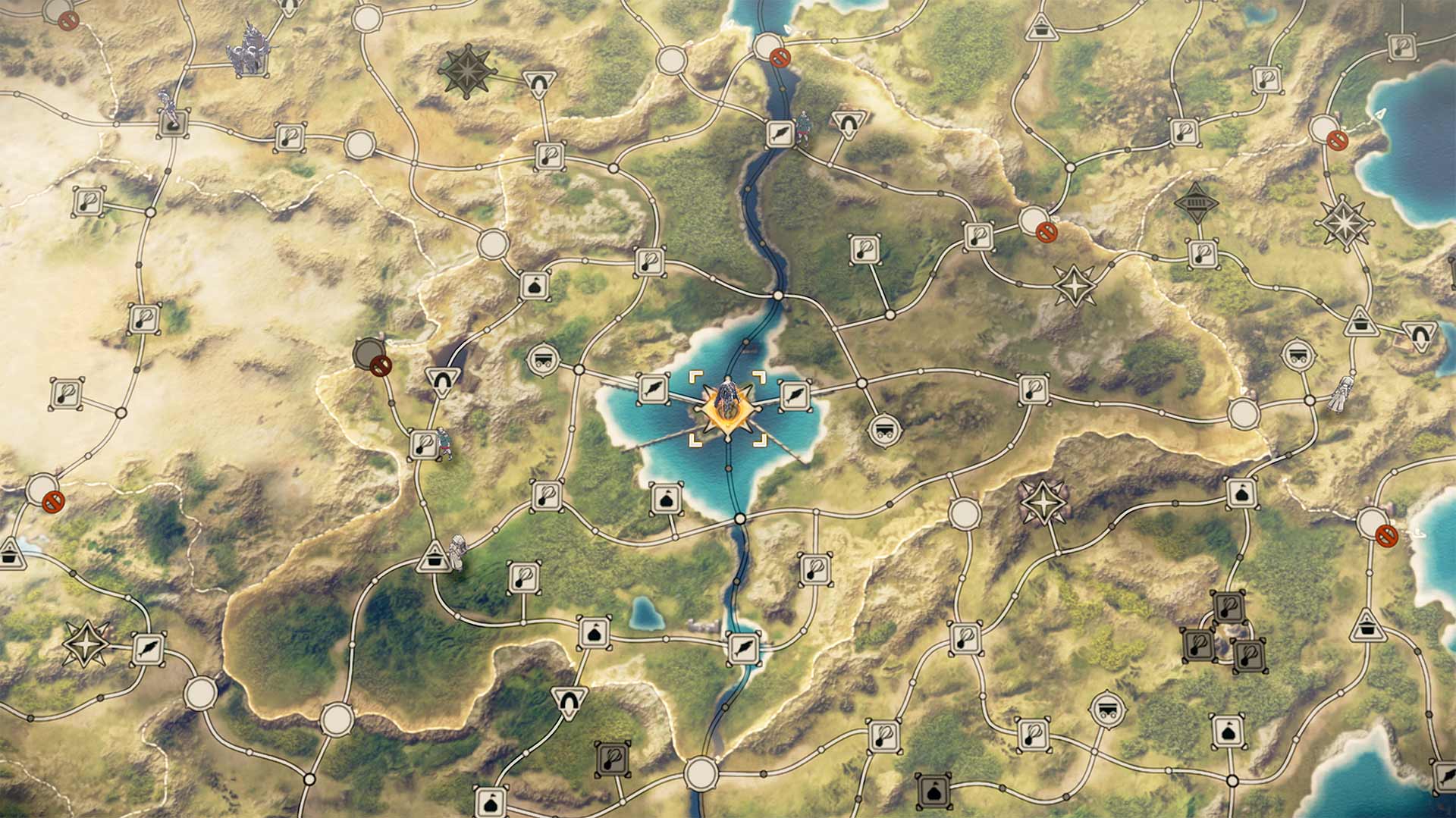
The world map is huge.
To complete sidequests, including the character-specific ones (in Leda’s case, reaching various towns to perform music), I had to carefully plan my route for maximum efficiency, taking into account obstacles like enemies and shifting environments (i.e. a desert that slows your traversal) and making full use of carriages that offer limited fast travel opportunities. It adds to the strategic ethos at the heart of Fire Emblem in a thoughtful way.
The world map is also vast enough to encourage exploration, as venturing off the main paths may unlock hidden villages, little areas with rare loot or even dungeons. That last element is especially worth your while.
In a welcome return from the excellent 3DS game Fire Emblem Echoes: Shadows of Valentia, dungeons are 3D environments that you can fully run around in to find chests and resources. Enemies can also be struck to give you a leg up in battles, which are represented here through Clashes, Final Fantasy-esque turn-based battles with a row of party members instead of Fire Emblem‘s signature bird’s eye view, tile-based combat. All in all, dungeons offer a refreshing change of pace, although their relatively copy-and-paste visual design and layouts leave much to be desired. (Get ready to see lots of uninspired, run-of-the-mill caves.)
And because the world map exploration is so full of rewards, the classic turn-based battles feel that much more impactful. I put in all of that work to acquire that extra gear, level up that character or complete that particular sidequest, and so I would head into fights feeling gratifyingly prepared. This is especially important because Fortune’s Weave has an annoying tendency to constantly throw many (often respawning) enemies at you in story battles, even on Normal difficulty, which I inevitably switched back to from Hard in Part III, the “Salvation Arc,” due to how unrelenting it became.
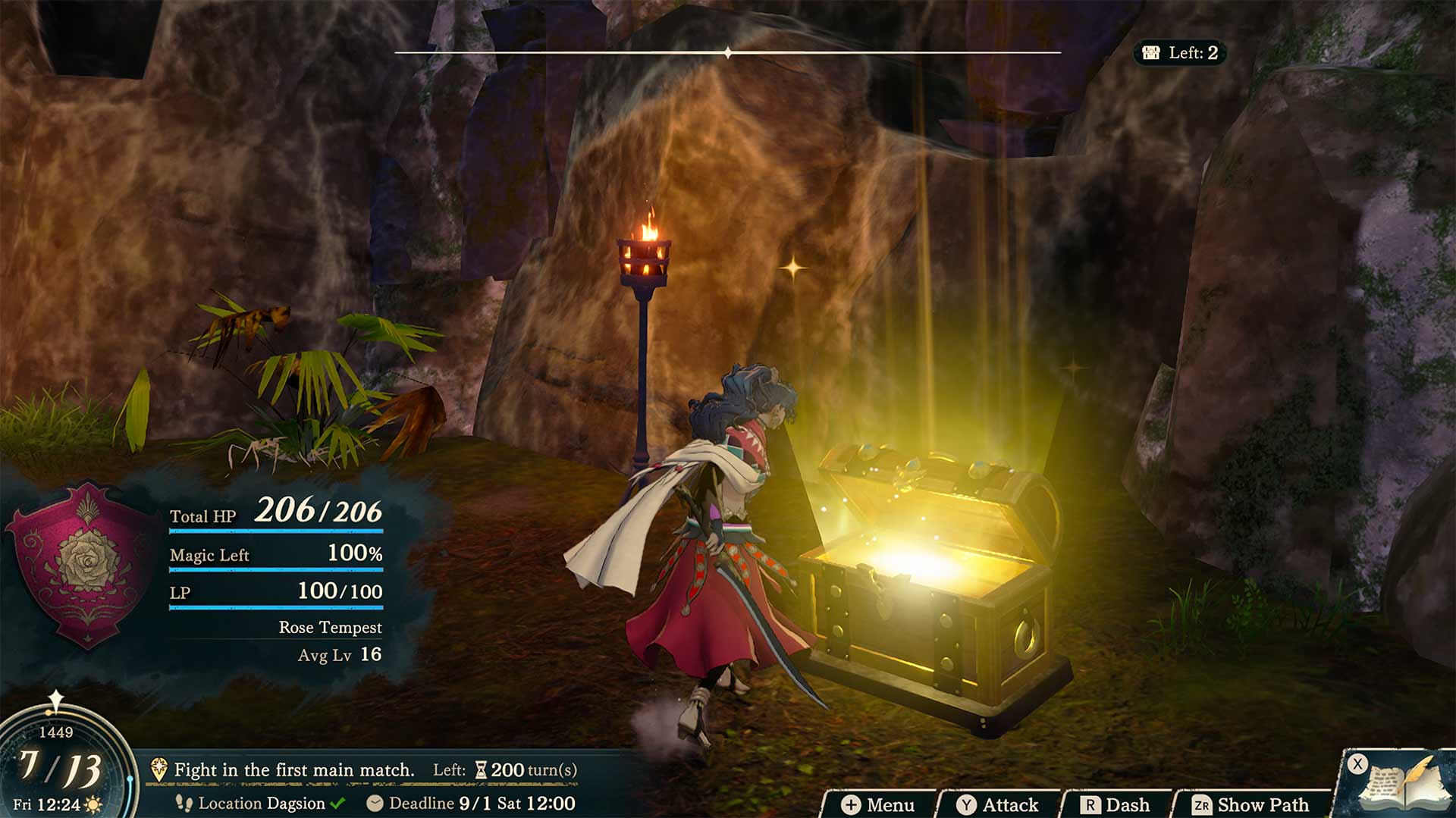
Dungeons make a welcome, if uninspired, return.
I am happy to report, if nothing else, that the one major new combat gimmick that Fortune’s Weave introduces is rather brilliant. Enter Blaze Arts, which are special Flame Lord moves that cost HP in exchange for huge benefits. Leda, for instance, can strum her vihuela instrument to dramatically buff allies and even clear environmental hazards, while Theodora is able to hurl chunks of the earth for long-range attacks.
Use enough of these moves (or special high-level weapons), and you’ll enter Overblaze, a super-powered state that increases your strength, but use too many and you’ll Burst, reducing your maximum HP for the rest of the fight. It’s a brilliant risk-reward mechanic, challenging you to let it rip at the right moment lest you weaken your central units too early.
With all of that said, the nature of Fortune’s Weave, segmented as it is by four campaigns, means that there’s only a handful of actually developed characters throughout. This means that the vast majority of the units that you’ll recruit to fill out your party are painfully thin. As you run around Dagda, you’ll encounter people who will join your cause, provided you meet arbitrary criteria like sharing a minimum Bond level with them (raised by inviting them to local activities like going to meals or shows together) or high enough Renown (a gauge that increases by completing sidequests and other activities on the world map).
But despite those hefty requirements to unlock them, they don’t actually have any fleshed-out narrative of their own, practically no backstory and certainly no Support conversations to speak of. Not even Seteth, the saintly warrior who returns from Three Houses as a recruitable character, has any actual scenes with the Flame Lords, Eshmel or any of the other cast. It feels almost insulting to force you to grind so much to recruit that one character, and then they don’t have any unique story material besides a few canned lines, making them feel interchangeable and even disposable. People bemoaned the heavy social elements in Three Houses, but those, at least, always felt meaningful because all of the students and teachers had their own backstories and Support conversations to make them feel like living, breathing people as well as combat units.
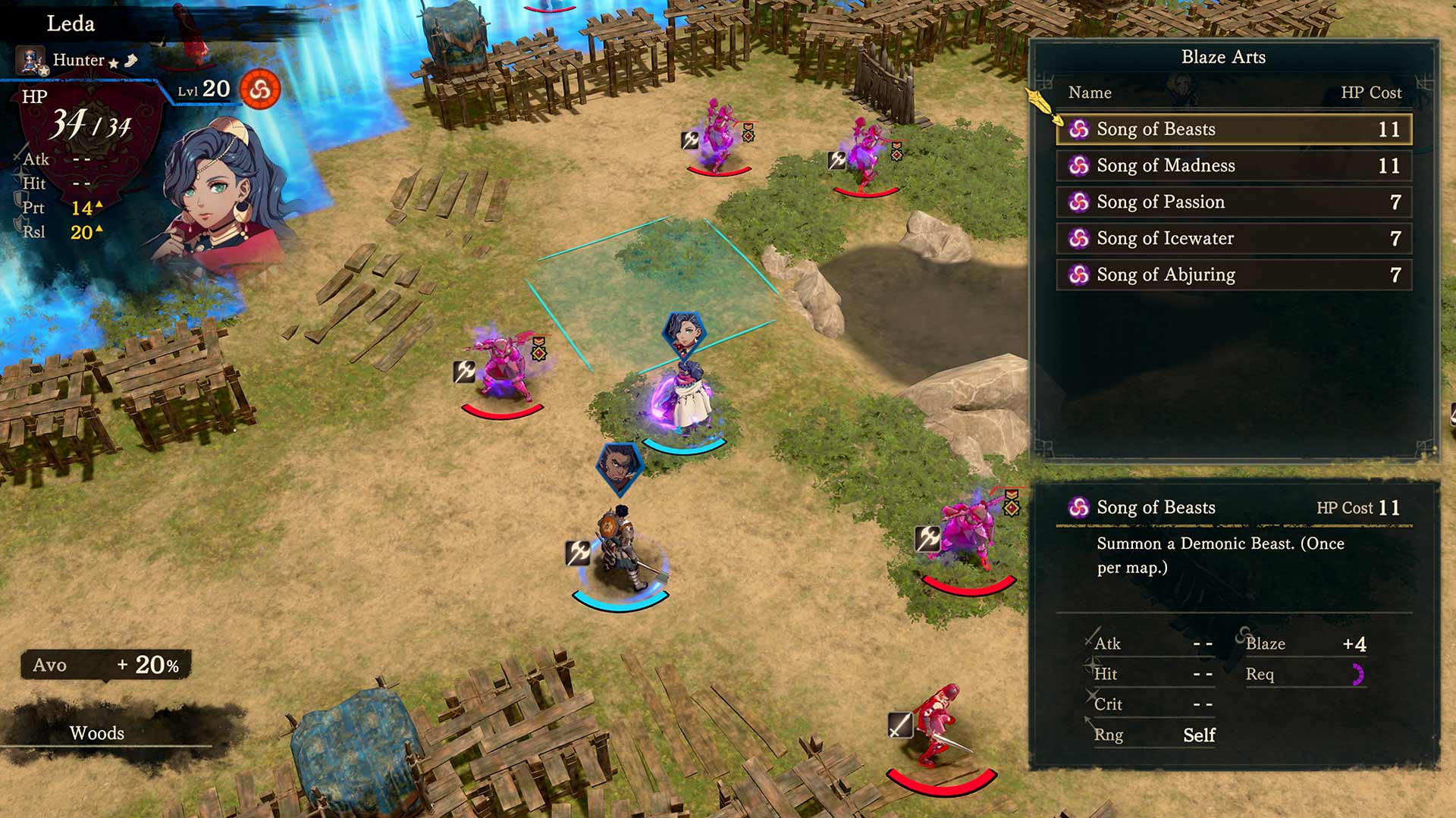
Blaze Arts are a welcome new addition.
The limited characterization in Fortune’s Weave proves especially glaring should you complete special Paralogue sidequests for some of the Flame Lords or their close allies in other campaigns. Doing so actually allows you to let them join you in the Salvation Arc even if you didn’t complete their campaigns, which feels like the rare time Fortune’s Weave actually forgives you for not doing everything. But even then, it leads to these hilarious MCU-esque guest roles in which characters like Dietrich became suddenly allied with me in the late-game even though I had zero context for who they were.
This also raises another critical issue: playing with Permadeath but not engaging with at least two campaigns severely kneecaps you. By the time I reached Part III, I had lost numerous allies (fatalities brought about, in no small part, due to playing on Hard for most of the game), and in this final stretch, the opportunities to recruit new units are limited outside of a few who join per the narrative or Paralogue completion. Your only other recourse, as the game keeps telling you, is to go back in time and guide the other Flame Lords to the future. In other words, Fortune’s Weave is, once again, punishing you for not putting at least 100 hours into the game.
All the while, the Salvation Arc feels dragged out due to its own structure. Essentially, you’re free to challenge Balor whenever, although naturally, you’ll need to be sufficiently levelled. What’s more, the Demon King summons Underworld Gates that you have to destroy within an allotted calendar period. None of this is inherently problematic, but as with so much of the game, it’s unnecessarily bloated. That’s because the Gates are often spread across the map, forcing you to split your units into smaller parties to divide and conquer, all while keeping one unit near Dagda to protect advancing waves of enemies.
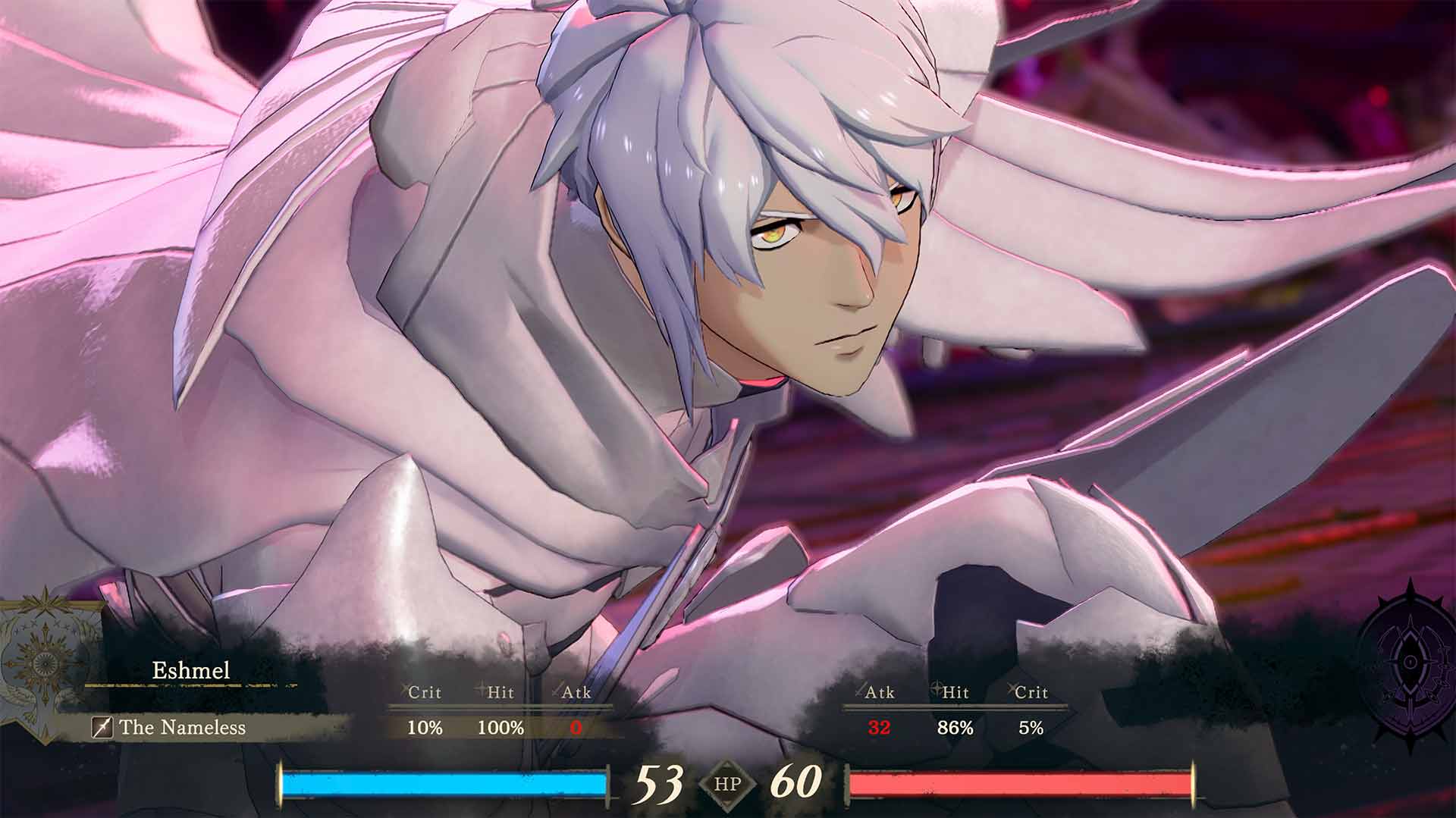
Eshmel.
The first or second time I had to do this, it proved quite captivating, challenging me to strategically deploy parties that were as balanced as possible while also saving a few to keep an eye on Dagda. It was a clever evolution of the earlier world map exploration that kept me on my toes. But having to do this several more times, with the gaps between the placement of the gates widening throughout and the individual map points that you have to reach to dispel barriers protecting them, just felt unbearably tedious.
Compounding this frustration is the fact the maps for Act 3’s story battles are all filled with their own unique forms of miasma, which coat many tiles with significant stat-reducing penalties that rarely even affect enemies. It’s yet another example of Fortune’s Weave being big for the sake of it, and it proved grating in those final hours.
Fortune favours the slog
Fire Emblem: Fortune’s Weave can be an exasperating game. For all of the meaningful ways it builds on the series’ central gameplay loop, particularly through an ingenious multi-act, cross-campaign approach to cause and effect and its densely layered world map, its insistence on maximalist game design regrettably harms the pacing, flow and RPG elements of the whole experience. Ultimately, I enjoyed the totality of the experience, but it really wore me out at times, and it leaves me begging Intelligent Systems to go with a “less is more” approach in future Fire Emblem games.
Fire Emblem: Fortune’s Weave launches exclusively on Nintendo Switch 2 on September 17.
Image credit: Nintendo
 Gaming
  Features
  Gaming
  Features