


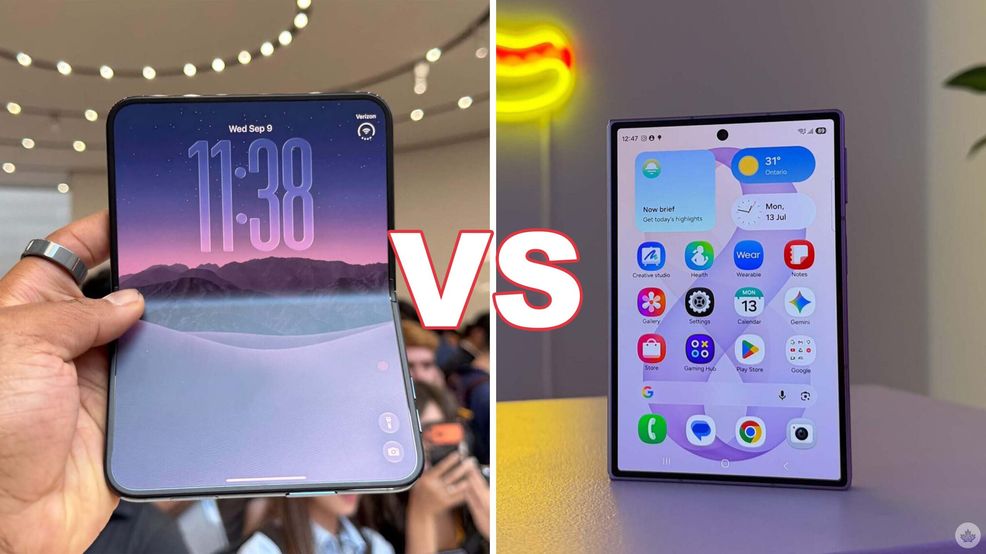
Apple has finally unveiled its foldable iPhone after lots of speculation, and it’s named the iPhone Duo (clever). We’ve already had some hands-on experience with the device and shared how much it will cost, along with the other new releases in Apple’s lineup. However, it’s not the first foldable phone on the market, with Samsung taking a cheeky jab at the company for “reheating our leftovers” (lol).
So, with these two companies now officially competing in the foldable phone space, let’s compare them and see how they do.
Now, dimension-wise, both the Duo and Galaxy Z Fold 8 have pretty similar screens. The inner screens are the same size at 7.6 inches, while the Galaxy Z Fold’s outer screen is an inch larger, but that’s not much of a difference. However, one bonus I can give to Apple is the Nano-texture finish on the main screen, which Mobilesyrup‘s devices editor Dean Daley noted reduces glare and actually makes it harder to see the crease — which is a huge plus, considering that the Z Fold 8 has suffered from a screen crease that has only gotten worse over time.


Under the hood, the Z Fold 8 gets more RAM, with an option up to 16GB, which is better than the Duo’s expected 12GB of RAM (though we don’t have an official spec on this from Apple). The Duo also gets Apple’s new and improved A20 Pro chip, which I’m curious to see side by side with the Z Fold 8’s Snapdragon 8 Elite Gen 5 for Galaxy.
Shifting back to feel, the iPhone Duo is a pretty sturdy device. Despite weighing 53g more than its Samsung competitor, the Duo comes with Ceramic Shield 2 on the front and Ceramic Shield on the back, which Daley noted makes it as durable as the iPhone Air.
Interestingly, the Z Fold 8 also comes equipped with IP68 water and dust resistance, which was previously only found on the Pixel foldables, which is another huge plus for the Duo.
Now, let’s shift to another major aspect: the cameras. The Z Fold 8 comes equipped with a 50MP f/1.8 wide lens and a 50MP f/1.9 ultrawide rear camera, alongside a 10MP front camera. The Duo, on the other hand, has a 48MP f/1.6 main camera, a 12MP f/1.6 aperture telephoto camera (a nice plus compared to the Z Fold 8), and a 48MP f/2.2 ultrawide camera, plus a “Center Stage” camera and an under-display FaceTime camera.
Now, on paper, the Z Fold 8 appears to have the upper hand, but 48MP versus 50MP isn’t a major difference. It will really come down to photo quality. I expect the Duo to have good front cameras, mainly because the FaceTime camera and selfie photos take a prominent spot in the marketing material. I’m curious how the Z Fold 8’s auto touch-up compares to Apple’s recent push for photo quality, as Daley noted in a review of the Z Fold 8 that the photos on their own look pretty dull until the post-processing kicks in.
Now, battery life is a toss-up. Apple only provided some basic stats (thanks, Apple) on battery life, but it did reveal that the Duo uses a two-battery system and can last up to 44 hours of video playback on the outer display—which is pretty good. However, one thing which I quite like about the Duo is the advanced ventilation and vapour-chamber cooling, which should give it a bit more of an edge under stress testing.
I’m looking forward to seeing how the Duo stands up against the Z Fold 8 as more hands-on testing gets done. But for now, you can check out all the specs in the chart above, and let us know your thoughts down below.
 Streaming
 Streaming
 Streaming
 Streaming
