


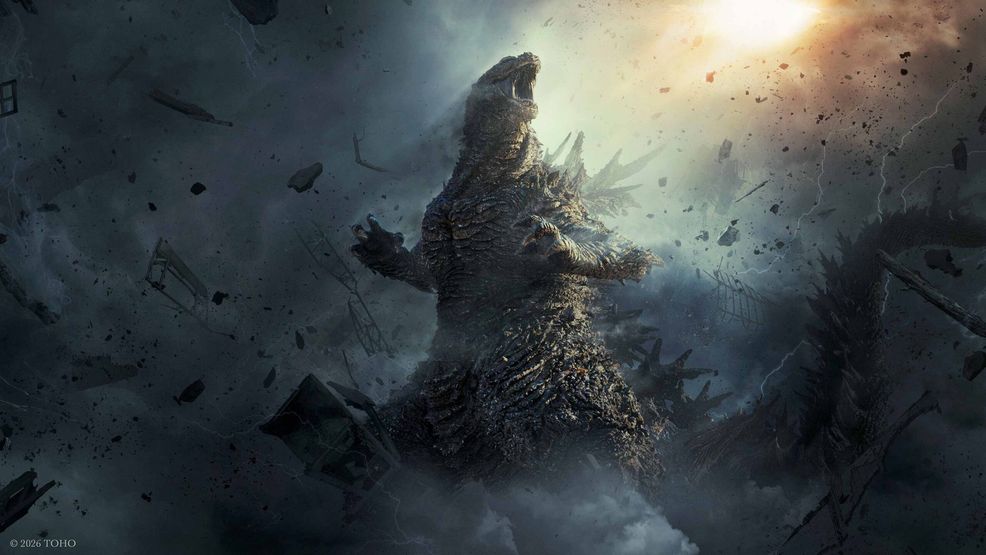
Godzilla Minus One took the world by storm in 2023.
Quite masterfully, writer-director Takashi Yamazaki’s kaiju epic mixed incredible visual effects (VFX) with a powerful story of traumatized former kamikazee pilot Kōichi Shikishima trying to rebuild his life, creating a truly unforgettable blockbuster.
The fact that this was all achieved with a reported budget of less than US$15 million was all the more impressive — so much so, in fact, that it even took home the Oscar for Best Visual Effects, the first non-English-language movie to win in this category.
Now, Yamazaki and his team are back with Godzilla Minus Zero, a sequel that sees Kōichi, his family and their allies struggling to survive a war between Godzilla and King Ghidorah.
To learn more about this exciting follow-up, MobileSyrup sat down with members of the VFX and sound teams. Through translators, they gave some fascinating insight into just how much work goes into crafting the look and feel of a Godzilla film.
The VFX team
Godzilla Minus One is so beloved, in no small part, because of that incredible Oscar-winning VFX work from the team. Going into Minus Zero, how did you hope to expand upon what you had already achieved in that first film?
Takayuki Ueki (VFX supervisor): Godzilla Minus One was already quite tough in its own right, but going into Minus Zero, I think one of the biggest changes for the VFX team was the fact that there were two kaiju on screen. We’ve got Godzilla and King Ghidorah towards the end having a duel to the death, really, and we wanted to get that sense of scale to come across the screen, and that, of course, required a lot of man hours to properly execute. But the goal that we never lost sight of was creating an experience and something on screen that the fans are really going to enjoy. So in total, there were four animators who were working on that, three of whom were there from pre-vis to the end. And the scene I’m talking about is the Yahaza operation when they’re trying to trap Ghidorah and then pit him against Godzilla. So the team kind of saw the scene through from pre-vis all the way through final animation, and watching the scene kind of evolve, I think that’s really indicative of the tone we were trying to set for the entire Godzilla Minus Zero experience.
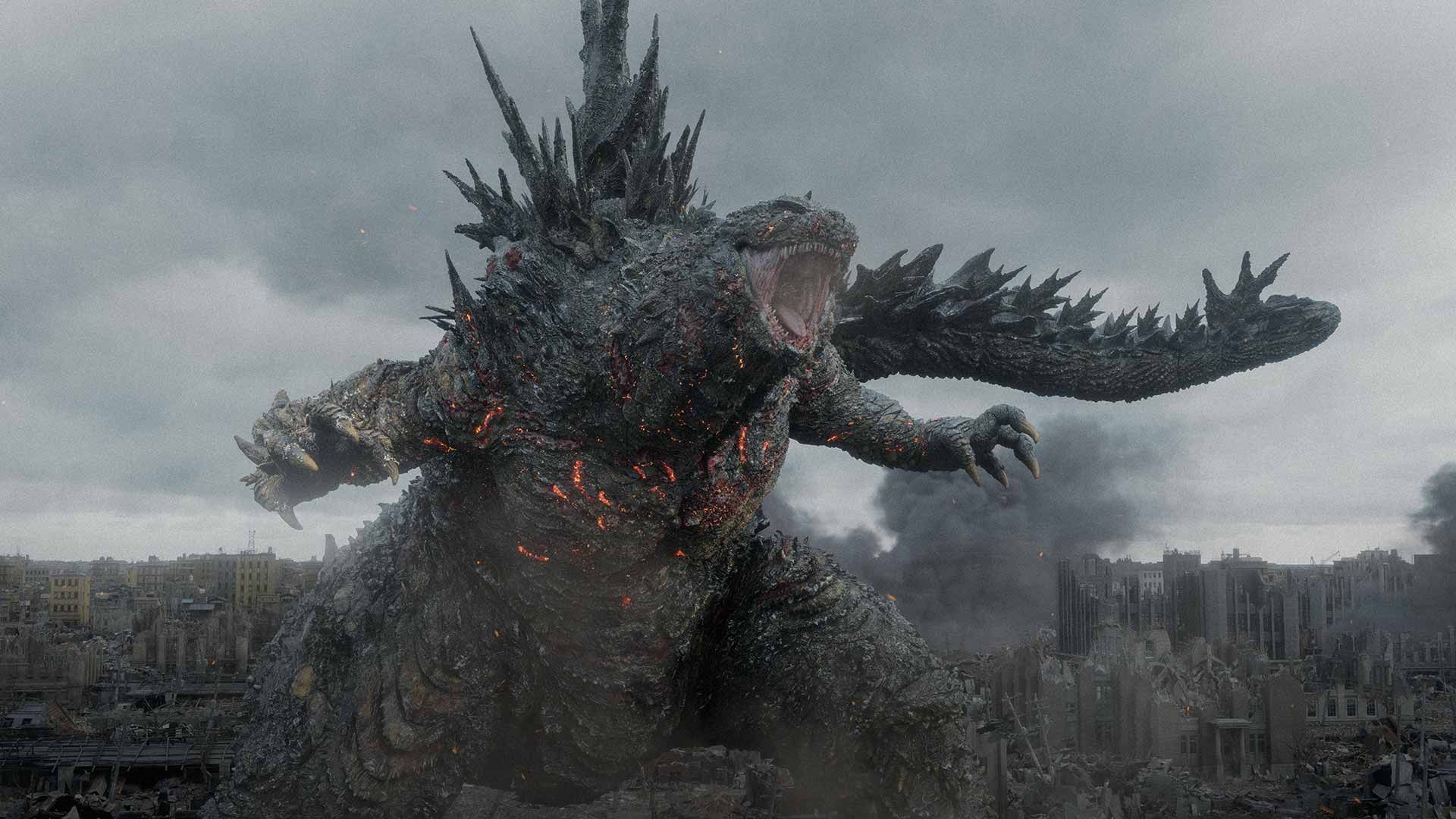
In Godzilla Minus One, the Warazumi operation was the climax of the film, where they’re out at sea trying to trap Godzilla, sink it, and bring it back to the surface, so that posed its own challenges to create all of that water and ocean and make it blend seamlessly with the effects. Something we wanted to attempt with Godzilla Minus Zero is really the human eye line, so putting kaiju and humans in the same space next to each other — not on a ship, on a battleship in the ocean. And we had to really sell this idea of this 300, 400 metres, over 1000 feet of space, because humans could be on the ground looking up and watching planes fly through, or looking up at the kaiju. So it required a lot more development and environment: the backgrounds — even down to the Ginza ruins. It required a lot more man-hours to render all of these backgrounds.
And that also extends to the dogfight, which there wasn’t much of in Godzilla Minus One. In the Narukami operation when they’re dropping the lightning rods, there was a huge sort of amount of screen time dedicated towards making sure the dogfights felt very authentic. So in order to do that and spin the camera around at all angles, we had to develop the entire city of Matsumoto in VFX, so that no matter where the camera was pointed, we would have some background. So the amount of VFX required between Minus One to Minus Zero, I would say, really exponentially increased when we read the screenplay. I think the whole team was thinking to themselves, “Oh my gosh, how are we going to achieve this?” So instead of creating backgrounds tailored to each individual shot, it’s almost as though the team created an entire city. So no matter where they wanted to place the camera, they would have some background coverage, and there was a lot of freedom to adjust that.
Tatsuji Nojima (visual effects artist and compositor): And there were, of course, challenges in the continuity. While there are two kaijus rampaging through a city, naturally from shot to shot, the city is not going to look the same. So we built this entire city, and then making sure, according to the shot, you’ve got fire and smoke in the right places, and all the different VFX that are happening. So, I would say the city probably took more computing power than some of the kaiju action in certain instances.
Minus Zero is the first Japanese production filmed for IMAX, which is really exciting. How did that larger ratio affect your approach to the VFX in Minus Zero?
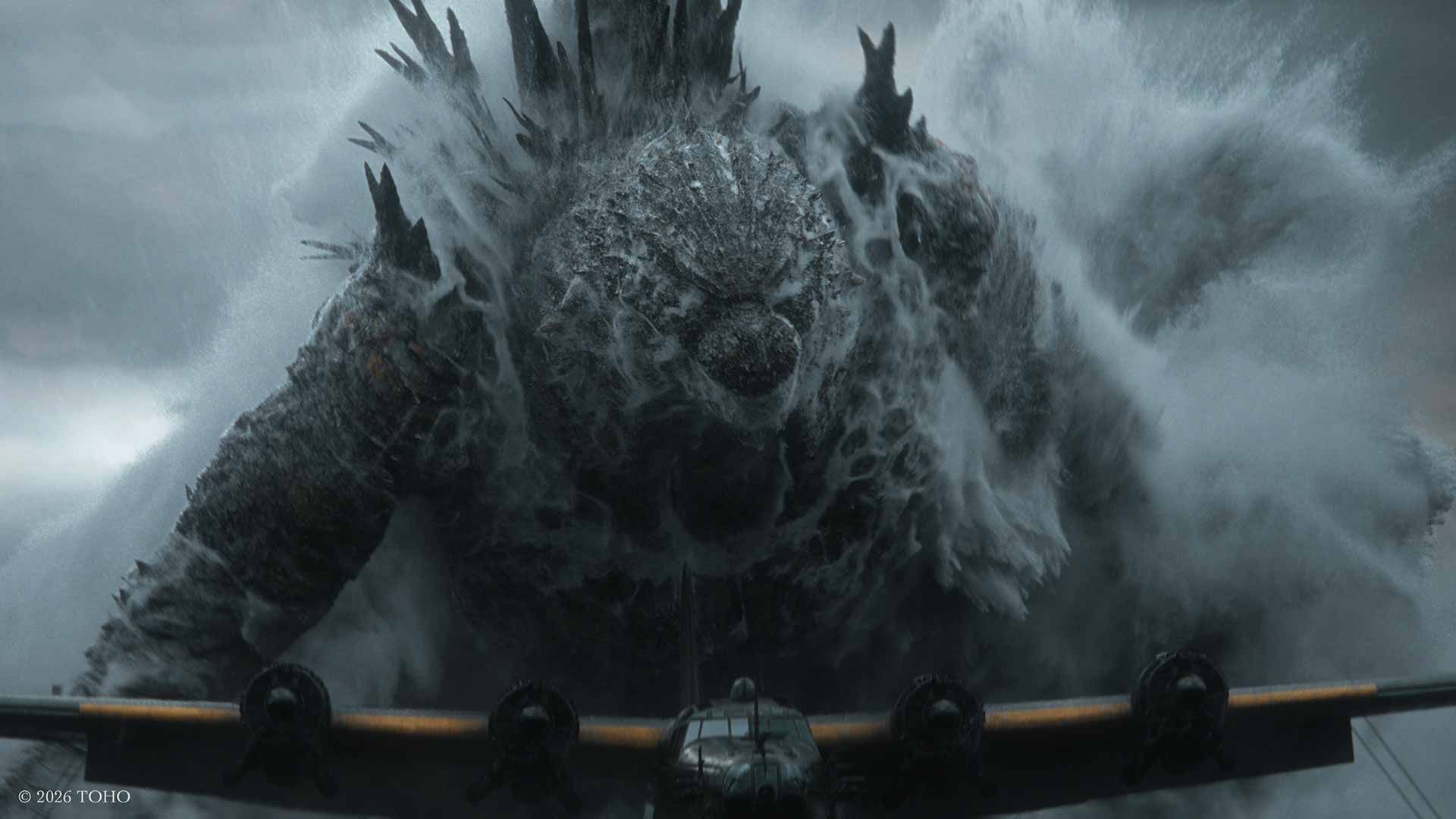
Nojima: With IMAX and the increased screen aspect ratio, there are a lot of details that are on screen now that normally you wouldn’t see in a more traditional CinemaScope aspect ratio. So, of course, as the VFX team, we have to build out a lot more environments, especially on the ground, the debris, etc. So it, of course, increases the amount of work that we have to do. But everything from the ocean to the Narukami operation, I think it really gives it a different sense of scale because of the added room we have for shot compositions.
Ueki: And we spoke with the IMAX people, and they have sort of this general theory of how to create for IMAX, which is you take your traditional CinemaScope, aspect ratio, composition, and you expand above and beyond. So the top and bottom, you kind of expand whatever background or scenery or shot you want to do in IMAX. But with the kaiju film, if we had done that, if we see Godzilla in the middle of Ginza and we compose our shot and CinemaScope and expand at the top and bottom, it would make Godzilla feel very tiny relative to the screen itself. So in this case, we thought we had the chance to make these kaiju look absolutely amazing. We put aside IMAX theory and ignored that for a second, and instead focused on creating shock compositions for IMAX, and then afterwards, rearranging it for the CinemaScope aspect ratio.
And going back to the Ginza scene, if we mess up this, we would have so much sky or too much ground, and the balance would feel really off because of the IMAX screen ratio, so it was important that we were able to tilt the camera slightly differently for the IMAX version, so that we have just enough back sort of environment surroundings and debris in front, and just the right amount of sky above. But because of these sort of fine-tuning adjustments we had to make, it goes back to the previous question of why we had to build out this entire city so that we can place the camera differently according to our needs.
The sound team
One of the biggest reasons why Godzilla Minus One is so beloved is because of how well-made it is from a filmmaking perspective, especially as a blockbuster. Going into Minus Zero, how did you want to expand upon the sound design?
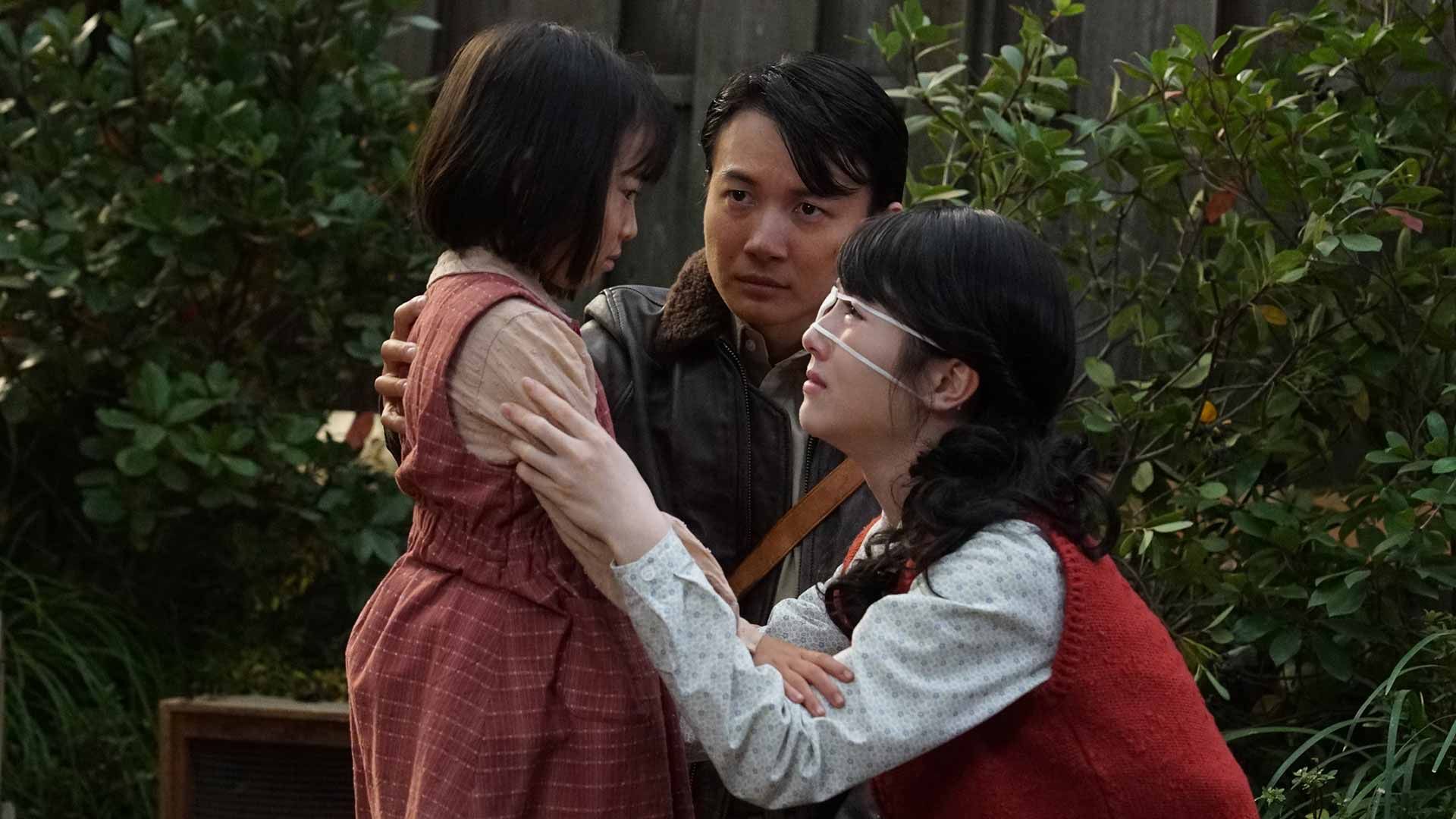
From left to right: Sae Nagatani as Akiko, Ryunosuke Kamiki as Kōichi and Minami Hamabe as Noriko.
Hisafumi Takeuchi (production sound mixer and post-production sound mixer): Of course, you want to keep kaiju and Godzilla, the impact that these creatures have whenever they’re on screen, so that has been sustained between Godzilla Minus One and Godzilla Minus Zero. But what I paid extra attention to with Minus Zero is the human drama element of the story. So I really wanted to find and strike the right balance between how much impact we have versus how emotional, how much drama, we can get the audience to buy into.
And within that, we have dialogue, sound effects, and music — these three different levers to play with. And I really wanted the audience to feel the right distance to any scene, to anything that was happening on screen, so that it would feel as though what they’re seeing and hearing is happening in real life. So, how to sort of pull the audience into the screen was something I wanted to create with the sound design.
There have been so many kaiju movies over the years. As you were working on Minus Zero, how did you balance creating sounds for the likes of Godzilla and Ghidorah that feel authentic and pay tribute to that legacy of all those films, but also be distinct and have your own unique touch?
Natusko Inoue (sound designer and foley artist): With Godzilla, of course, but with King Ghidorah, especially, we could go in various directions, but we had to create sound from scratch, really. And what I felt was really important is to make sure we retain and inherit this soul that King Ghidorah has that has been sort of transpiring over several years. And I didn’t want to lose whatever that spirit of King Ghidorah is through the sound design. And the conclusion I arrived to, and sort of central theme that I have for King Ghidorah’s voice is this idea that King Ghidorah “sings fear,” so I wanted its cry to have an almost melodic tone to it and a harmony between three heads.
Springboarding off of that, I think a lot of us in the audience when we’re watching these movies probably take for granted what a kaiju film and blockbusters in general “should” sound like. But of course, a lot of work goes into it on your part to create those sounds. What would you say are some of the most challenging aspects of working on the sound design for a giant kaiju movie like Minus Zero?
Inoue: At first, I certainly felt a lot of that pressure, and I could see this sort of challenge that stood before us. And I think that there were moments where that worked, and moments where it kind of hindered the project having that added pressure. So what the sound team and I discussed was, “Let’s for a moment forget the fact that this is a sequel, forget the fact that it’s a mega-scale blockbuster type experience, and then just really look directly at the movie and just only focus on what the movie is supposed to do.” And I could feel there was a certain shift in the sound design team and process from that point onward. And I think it really improved the overall experience that we were able to kind of shed off the pressure of the sequel.
Takeuchi: After doing the first pass of sound design on the Narukami operation, where they’re trying to drop the lightning rods on Ghidorah, the sound felt very busy, very congested. It’s like we were in a traffic jam. So we were kind of at a loss of where to take this because it just didn’t feel quite right. So what we did next is we rewatched Godzilla Minus One, which was something that we also sound designed, as a reference point to kind of reset what our objective should be. And what I felt when watching Godzilla Minus One was that the sound was very authentic, very honest, very pure. It wasn’t sort of tainted or muddied by all this other pressure, extra added tension, I guess you could say.
And when working with the three levers I have to pull, dialogue, sound effects, and music, trying to push them all to the front equally, I think, was what got us in that trap and created that traffic jam. So the audience would be lost; they wouldn’t know what to listen to and what information to consume and process as part of this emotional experience. So, to find the right balance, at times I would pull back on the music and make the sound effects feel like they’re coming forward even more, or even subtract some volume in general and create more contrast between human drama scenes and the kaiju scenes.
So when you first see Godzilla roar, it’s supposed to have a ton of impact. And every moment Ghidorah is on screen, we wanted to make sure the audience felt its presence. And in doing so, we wanted to create a unique sonic experience, of course, while still paying a lot of respect to the history of Godzilla and the kaiju and what has brought this moment before us. But at the same time, I think it was important that we had our own interpretation of what “Godzilla-ness” means in this context and interpreting that into sound. And I really felt myself and the whole team, on behalf of them, that we succeeded in executing this. So there’s a huge emotional journey awaiting you.
Godzilla Minus Zero opens widely in theatres on November 6.
Image credit: Toho
 Gaming
 Features
 Features
 Features
