



Ookla, the internet analysis company behind popular tools like Speedtest, has shared its latest evaluation of the evolution of Wi-Fi in Canada, which reveals that Wi-Fi 7 is on the rise, while Wi-Fi 4 is struggling.
While the overall uptake of Wi-Fi 7 tech in Canada is slow, a key takeaway is that Bell and Telus are driving the adoption.
Ookla used recent Speedtest Intelligence data to explore how new technologies are impacting the broadband experience within Canada.
Wi-Fi 7 is on the rise
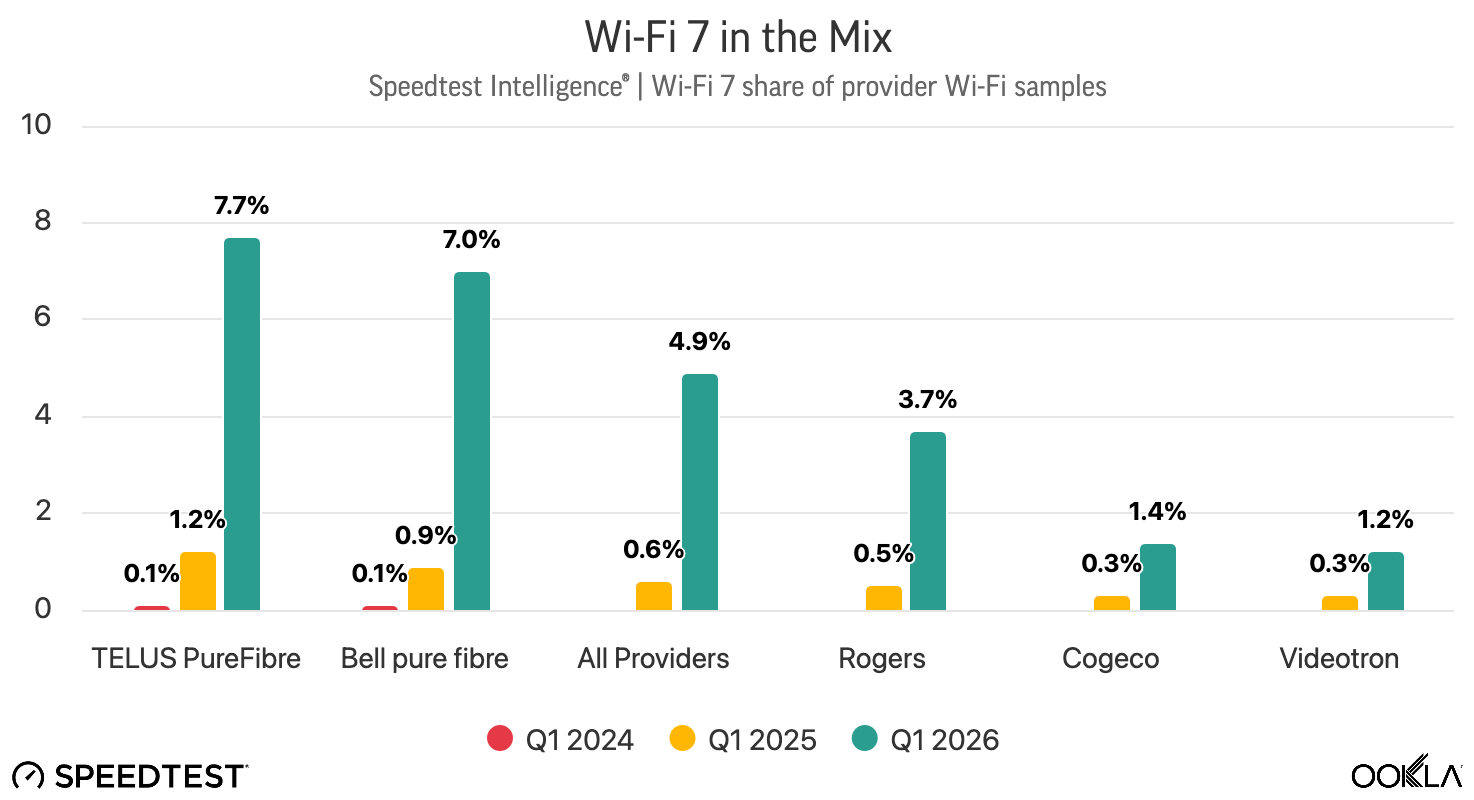
One of the ways that new technologies are impacting the broadband experience within Canada is through the adoption of Wi-Fi 7.
According to Ookla, Canadian adoption of Wi-Fi 7 jumped to a 4.9 per cent sample share across all providers in Q1 of 2026, compared to Q1 of 2025, when it was only 0.6 per cent. Notably, Wi-Fi 7 routers only became available in 2024, though Canada saw near-zero adoption into 2025.
The main reason for the sudden jump, according to the report, is that service providers have released their own Wi-Fi 7 offerings. Rogers, Bell, and Telus all began deploying Wi-Fi 7 hardware in 2025.
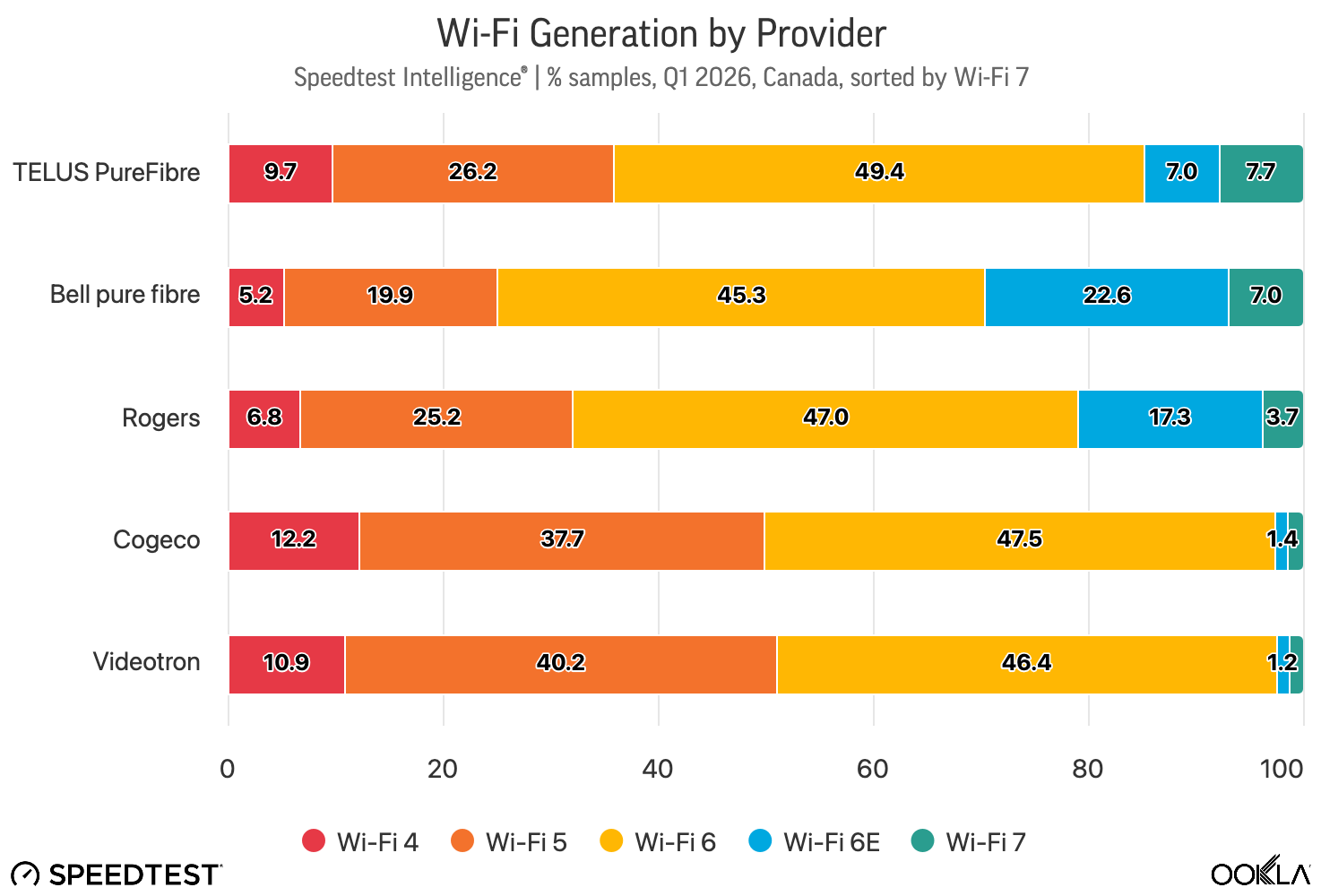
In Q1 2026, Telus PureFibre (7.7 per cent) and Bell Pure Fiber (7.0 per cent) led the way in terms of Wi-Fi 7 samples in their customer base, while both Videotron (1.2 per cent) and Cogeco (1.4 per cent) had yet to show meaningful adoption. For those who are wondering, Rogers sat right in the middle, with 3.7 per cent samples in its customer base.
Notably, Canada still trails the U.S. in Wi-Fi 7 use, with the States seeing 7.2 per cent adoption compared to Canada’s 4.9 per cent.
Who’s the fastest with Wi-Fi 7?
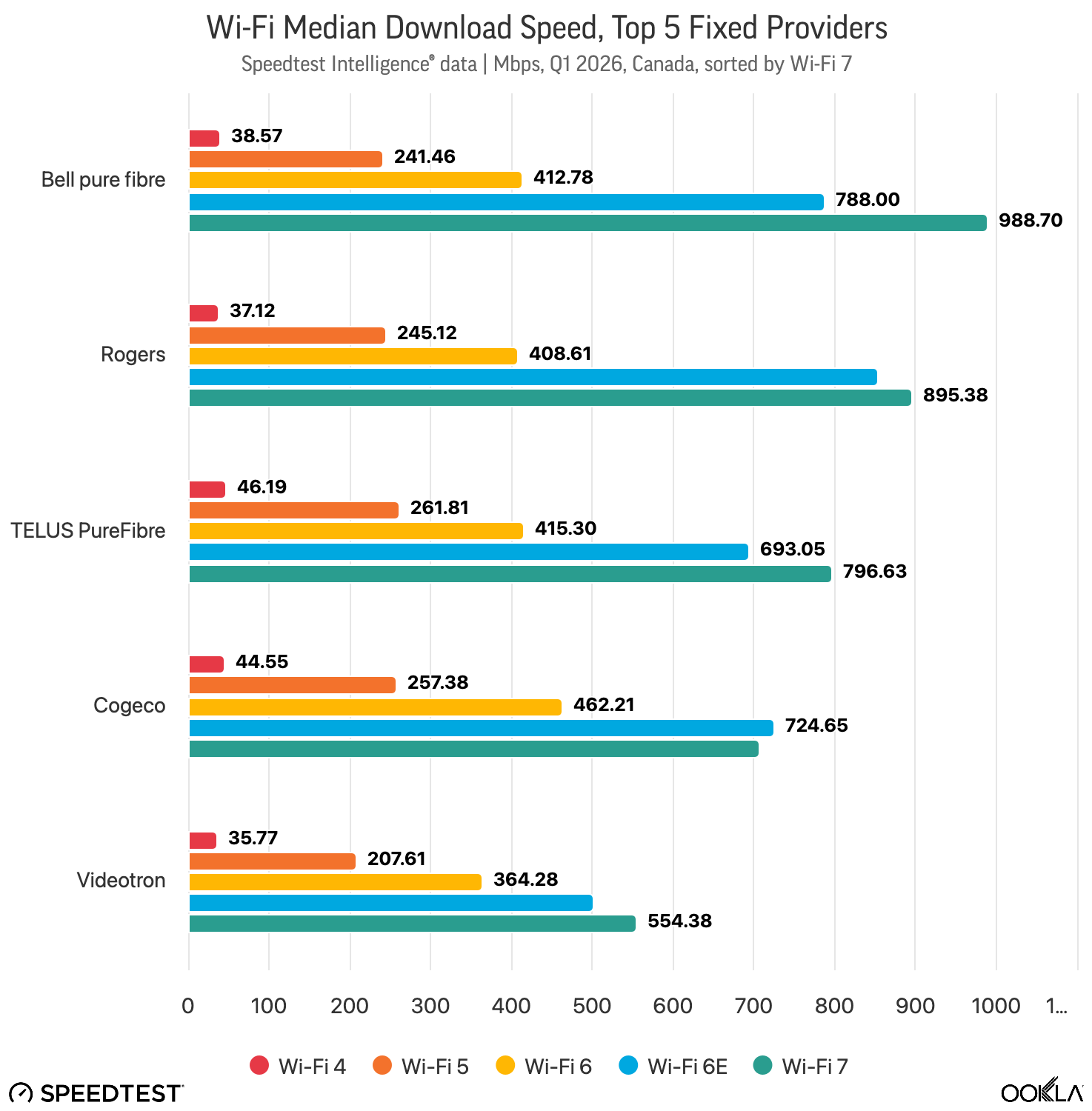
Now, Speedtest’s data also showed the median download speed between each provider across different Wi-Fi generations.
In terms of Wi-Fi-7, Bell’s Pure Fibre (which routinely does well in Ookla reports) was deemed the fastest, with a median download speed of 988.70Mbps, while Rogers came in close behind with 895.38Mbps, while Telus PureFibre ended up in third with 796.63Mbps.
Rounding out the back of the pack were both Cogeco and Videotron, who had about 723 and 554.38Mbps, respectively.
Wi-Fi 4 isn’t enough anymore
The data surrounding speeds from different generations also showed that Wi-Fi 4 is severely lagging compared to other generations.
The report notes that the media download speed of Wi-Fi 4 from every mentioned provider falls short of the Canadian Radio-television and Telecommunications Commission’s (CRTC) 50Mbps target. In fact, the closest one was Telus PureFibre, with a median download speed of 46.19 Mbps. I imagine that it won’t be long before Wi-Fi 4 will start to be phased out, as more companies adopt and promote Wi-Fi 7.
Source: Ookla
 News
News  News
News  News
News  News
News 