


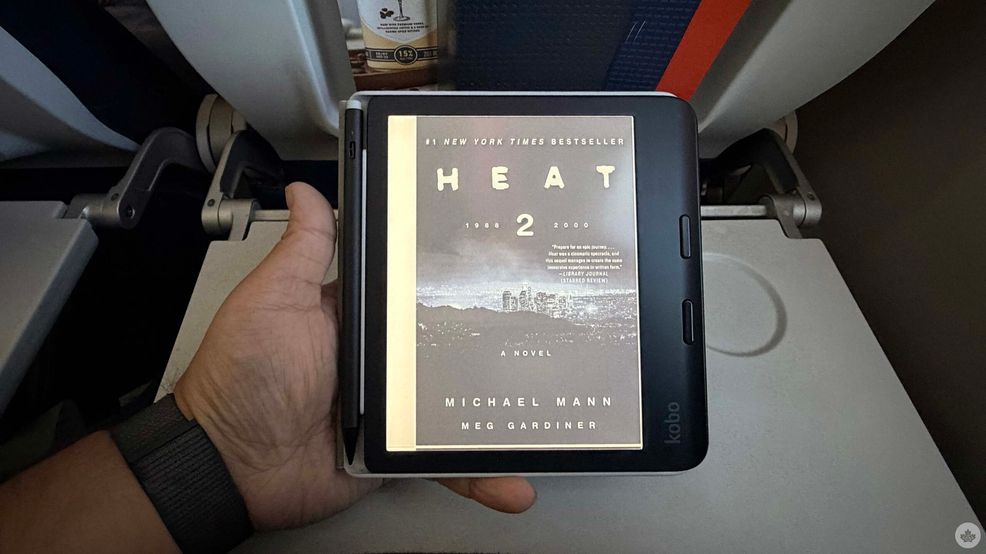
I used to love reading.
Since I was late to getting a smartphone, my introverted self passed many a long bus ride to school with my nose in a book. But like many, I fear, my easily distracted self became addicted to tech. Not for a lack of interest — I just simply found it hard to focus on reading anymore. I’ve read the odd book over the past number of years, like the memoirs from Canadian Simu Liu and Nintendo legend Reggie Fils-Aimé, but not much more.
But at the end of this summer, I started getting back into reading more — fittingly enough, by using technology. Meeting both of these interests halfway, I took on the opportunity to review a Kobo Libra Colour. And so, as I’ve been using it on-and-off over the past few months, I’ve been finding myself falling back in love with reading. What’s more, some of its unique tech-powered features have enhanced that experience.
First and foremost: the slim form factor. It can’t be overstated just how much I love the 200g weight and size of the 7-inch tablet. As someone who travels often for work, my bags are often stuffed with my laptop, a gaming handheld, snacks, cables and clothes, among other things. And so, having something so compact is truly wonderful.
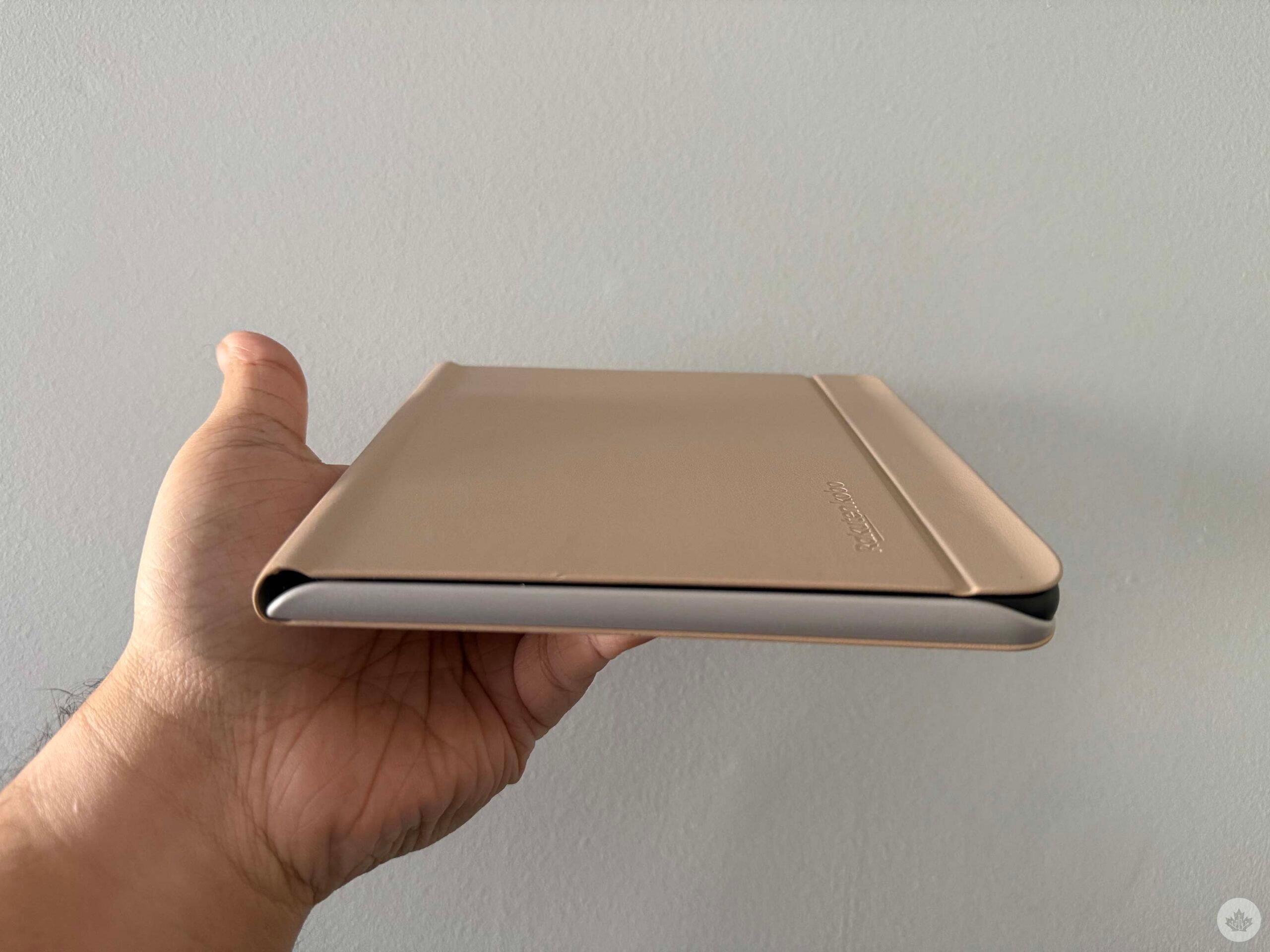
This is especially true on flights. I’ve had a few to Europe this year, which, naturally, go for 7-plus hours from Toronto. At the same time, the little table you get on the seat in front of you is rather tiny. But with the Libra Colour and its foldable case, I can easily put it on the table alongside other things, like a drink and my phone. (The only downside with the tan case I received with the Kobo is that it’s dirtied fairly easily on my travels.)
But before I go further, I should stress that there were some growing pains. For one, I found the touchscreen a bit finicky. At times, I thought it had actually frozen, only to realize it simply didn’t register my input and I had to use my nails or a stylus. Further, the setup process was decidedly laborious, with the QR code not showing up at first and then the loading process being somewhat slow from there.
But once I was past those pain points, I had a blast going through the storefront to search for books. For a while, I’ve been interested in checking out Dune and Neuromancer, the former due to Canadian Denis Villenueve’s grand cinematic trilogy and the latter since it’s the pioneering cyberpunk work from American-Canadian author William Gibson. Finding and buying these books was satisfyingly quick, as was Michael Mann’s Heat 2, which I’ve wanted to read as a big movie buff, or even something as niche as James Mielke’s biography of legendary Final Fantasy composer Nobuo Uematsu.
That said, I quickly realized, to my frustration, that some books weren’t available when I searched, like Dungeon Crawler Carl. After a quick Google search on my phone, I realized it was only on Amazon Kindle. I wasn’t exactly surprised, mind you, as exclusivity defines so much of the entertainment industry, especially in the gaming space, which is my bread and butter. But it was a good early reminder to expect the same in the ebook space — something that wouldn’t really be an issue when buying a paperback or hardcover copy.
But of course, the most important thing is the actual experience of reading itself, and on that front, I love what the Kobo offers. Right away, I was pleased by the variety of lighting options which made it perfect for my red-eye European flight. That, coupled with the compact form factor, made it easy to use, especially as I would inevitably keep shifting in my claustrophobic seat in a futile effort to get comfortable.
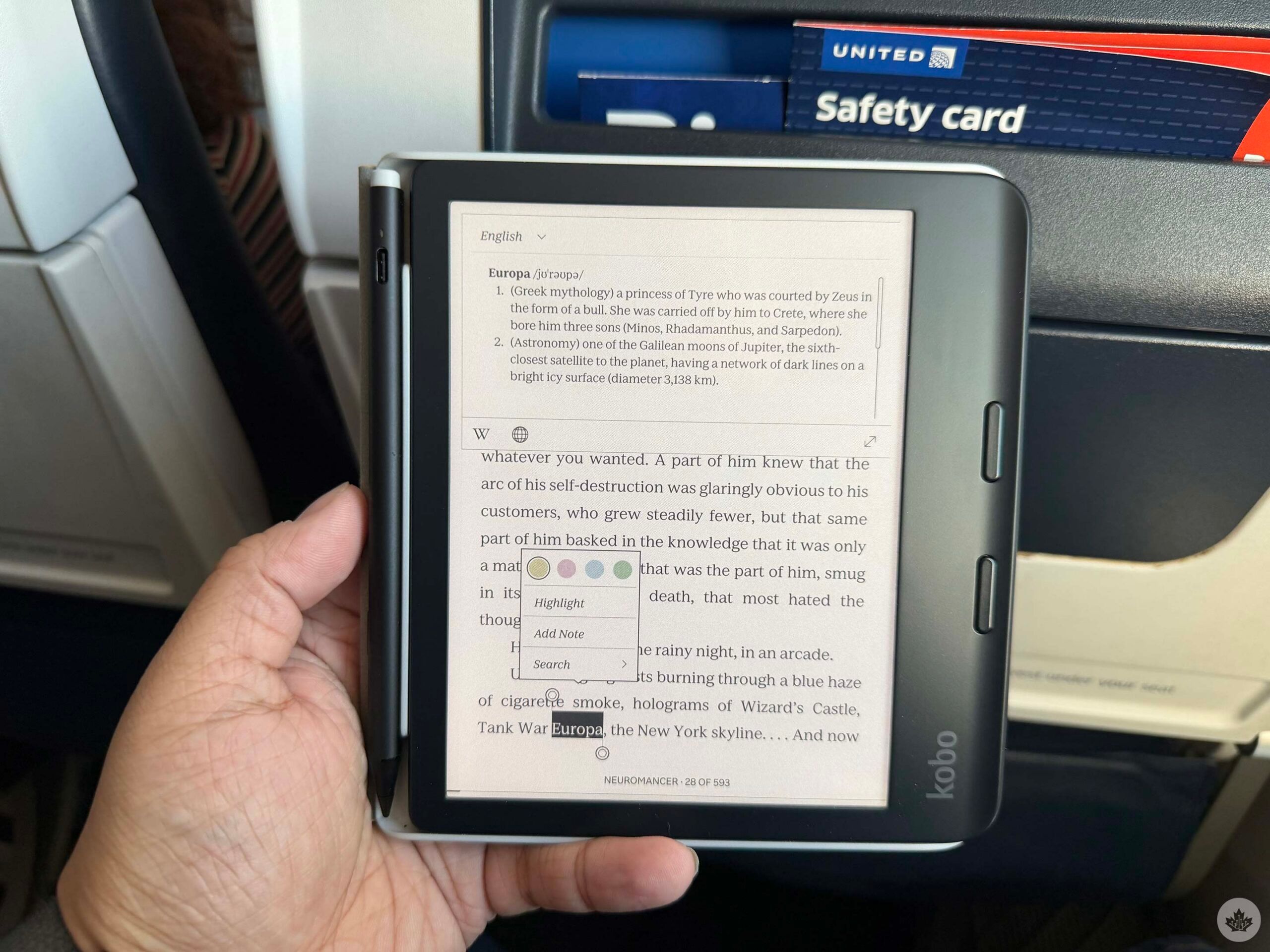
I also loved the built-in features to enhance the reading experience. As I started Neuromancer, I was delighted to discover I could click on a word to get a dictionary definition of it. Footnotes are also embedded into the text so you can click on them to see more. Getting all of this within the Kobo, rather than having to break immersion and check my phone, was a game-changer for me. (For instance, one fun fact is that the Vancouver-based Gibson, as he explains in his foreword, wasn’t aware at the time of writing that the book ended up being translated into Chinese, but the footnote confirms, as of May 13, 2018, that Chinese has been added.)
Meanwhile, I appreciated how the Kobo would not only keep track of my reading progress, but also tell me how much I had left in a given chapter. As someone who likes to leave off in a clean spot when putting a piece of media down, knowing that I only had X number of pages left, without having to physically leaf ahead and potentially spoil myself, was really handy.
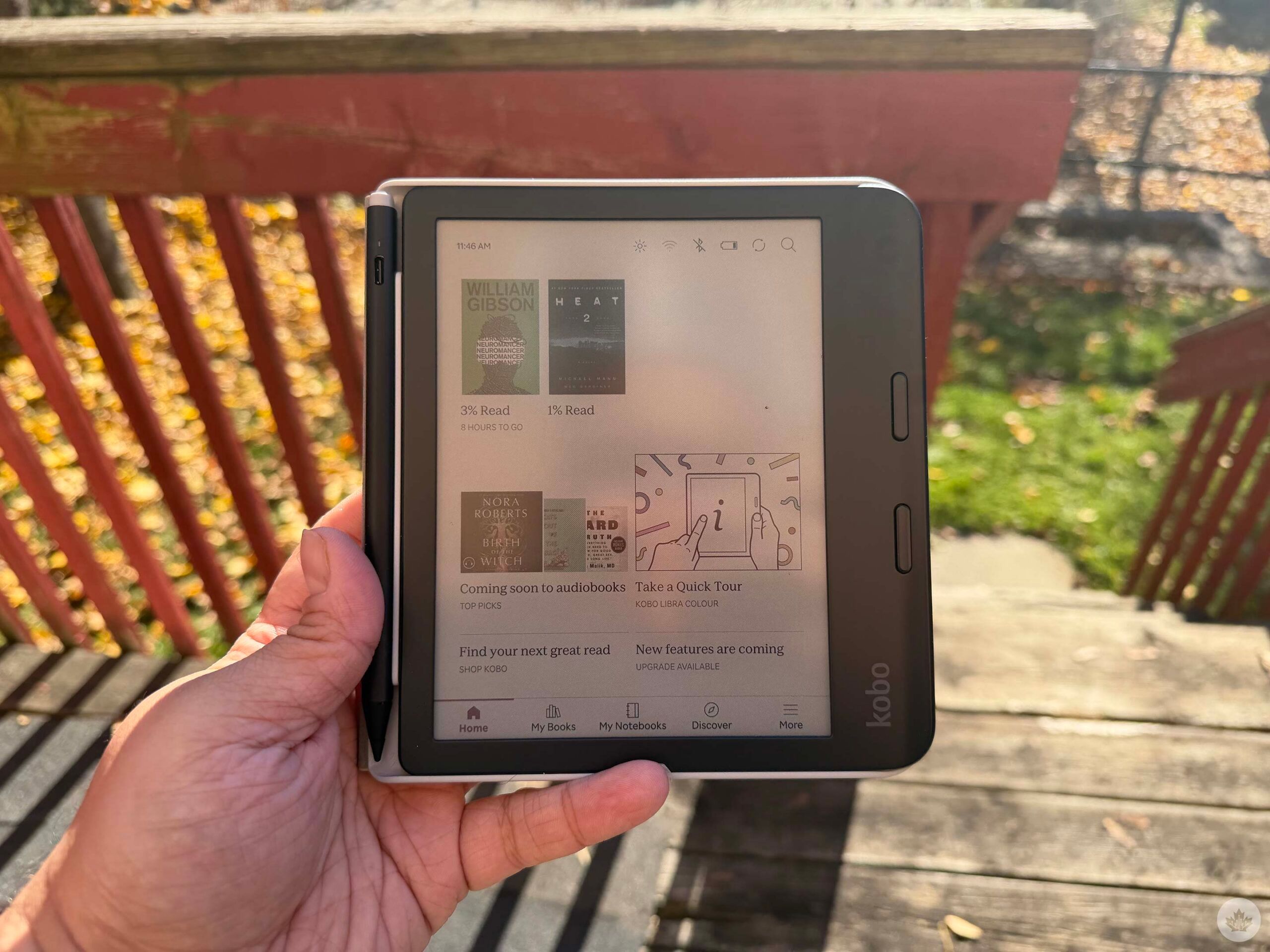
All of these are welcome features that kept me locked in. And the fact that the ebook has a crazy long battery life when not in use meant that I could come back weeks later and it still had a decent amount of juice is fantastic. So many times I’d go on a trip with several devices and forget to charge one of them, so knowing the Kobo has ample battery in case of such situations is great for peace of mind during travels.
The only thing that hasn’t kept me locked in, honestly, is me. Indeed, I haven’t used the Kobo as much as I had been planning to when I received it during the summer, but that’s not a reflection of the product itself. Part of that comes down to not travelling nearly as much as I did last year — a conscious choice to avoid the U.S. when possible. I’ve also been rather swamped the past couple of months with some big features and approximately 87,000 game releases, including a little title called GTA VI, as part of my duties as a juror for The Game Awards.
But if anything, the fact that I’m still thinking of the Kobo and looking forward to getting back to reading is a testament to how much I’ve enjoyed my time with the device. And given that I’ll undoubtedly be burned out on games come the holidays, I’m excited to pick it back up and catch up on some books. Neuromancer awaits.
The Kobo Libra Colour normally retails for $289.99 but is on sale for $259.99 for Black Friday.
 Features
 Features
 Features
 Gaming
