



Canada’s 5G performance on C-band spectrum is improving and closing in on peer countries, according to new analysis from Opensignal showing how Canada’s 5G compares to other members of the Organization for Economic Co-operation and Development (OECD).
To add some context, C-band is another name for midrange 5G spectrum that typically sits around 3.7 to 4.2GHz (about 3,700 to 4,200MHz) and acts as the middle option for 5G connections. It offers more capacity and higher speeds than low-band 5G, and better range than high-band 5G, also known as mmWave.
The report noted that 5G C-band usage has nearly doubled in Canada over the last three years. Opensignal noted that there was a bit of a slow start, and it is now closer to the median across its OECD peers, at 52 per cent of 5G readings now using C-band. Alongside that, 32 per cent of of 5G readings are still on the AWS spectrum that previously made up a lot of Canadian 5G readings in 2023.
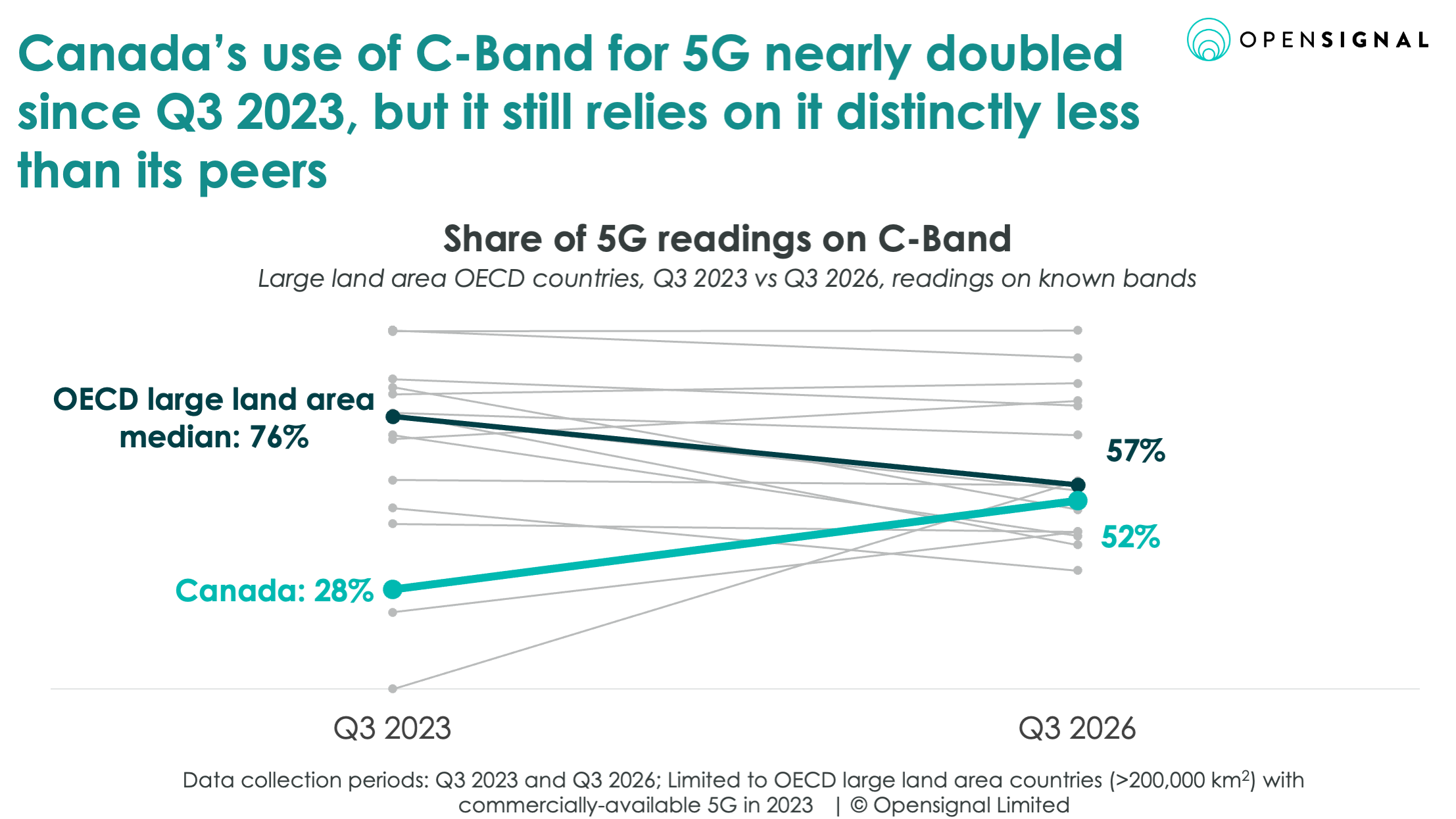
Image Credit: Opensignal
Adding to this, the OECD median for 5G C-band readings has fallen from 70 per cent to 58 per cent, with countries like Austria, Finland, and Sweden shifting to lower-band spectrum for better range and indoor coverage.
Secondly, all three major Canadian operators are seeing faster 5G speeds on C-band. Users on the C-band 5G get 2.0-2.8 times faster speeds than users not on C-band 5G. Interestingly, Rogers customers saw the biggest improvement, with its C-band users getting speeds up to 2.8 times faster than non-C-band users. However, between operators, C-band speed results differ by less than 8 Mbps, ranging from 245 Mbps to 237 Mbps.
The same results are not seen for 5G Consistent Quality, which measures how often a 5G connection is good enough to use common apps. There was either no significant change or quality increased by a mere 1.3 to 1.6 per cent across tests. Rogers was the lowest, sitting at 81.2 per cent of tests. Telus jumped up to 91 per cent, and Bell was the highest at 92.1 per cent.
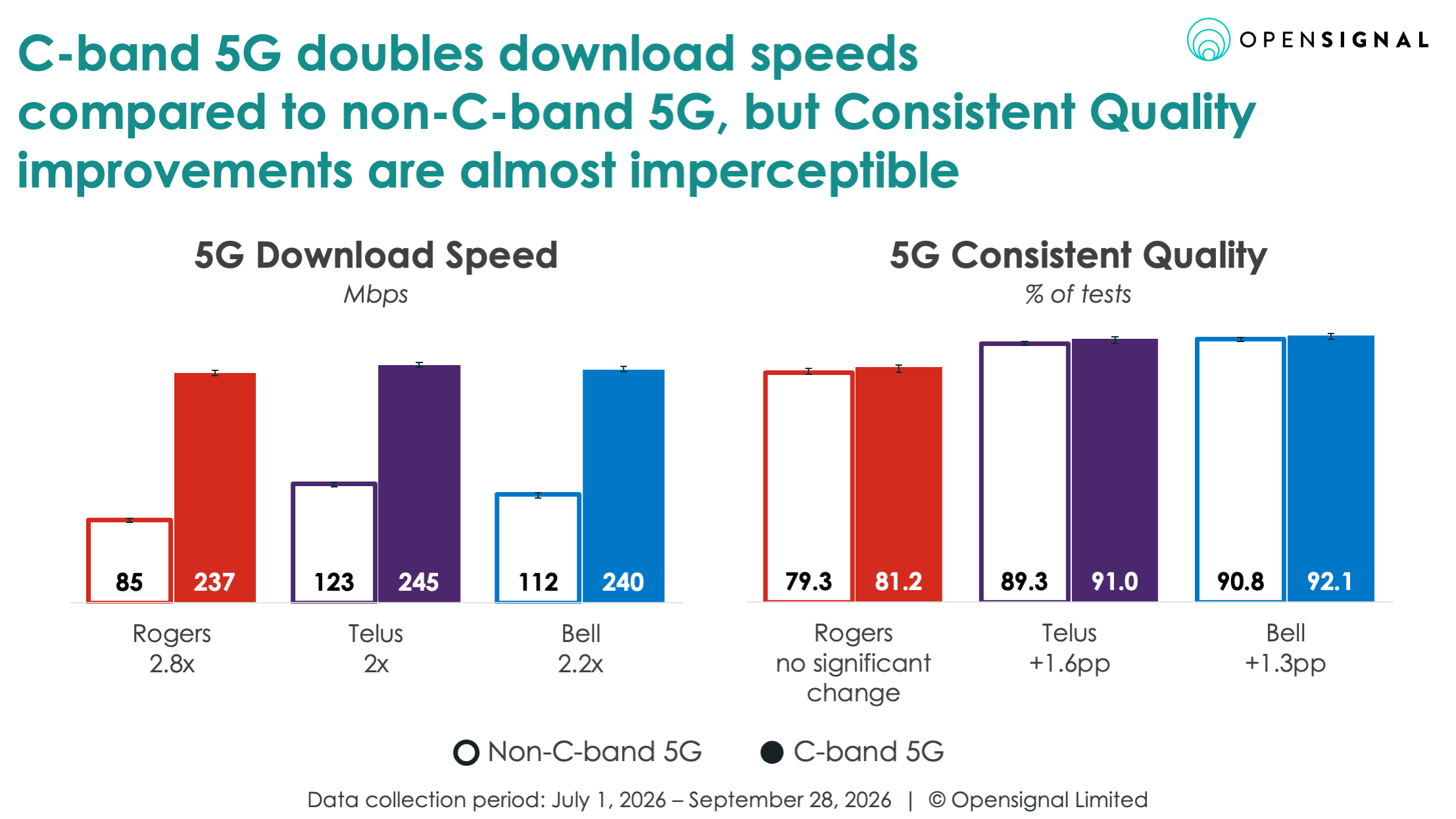
Image Credit: Opensignal
Interestingly, Opensignal notes that both Canada’s 5G Download Speed and its 5G Availability remain below the OECD median, with the U.K., Japan, Italy, and Germany below it. Above the median are France, the U.S., and South Korea; the latter has almost all connections using C-band, and each operator has 100MHz of contiguous spectrum. For Canadian operators, it varies depending on the carrier, and the region, with the average being between 60 to 100 MHz.
 Sponsored
 News
 News
 News
