


Organizations building EV chargers say municipal approvals are slowing down infrastructure build-outs, and suggest a unified process could help.
The Canadian Charging Infrastructure Council (CCIC) surveyed nine organizations, including seven charge point operators or charging networks and two engineering, procurement, and construction contractors.
The survey examined barriers to installing public chargers and identified ways to speed up installation—mainly municipal requirements, approval timelines, project consequences, and opportunities to improve municipal and utility processes.
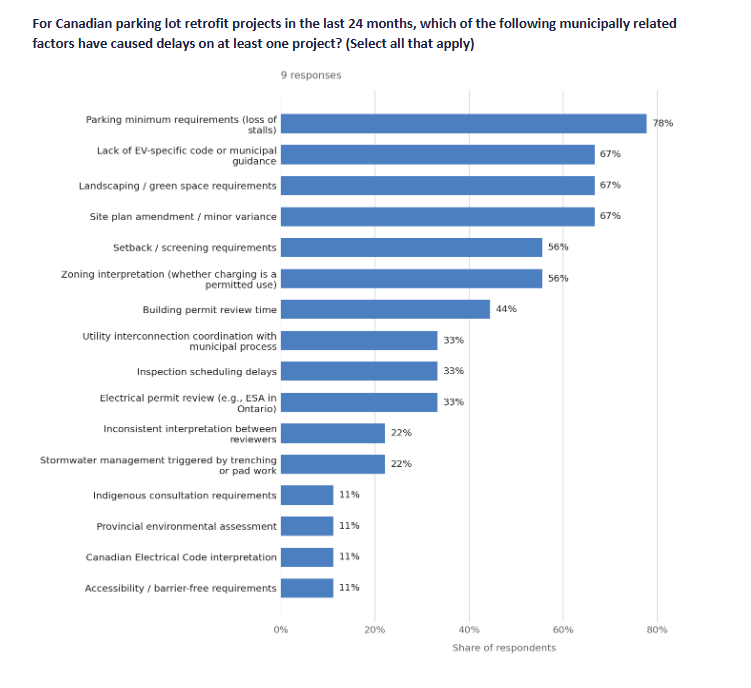
Image Credit: CCIC
Starting with factors that have caused delays, 78 per cent of the respondents noted that the parking minimum requirements held them up the most, with lack of EV codes or municipal guidance, green space requirements, and site plan amendments tied for second with 67 per cent.
Interestingly, factors like environmental assessment, accessibility, and Indigenous consultation requirements were the lowest, at 11 per cent.
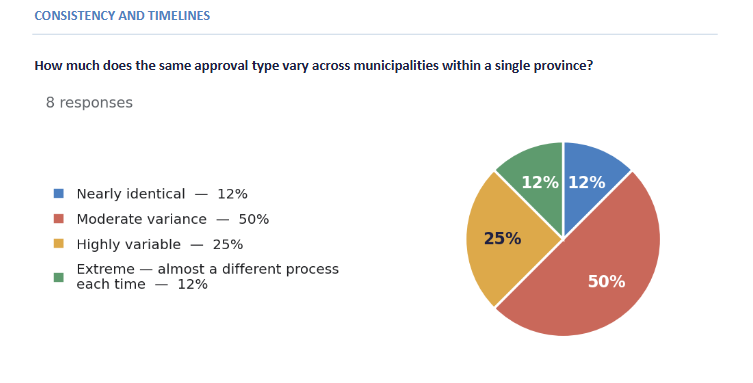
Image Credit: CCIC
Interestingly, 87 per cent of respondents reported that there were moderate to extreme variations in the approval processes for new EV charging sites across different municipalities in the same province. The majority said that there are moderate variations, while only 12 per cent said that it is almost a different process each time.
Shifting to approval speed, most respondents said they either do not have enough experience to say which province has the fastest approval process or voted for B.C.
Nova Scotia and Ontario were mentioned by 12 per cent of respondents, while no other province was listed. As for the slowest, 38 per cent of respondents said both Quebec and Ontario, while 25 per cent said they didn’t have enough experience to say.
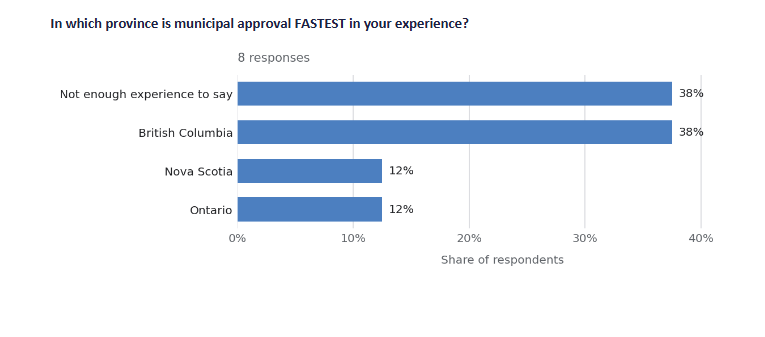
Image Credit: CCIC
However, on speed, one surprising finding is that most respondents said the median time was three to six months, while the fewest said it took 12 to 18 months. In addition, 89 per cent of respondents said a reasonable benchmark for getting a permit to retrofit a parking lot was less than three months.
Shifting to abandoned sites, respondents said 54 sites were abandoned after securing a site host agreement, with 10 abandoned due to municipal approvals/delays and 17 due to utility interconnection delays or costs.
Header image credit: Shutterstock
 Gaming
 News
 News
 News
