For well over a decade, Assassin’s Creed fans have been clamouring for a feudal Japan entry in the series. It’s a logical fit, after all, given the Ubisoft action-adventure games’ focus on exploring a variety of rich, well-realized historical settings. What better than the era of the samurai?
Now, we’re finally getting exactly that in Ubisoft Quebec’s Assassin’s Creed Shadows, which takes place in 16th-century Japan towards the end of the Sengoku period. It was a time of civil wars and social upheavals, making it a particularly ripe setting for the series’ central millennia-spanning Assassin-Templar conflict. It’s also the first full-sized Assassin’s Creed game since 2020’s Valhalla, as 2023’s Mirage was a smaller, scaled-back title more in the line with the series’ very first title.
But for me, what’s excited me the most is the prospect of what Ubisoft Quebec might bring to the table. This is the team behind 2015’s underrated Victorian London-set Assassin’s Creed Syndicate and my personal favourite AC game of the last decade, 2018’s ancient Greece-set Assassin’s Creed Odyssey, as well as 2020’s excellent but often-overlooked Immortals Fenyx Rising. For my money, the Canadian developer is one of the best teams in Ubisoft’s global portfolio, so I’ve been eager to see how they’d approach a long-awaited feudal Japan Assassin’s Creed.
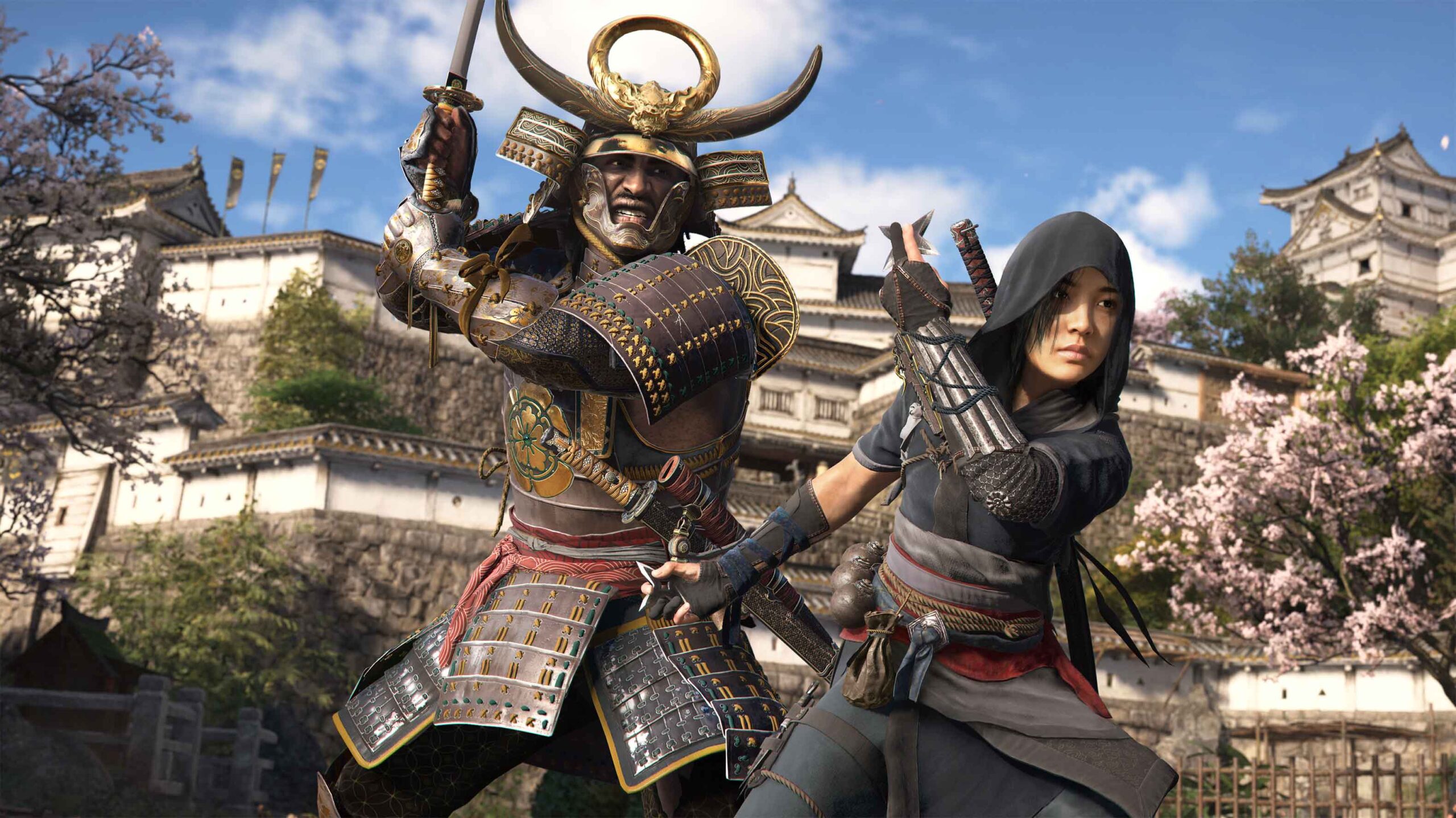
And after playing nearly four hours of Shadows, I’m happy to say I’m so far really admiring what the team has done. First and foremost: the dual protagonists. The first character, Naoe (Masumi Tsunoda), is a female shinobi whose family is connected to the Order of the Assassins, while the second, Yasuke (Tongayi Chirisa), is an African samurai inspired by the historical figure of the same name. Notably, this is the first time the series has featured a real person as a playable lead character.

Sadly, Yasuke’s inclusion has been met with backlash from players claiming his status as a samurai is “historically inaccurate,” despite the fact that historians haven’t questioned this. It’s also unbelievably silly to even attempt to claim “historical accuracy” as an issue in a series whose most iconic game, Assassin’s Creed II, has Leonardo Da Vinci serving as your personal arms dealer and you fist fighting the Pope over a magical apple. (It’s almost like most of this so-called “controversy” is just plain ol’ racism.)
Others have tried to argue that a Japan-set game should star, well, Japanese people — another moot point considering Naoe is the co-lead. If anything, the decision to feature both a native Japanese character and a foreigner offers a lot of potential. For one, the inclusion of Yasuke helps further differentiate Shadows from the many other historical Japan action games on the market, like Ghost of Tsushima, Nioh, Rise of the Rōnin and Sekiro: Shadows Die Twice. On top of that, it creates a compelling dynamic wherein both of our leads bring different world views into the mix. After a personal tragedy, Naoe — at least in my demo — seems to have more of an edge to her. Yasuke, conversely, was rescued from Jesuit slavery by lord Oda Nobunaga who, by all accounts in the demo, has treated him far better, so he tended to be kinder and more noble.
These different life experiences have already proven quite interesting based on my demo. After somewhat hasty prologue sections for each character, I was dropped into a chapter much later in the campaign in which Naoe and Yasuke had already become allies. After arriving in the city of Himeji, the pair discover that the young son of a daimyo (feudal lord) named Ukita Naoie (an actual historical figure) has been kidnapped right before a peace treaty is about to be signed. Naoe is appalled that a child is being used as a political pawn like this, while Yasuke — undoubtedly drawing from his time as a slave — rather soberingly points out that this callous use of human lives is quite common. I’m already looking forward to seeing more from this unlikely partnership.

In general, I found myself surprisingly invested in the entire quest line. Meeting the child early on as he welcomes you to a new city establishes his innocence and the stakes of the mission, which, in turn, deepens the political intrigue surrounding his kidnapper and their hidden motives. The quest also takes you on a journey across the outskirts of the city to investigate different shrines, some of which have assailants waiting for you to spring their traps, which only adds to the almost “mystery thriller” vibes.
What also makes the whole experience even more dynamic is the fact that you can choose between Naoe and Yasuke at pretty much any point, thus opening up the flow of missions. Besides having different dialogue, each character boasts a remarkably different playstyle. Naoe, for her part, is an expert ninja who can sneak and parkour her way around effortlessly. Ubisoft has talked about enhancing parkour in this game, and I was pleased to see this in action from her fluidly animated acrobatics to such new stealth options as going prone and swinging from any direction with her grappling hook. The trade-off, however, is that Naoe is much less proficient in combat, taking far more damage while dishing out weaker attacks.
On the flip side, Yasuke is an absolute tank of a character who is far less agile but remarkably powerful in battle. From the way he full-on demolishes doors while sprinting to hoisting enemies on his sword before swatting them off, there’s a satisfying brutality to his fighting style. That said, Yasuke is incapable of climbing most surfaces, meaning he’s all about a brute-force approach. Perhaps the most amusing illustration of this: fast travelling to a high-up synchronization point as him and then attempting to do the classic leap of faith into a pile of hay has him flailing his arms as he falls and then getting up while clutching his back and pretending nobody saw his clumsiness.

I will say that Yasuke’s playstyle does highlight my only major issue with Shadows so far — the core combat mechanics. Truthfully, he has a rather standard repertoire of sword-based light and heavy attacks, as well as a few abilities that operate on a cooldown, like a 300-esque punt that comically sends enemies flying. On the whole, it just doesn’t feel very different from many other combat systems, including those from earlier Assassin’s Creed games that adopted this more “action-RPG” framework. It made playing as Yasuke feel a bit boring at times. I hope that new weapons will help shake this up a little bit.
Ironically, Naoe actually ended up being far more enjoyable in combat in no small part because of the added friction. In her shoes, I had to be far more thoughtful about the timing of my katana strikes, dodges and parries. Her abilities were also more strategic, with one in particular allowing her to trip multiple enemies in a row and leave them open for potent ground stabs. At the same time, her Kusarigama (a sickle attached to a chain) provides a welcome ranged option which is especially useful for crowd control. All of this came together to create battles that were significantly more challenging (I died several times) but undeniably more entertaining.
But perhaps my favourite part of Shadows is how it eases up on the hand-holding. In several instances, you’re given basic descriptions of a target, such as their rough location (“southern Himeji”), and you have to scout out the area and pay attention to NPC dialogue and behaviour to identify them. This proved particularly exciting during the final mission of the demo, which had me hunting down three assassins in the sprawling Himeji castle grounds. Ninja running atop pagodas while the cherry blossoms blow around me to pursue my next target was thrilling and almost felt like a well-crafted Hitman level.

It’s on that high note that I found myself leaving the demo. So far, the characters are both compelling, the stealth mechanics are tighter than ever and the liberating quest design refreshingly affords multiple ways of play. I do have some questions for the full game, of course. Will the structure and pacing of the campaign support both characters equally? I didn’t get to see much besides the immediate outskirts of Himeji, so how meaningful will the broader open-world be? Will the inclusion of new weapons and abilities make fights as Yasuke feel just a little more dynamic?
But based on my experience, I’m now much more excited for Shadows than I was and am eager to lose myself in its stunning and expansive world.
Assassin’s Creed Shadows will launch on PS5, Xbox Series X/S, PC, Mac and iPad on March 20th, 2025.
Image credit: Ubisoft
MobileSyrup may earn a commission from purchases made via our links, which helps fund the journalism we provide free on our website. These links do not influence our editorial content. Support us here.