


I’ll admit that I was a tad apprehensive going into Capcom’s Pragmata.
While I’d had positive early impressions from previewing the game multiple times, I wasn’t entirely sure it would stick the landing. After all, it was focused on a real-time hacking puzzle mechanic that we’d never really seen in a third-person shooter before. As a result, it was easy to imagine all of the ways that could go wrong.
But now, after playing through Pragmata to completion, I’m happy to report my concerns were unfounded. Not only is the game a refreshing take on a well-worn formula, but it also presents a fascinating, timely sci-fi world anchored by a surprisingly emotional story. It all comes together in a remarkably tight way that positively brings to mind old PS3-era games wherein developers experimented with unique mechanics through the framework of tightly crafted, largely linear single-player campaigns.
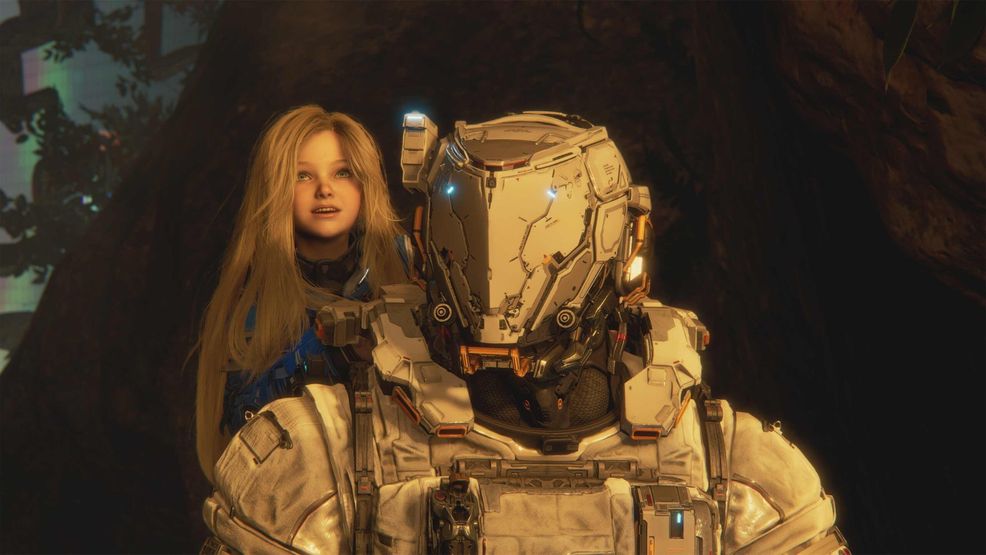
That’s Pragmata to a tee, and it all starts with its solid premise. As Capcom’s first new IP in many years, the game takes place in a wholly original near-future world in which you play as Hugh, a spacefarer sent to investigate a lunar research facility overrun by a rogue AI known as IDUS (Intelligent Direction Unification System). To return to Earth, he’ll have to begrudgingly team up with Diana, a version of an android called Pragmata that’s modelled after a little girl.
While it’s a father-child dynamic that you’ve seen many times, especially in games, it’s nonetheless handled exceptionally well here, in no small part due to how it’s presented. In particular, the game explores how Hugh was adopted, contextualizing how his experiences in finding family allow him to slowly connect with Diana. From Hugh explaining the significance of dinnertime with his adoptive parents to regaling her with the excitement of waiting week to week for a new TV show episode, there’s an utterly endearing rapport between the two.
And Diana only further comes to life in the game’s hub area, Shelter, where she jumps off Hugh’s back and runs around to gleefully interact with the environment and your robot helper Cabin. Her wide-eyed excitement extends to mementos of Earth that you can find throughout the base and gift to her, like a classroom globe, remote-controlled car or swing set. It’s a clever way to make collectibles narratively rewarding, as each one provides a sweet dialogue exchange between Hugh and Diana that fleshes out each of them. And sometimes, she’ll even gift you charming little doodles of your adventures, further deepening their bond.
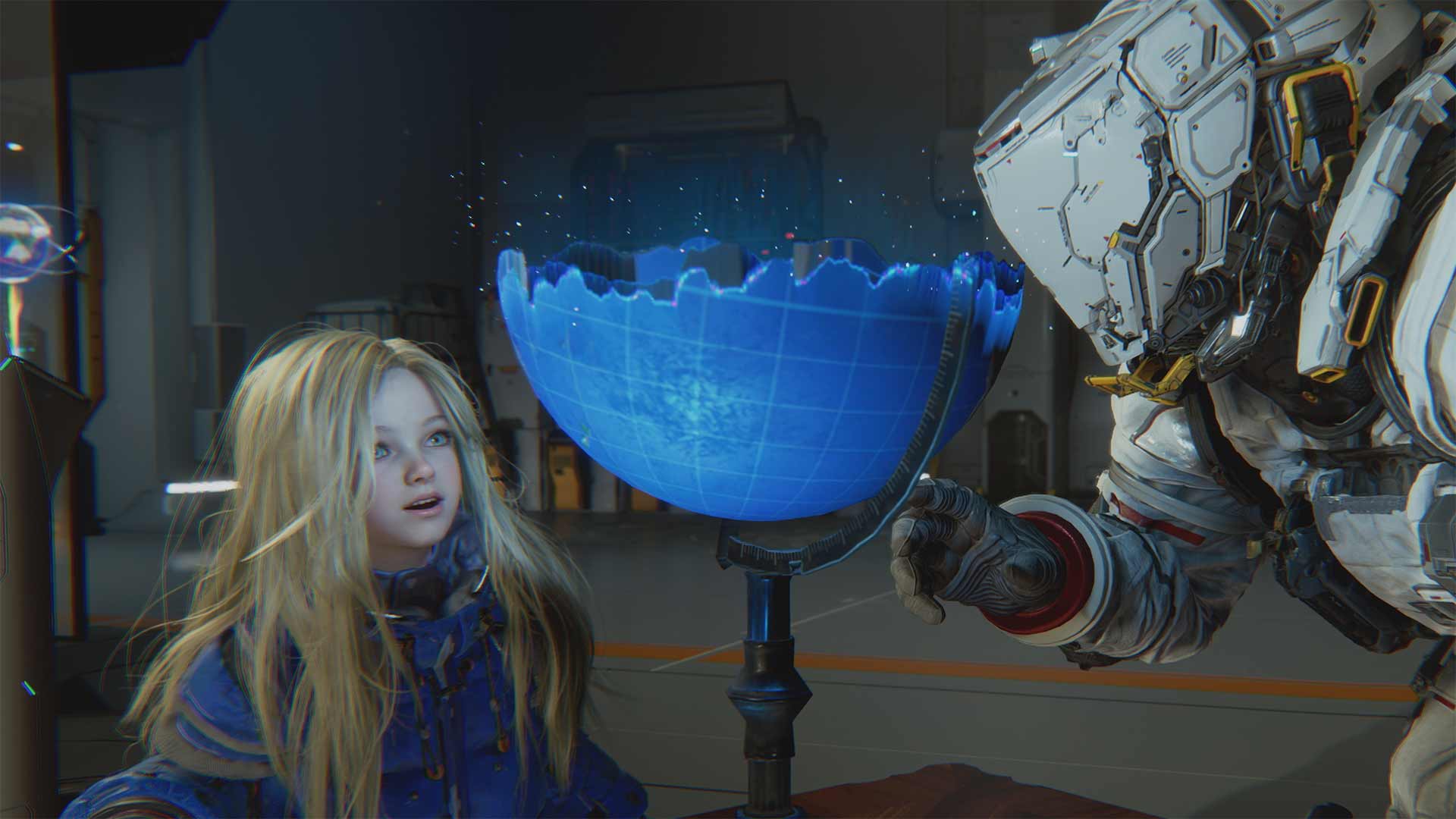
Diana isn’t a one-note cutesy child, though, with her story leading into a sympathetic arc about coming to terms with her own individuality and self-worth. All told, there’s a great deal of heart behind their relationship, and I found myself getting genuinely choked up at times. It’s a particularly meaningful hook to have as the actual plot of investigating IDUS and attempting to escape the base admittedly does unfold at a rather sluggish pace.
What’s absolutely not sluggish, though, is the central gameplay loop, which is anchored by the aforementioned novel hacking mechanic. Essentially, Hugh only has a basic firearm — a pistol to start, with a few other options later, like a burst rifle — that deals marginal damage to the IDUS-controlled robots you encounter. This means that you’ll need to rely on Diana’s hacking abilities to weaken them, and this manifests in a Snake-esque minigame in which you guide a cursor through obstacles on a grid to a target node. What makes this tricky, however, is that you still have to control Hugh in real-time, running, jumping and thruster-powered dodging along the way. Only once you successfully execute a hack will a robot’s defence system be briefly disabled, allowing you to target its weak points and do some real damage.
It’s an ingenious approach to third-person shooting, as you can’t just mindlessly fire at enemies and are constantly challenged to keep moving. What’s more, your gun has a limited ammo count, which, when depleted, will slowly replenish. Similarly, power weapons you find in the environment, which range from more traditional use cases like shotguns and sniper rifles to more inventive applications like tripwires, shields and defensive counter-attacking drones, only have finite ammo before you dispose of them. This creates an exhilarating, Resident Evil 4 on steroids sense of tension in combat, forcing you to carefully pick your shots while evading and juggling different weapon types to survive increasingly dangerous mobs of enemies.
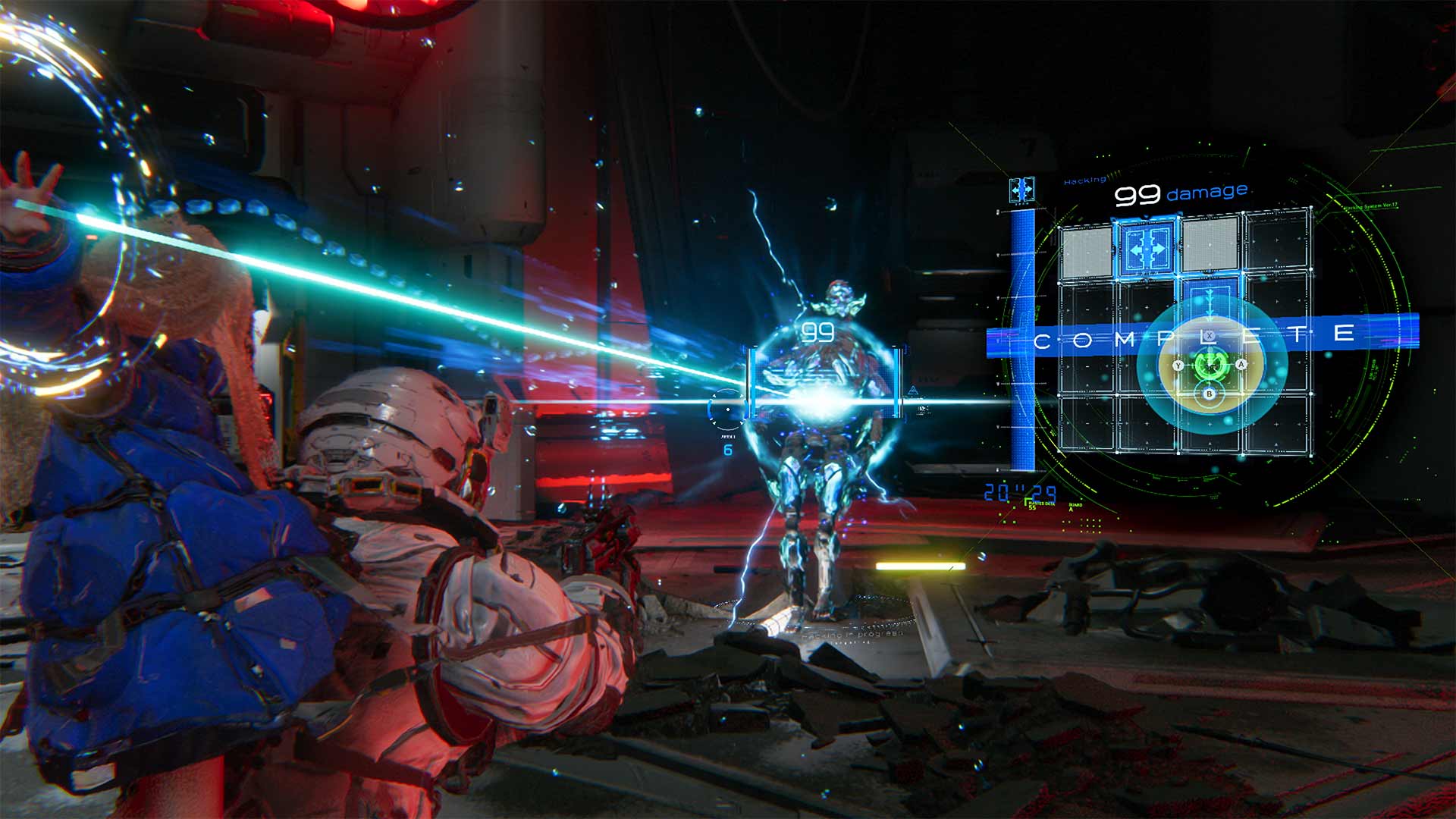
But the best part about combat is how it evolves over time. Admittedly, one of my concerns with Pragmata had been that the hacking would soon get repetitive, but that proved to be completely wrong. Quite brilliantly, Capcom continues to introduce new twists on the hacking that keep things fresh over the course of the roughly 12-hour campaign. For instance, you’ll unlock a wide variety of new types of limited-use nodes that add buffs to your hacking grid, and these can do everything from hacking multiple enemies at once or freezing them to disrupting their sensors so they’ll attack other bots and creating a burn gauge that, once built up, will leave them vulnerable to a special attack.
I particularly enjoyed using the Burn nodes to allow me to execute the powerful attacks while conserving precious ammo. Conversely, some tough encounters had me running with a Drain node to restore some health upon a successful hack because you only have a small handful of Repair Canister healing items that only replenish at the Shelter, like Estus Flasks in Dark Souls. The flexibility in this system is impressive, allowing you to prioritize your offensive or defensive playstyles at your leisure, and it helps ensure that all of the multitasking demanded by the game never feels overwhelming or unfair.
Combat becomes even more dynamic through the various enemy types (which include a giant baby bot that can generate shields to block parts of your hacking grid), various new obstacles on the grid itself, and environmental hazards like a synthetic muck that hinders movement as you’re controlling Hugh’s evasive maneuvers mid-hack. All of this ensures that there’s a constant rush in successfully pulling off a hack right before an enemy is about to reach you, especially if you manage to activate your special Nodes to enact that life-saving buff or debuff. The only real issue with combat is that sometimes enemies or hazards you have to hack will be in close proximity to one another, and the game won’t always snap to your intended target. Thankfully, this only happened in a few instances and was a minor blemish on an otherwise stellar battle system.
Outside of engaging with IDUS’ armada, your journey through the base will lead you to resources to upgrade Hugh and his weapons, acquire new nodes and more. Meanwhile, unlockable challenge rooms throughout the base and training missions at the Shelter will net you even more rewards, including stamps that can be used in a strange but lucrative Bingo-inspired minigame with Cabin. Pragmata is a predominantly linear game, but the surprisingly expansive progression system and meaningful optional challenges allow you to extend your playtime by several hours if you so choose.
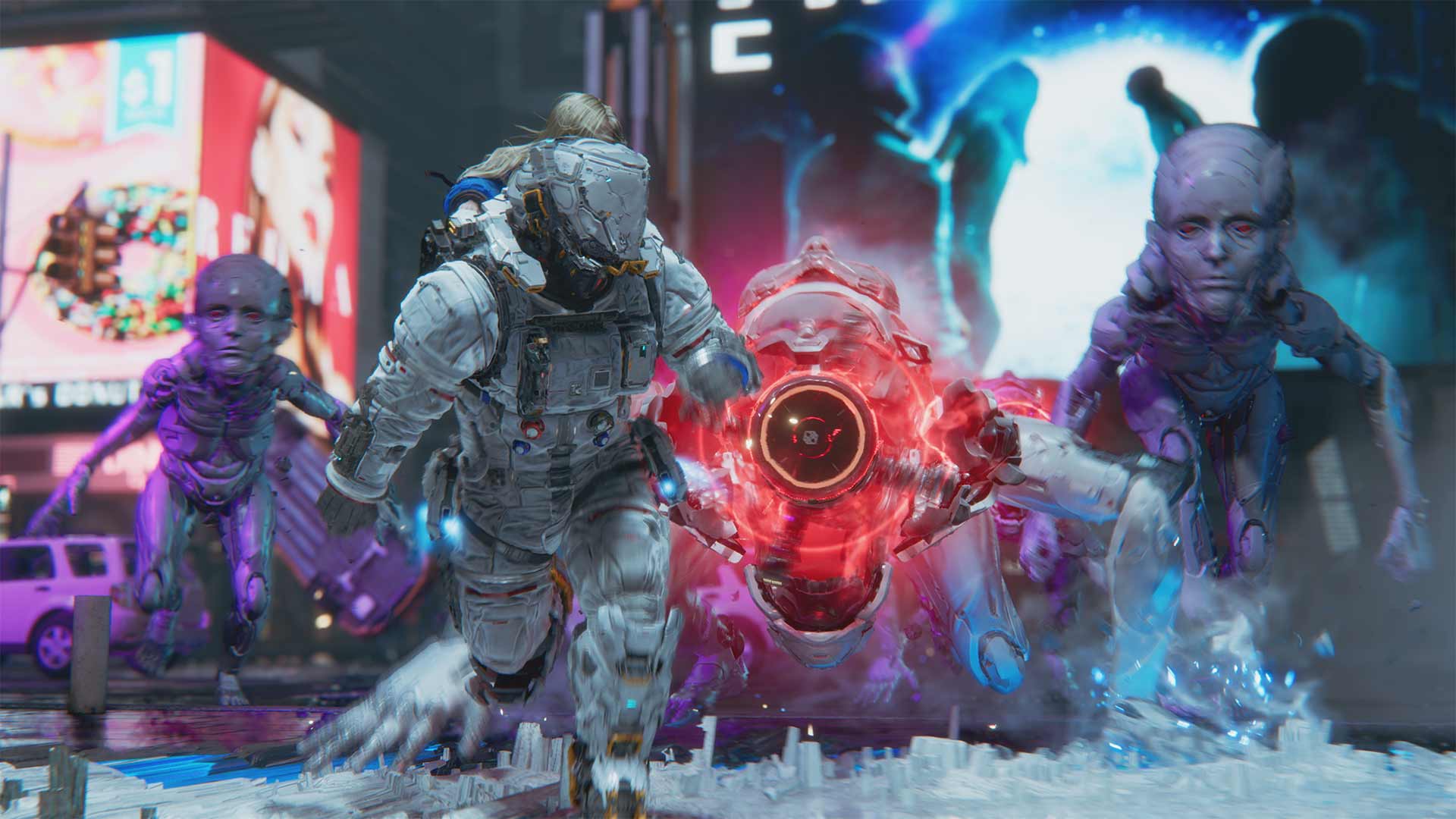
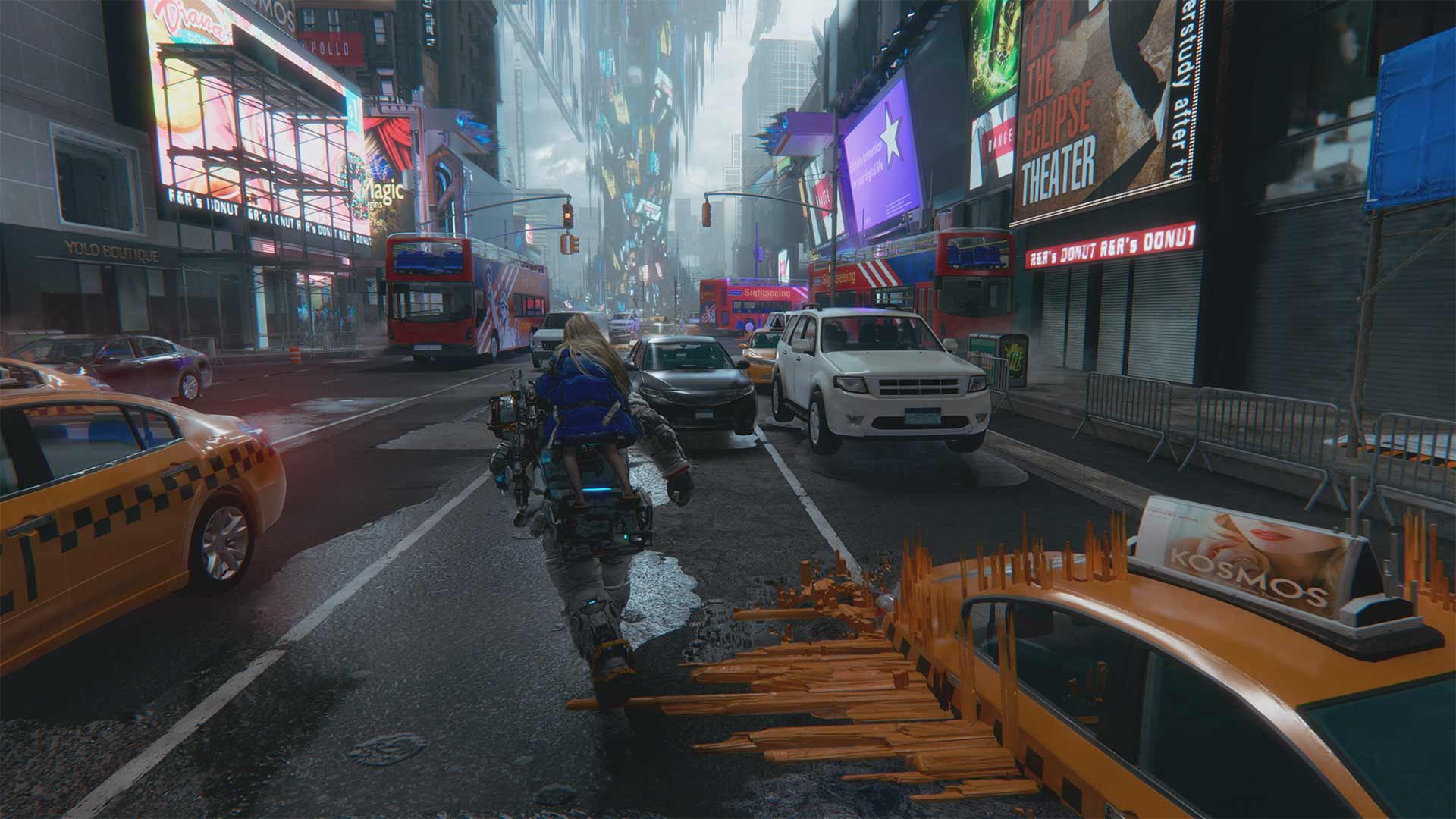
But honestly, just wandering through the base is a reward unto itself thanks to the game’s stunning art direction. That’s because you’ll frequently come across vistas that draw from Earth through advanced 3D printing technology but have since been corrupted by AI. In one standout level, you venture through a version of New York that at first glance features a believable approximation of Times Square, only to soon see how it’s been distorted. Initially, this just manifests through dark crystals protruding from the environment, but eventually, you’ll see everything from lettering on signage being jumbled together to taxi cars folding into one another. The next level, a large forest biome, looks even more convincingly photorealistic until you look close and see little hologram scuff marks on the ground and certain unfinished areas of trees.
It’s chillingly effective in illustrating the techno-horror elements of the story, showing the many ways, both big and small, that AI can pervert that which we know and love. At the same time, Capcom has been quick to confirm that all of this was hand-crafted by artists, not generative AI, and you can feel that intentionality in how meticulously everything has been sculpted. The eerie juxtaposition between the near-lifelike environments and the artificiality beneath them gives Pragmata a believable tactility and, through that, a sense of grounding to Hugh and Diana’s celestial journey.
That’s ultimately what I’ll take away from the experience. In an uncertain world becoming increasingly overtaken by AI, it can be difficult to latch onto what’s real. But through Hugh and Diana’s unlikely bond, Pragmata shows us what really matters. It shows us what AI can’t replicate, no matter how hard it tries. It shows us how a genuine connection can be just as powerful and cathartic as shooting down the algorithmic machines. Heartfelt, thrilling and timely, Pragmata is an excellent and refreshingly original effort from Capcom, and hopefully, it will only pave the way for more to come.
Pragmata launches on PS5, Xbox Series X/S, Nintendo Switch 2 and PC on April 17.
Image credit: Capcom
 Reviews
  Reviews
  Reviews
  Reviews