


Google is experimenting with replacing human-written headlines with ones generated by AI in the company’s Discover feed. Unfortunately, the AI-generated headlines are often misleading or flat out wrong.
Discover, for those unfamiliar, is a content feed that lives to the left of the main home screen on several Android devices, like Google Pixel and Samsung Galaxy phones. It can also be accessed through the Chrome browser and Google app on Android and iPhone. Thanks to its ease of access, Discover has become a prominent way for people to find news and other web content they’re interested in, and it has also become a leading traffic source for many publications (including us here at MobileSyrup).
So, it’s no surprise that publications are up in arms over the change. The Verge was one of the first to spot the AI headlines, and it collected multiple examples of headlines that were made worse, or wrong, by Google’s AI. Notable examples include a PC Gamer story about Baldur’s Gate 3 players finding an exploit to create an army of unkillable kids getting an AI-generated headline of “BG3 players exploit children.” Meanwhile, a 9to5Google story analyzing the charging benefits of Qi2 25W over the slower 5W version received an AI-generated headline saying “Qi2 slows older Pixels.”
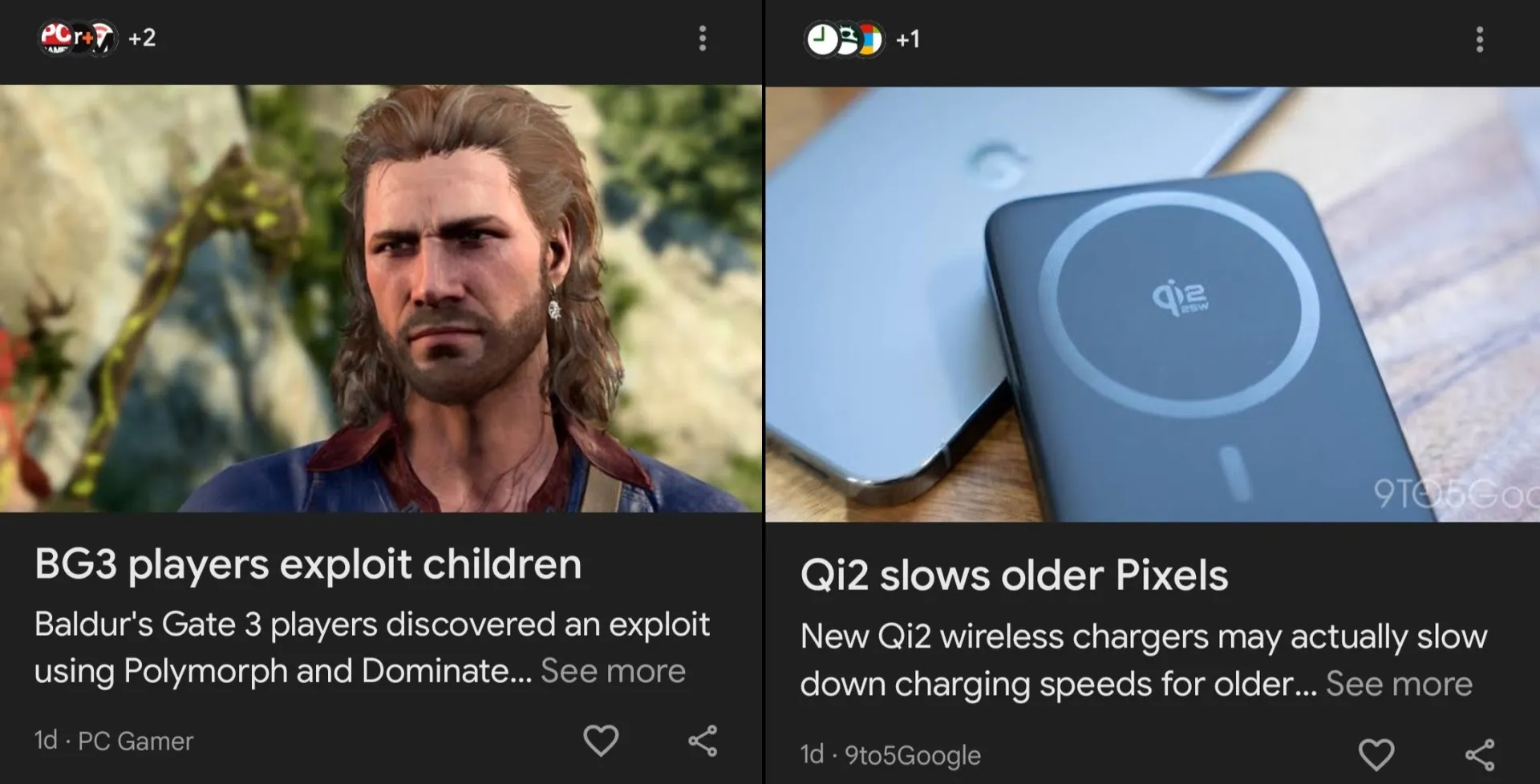
Screenshot credit: The Verge
While those headlines were just straight up wrong, other AI-generated headlines simply replaced decent headlines with ones that were boring, mediocre, or less enticing overall. In other cases, the AI replaced headlines with pure clickbait — which actually goes against Google’s own Discover content policies.
But the bigger issue is that Google doesn’t do a great job explaining when its AI replaces headlines. First, Discover doesn’t show an AI label unless users click the ‘See more’ button. When they do, the label only notes that content was “Generated with AI, which can make mistakes,” but doesn’t specify whether it was the headline, summary, or both that were generated.
That can leave readers thinking that publishers are responsible for the bad headlines, when the reality is that AI is replacing the good, human-crafted headlines that try to draw people in.
Thankfully, it is just an experiment, with Google telling The Verge that the test is only for a “subset of Discover users.” While it’s possible the search giant won’t move forward with a wider release, we’ve also seen the company repeatedly prioritize its own AI products over the well-being of the internet.
Source: The Verge, Android Authority
 News
News  News
News  Carriers
  News
News 