


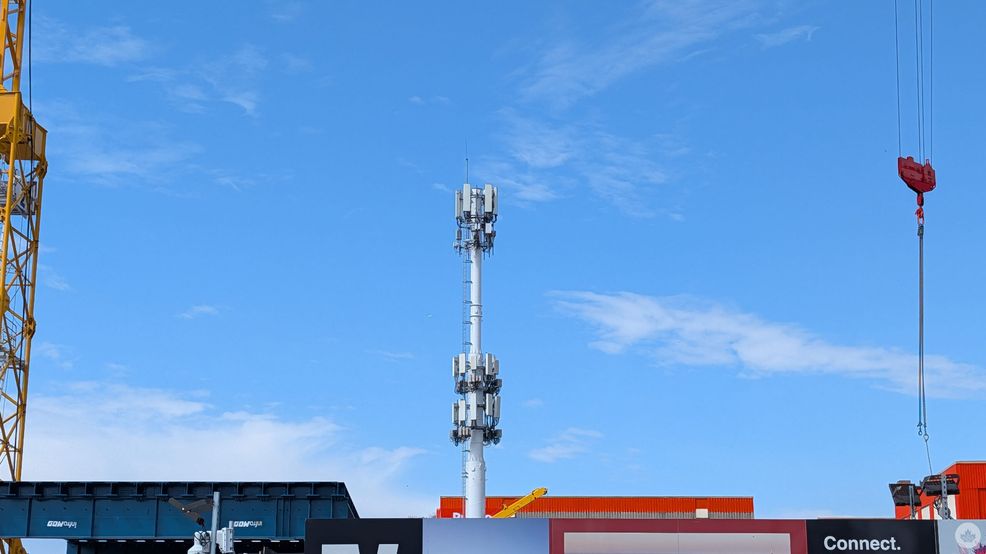
Canada’s next cellular radio spectrum auction will allow carriers to access millimetre wave (mmWave) frequencies, finally enabling access to the high-speed 5G wireless service seen in other countries.
As a quick refresher, 5G connectivity comes in two flavours, low-band frequency (commonly referred to as sub-6GHz, or just sub-6) and high-band frequency (mmWave). So far, Canadian carriers have deployed 5G service using sub-6 frequencies, such as the 3,500MHz and 3,800MHz spectrum we’ve seen in recent years, which has left Canadian 5G quite a bit slower than other places that prioritized the mmWave rollout.
High-band, mmWave 5G operates in the 24.25-71GHz range. That radio spectrum offers multi-gigabit speeds, but doesn’t travel as far and can be easily interrupted by objects like walls, windows, and vegetation. That makes mmWave ideal for dense urban regions, but less suited for rural areas. So, it’s not exactly a bad thing that Canada prioritized sub-6 first, even if that meant our urban connectivity wasn’t quite as fast. But that’s all set to change.
mmWave is coming, but not as soon as you think
Earlier this week, Innovation, Science, and Economic Development Canada (ISED) released tons of information about the upcoming spectrum auction. It will allow Canadian carriers to purchase licences to blocks of spectrum in the 26GHz and 38GHz bands, which will be needed to deploy mmWave.
However, the auction process is lengthy, so it will be some time before Canadians will be able to start using mmWave. Per the key dates released by ISED, the auction won’t even start until October 19, 2027, with no set end date. ISED will announce the licence winners within five days of the end of bidding, and then in 60 days, carriers will need to submit final payment, and ISED will issue licences.
Based on ISED’s timeline and previous spectrum auctions, we’ll likely see carriers begin deploying mmWave in mid- to late-2028. With the 3,500MHz spectrum, for example, the auction took place in June 2021, and carriers started deploying the spectrum about a year later. Similarly, the 3,800MHz auction wrapped in November 2023, and we saw carriers begin deploying that spectrum in mid-2024.
Keep it competitive
Alongside the key dates, ISED published a framework for the spectrum auction. There’s a ton of stuff in there, but the most notable are the measures ISED detailed around competition. In short, ISED will implement rules to ensure that smaller telecom players will be able to get some mmWave spectrum.
“ISED is of the view that larger service providers likely have the means and incentive to prevent other bidders, particularly smaller service providers, from acquiring spectrum licences in an open auction,” the department explains in the framework.
As such, ISED will implement a 1,200MHz spectrum cap across the 26 and 38GHz bands. The cap will only last for five years. However, the 1,200MHz cap — while intended to favour small providers — actually falls more in line with what the Big Three wanted.
Bell opposed pro-competitive measures in general, but supported caps of 800MHz or 1,200MHz, noting that 800MHz should be sufficient but could leave spectrum unallocated.
Telus, meanwhile, pushed for a 1,200MHz cap, also warning that 800MHz may leave some spectrum unallocated, while Rogers proposed an 1,800MHz cap, or at minimum, a 1,200MHz cap. Rogers said that 800MHz might not be enough for high-traffic use cases.
Meanwhile, several smaller providers, including Quebecor (which owns Freedom, Videotron, and Fizz), Cogeco, Xplore, Eastlink, and SaskTel, preferred an 800MHz cap, saying it was sufficient for 5G use cases. However, some warned that higher caps would be more likely to leave smaller operators with less desirable spectrum.
Ultimately, it remains to be seen what comes of next year’s spectrum auction. Here’s hoping smaller players can get what they need to deploy fast, mmWave 5G.
 Gaming
  News
News  News
News  News
News 