


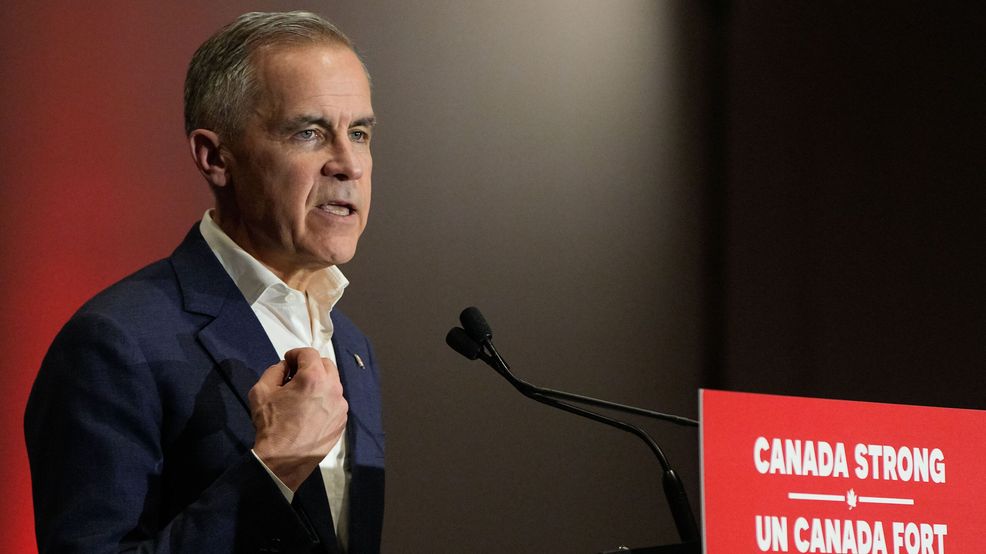
Prime Minister Mark Carney spoke on Thursday about the Canadian auto plan, the removal of the Canadian auto mandate, and the introduction of a new $2.3 billion rebate program. However, as mentioned in earlier coverage, Carney also announced a $1.5 billion investment in the charging infrastructure and stressed a tariff-free deal with the U.S.
During the question period of Thursday’s conference, Carney noted that the Canadian government would still prefer a tariff-free deal with the U.S., but it is actively seeking other countries to manufacture within Canada as well. So far, the government has already scored deals with two countries: China (49k EVs/year) and South Korea (manufacturing).
Carney also noted that countries that manufacture vehicles in Canada will earn tradeable credits and can sell them to companies that didn’t build their EVs here.
This, as Carney noted, would hopefully incentivize manufacturers to build EVs in Canada, with Carney stating that “If the U.S., through the CUSMA review, insists on some form of auto tariffs, we’ll ensure that companies that sell vehicles in Canada are strongly incentivized to produce in Canada.”
Shifting focus to infrastructure investment, $1.5 billion will be allocated to the Canada Infrastructure Bank (CIB)’s Charging and Hydrogen Refuelling Infrastructure Initiative, which partners with EV charging networks such as Flo, Parkland, and JOLT. Carney noted that a new electricity strategy will be released in the coming weeks to double Canada’s grid capacity to support the growth of EV charging stations.
The Canadian Charging Infrastructure Council (CCIC) expressed its support for the new auto plan in a statement shared with MobileSyrup.
“Canada’s new automotive package could unlock billions of dollars in charging investment if implemented fully,” said Travis Allan, President and CEO of CCIC. “A Canadian vehicle emissions standard that achieves 75% EV sales by 2035 and 90% EV sales by 2040 will be a major step toward achieving a globally competitive automotive sector, provided that appropriate regulations are finalized in 2026.”
The CCIC also noted that Canada’s charging industry deployed over 2,000 public fast-charging stations last year alone, a 30 per cent increase, which it says was a “record year for deployment and investment.”
Alongside this investment, the government is also delivering a cash injection into the auto industry that includes $3 billion from the Strategic Response Fund, and up to $100 million from the Regional Tariff Response Initiative to help the industry “adapt, grow, and diversify to new markets,” according to a government statement given to CBC. The government is also providing assistance and reskilling support for up to 66,000 workers (including auto workers) across Canada at a cost of $570 million.
Image Credit: Shutterstock
 News
News  News
News  News
News  News
News 