



The Commission for Complaints for Telecom-Television Services (CCTS) has released its annual review for the 2024-25 reporting period.
The commission accepted 23,647 complaints across all services (wireless, internet, TV, and phone) in Canada, a 17 per cent increase from the previous year, marking the highest total in the organization’s history for the third consecutive year.
The ongoing rise in complaints accepted this year is attributed to the CCTS’s public awareness campaigns, with the organization pointing to the addition of podcast advertising alongside its digital, social, and radio efforts. This aligns with the organization’s published five-year strategic plan (2024–29), which aims to deliver progress across three areas: service excellence, stakeholder value, and organizational effectiveness.
The rise in accepted complaints mirrors an upward trend across the four national service provider groups (PSP) – Rogers, Telus, Bell, and Videotron, which acquired Freedom Mobile. During the reporting period from August 1, 2024, to July 31, 2025, the four national PSP groups accounted for 95 per cent of complaints, an increase of 2 per cent from the previous year. The report includes 427 brands operated by 305 service provider groups.
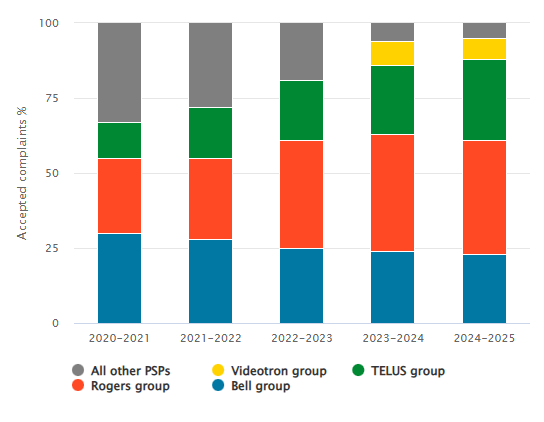
Among the big three provider groups (Rogers, Bell, and Telus), the Rogers group, which the CCTS notes includes Shaw’s brand data, accounted for the largest share of complaints among all national groups, with 6,485 accepted complaints representing 38 per cent across all services. The CCTS reported that Rogers saw a 15 per cent increase in accepted complaints compared to last year, marking the third consecutive year of rising complaint volumes.
These complaint categories saw a significant growth for Rogers/Shaw this year:
- Regular price increase of monthly price plan: 76 per cent increase.
- Changes to the contract: 69 per cent increase.
- Breach of contract: 116 per cent increase.
- Early termination fees: 24 per cent increase.
Telus received 4,904 complaints this year, with the CCTS reporting a 78 per cent increase in complaint volumes from last year. This represents a higher rise than the 17 per cent increase across all service providers, and marks the fifth consecutive year that Telus has seen an increase in CCTS complaint volumes. Telus accounts for 21 per cent of all complaints, up from 14 per cent last year.
Telus’ customers raised the following issues more often than last year:
- Incorrect charge for monthly price plan (top issue): 70 per cent increase.
- Disclosure issues: 42 per cent increase.
- Credit or refund not received: 74 per cent increase.
- Regular price increase of monthly price plan: 195 per cent increase.
- Breach of contract: 299 per cent increase.
The CCTS accepted a total of 3,966 complaints for Bell this year, a 16 per cent increase from last year. Bell accounted for 17 per cent of all complaints, a slight decrease of 0.2 per cent year-over-year.
The following issues Bell customers reported saw an increase this year:
- Breach of contract issues: 136 per cent increase.
- Credit or refund not received: 29 per cent increase.
Billing issues, wireless remain top concerns
Billing issues across all service types (wireless, internet, TV) remain the largest concern for Canadians, with the CCTS reporting an increase of 16 per cent this year, marking the highest number of billing issues reported in the last five years and second-highest on record.
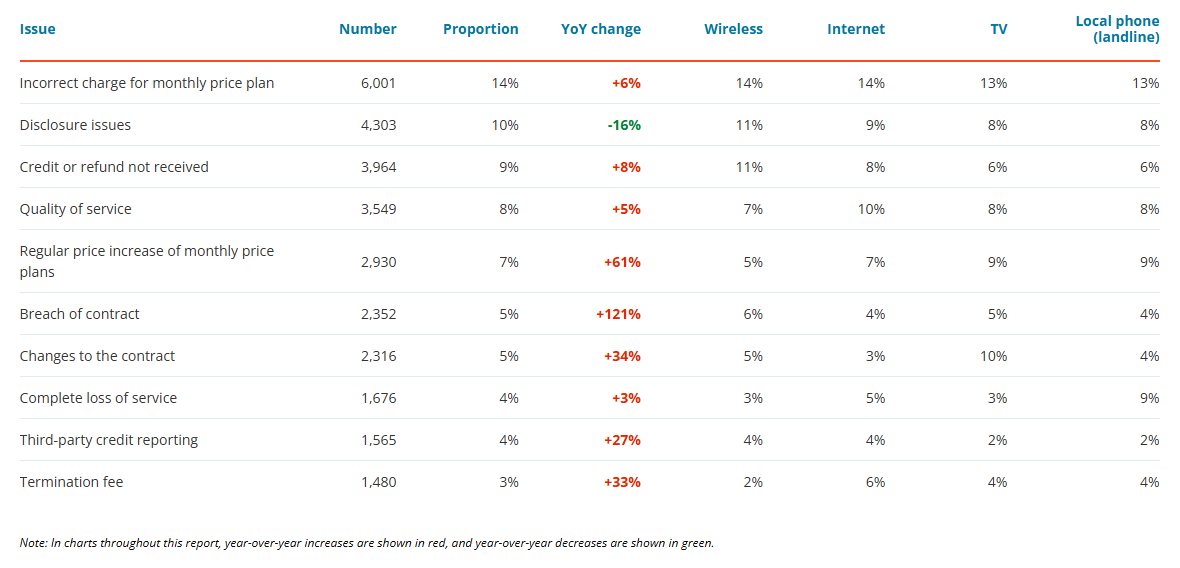
Wireless services continue to be the most reported category, representing 51 per cent of all issues raised this year. Issues regarding wireless services increased by 9 per cent, with the CCTS noting this year reflects the highest number of issues reported by consumers in the past five years.
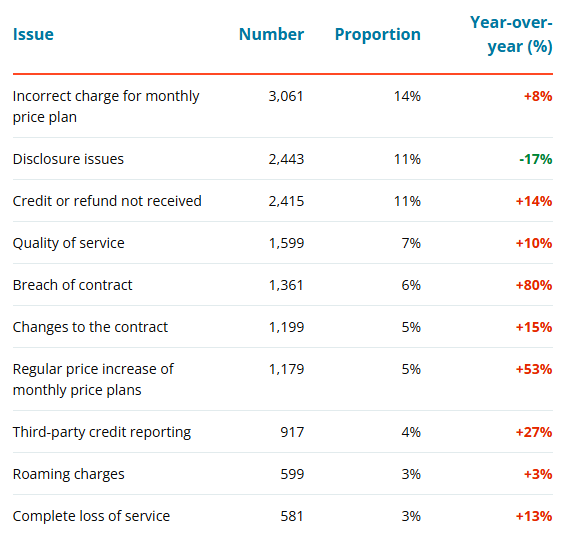
The top four contributors to the rise in wireless issues include:
- Breach of contract issues: 80 per cent increase.
- Regular price increase of monthly price plan: 53 per cent increase.
- Third-party credit reporting: 27 per cent increase.
- Credit or refund not received issues: 14 per cent increase.
The report highlights billing as the leading category of issues for wireless services, with a 13 per cent increase from last year. In contrast, wireless disclosure issues decreased by 17 per cent.
Wireless Code
The CCTS assesses how service providers behave using four codes developed by the Canadian Radio-television and Telecommunications Commission (CRTC), an independent tribunal that oversees Canada’s telecommunications and broadcasting sectors in the public interest.
Established in 2013, the Wireless Code provides guidelines and fair-practice standards for service providers. For consumers, it helps ensure reliable access to communication services, makes contract terms accessible for individuals and small businesses to understand, and safeguards the rights outlined in those contracts.
The CCTS received 2,957 reports of alleged breaches of the Wireless Code this year. The organization investigated 140 of the alleged breaches, resulting in 70 confirmed breaches, an increase of 52 per cent from 46 confirmed breaches last year.
Clarity (Section A of the Wireless Code) and Contracts and related documents (Section B) were tied as the most frequently breached requirements. According to the CCTS, a breach of these sections occurs when “the service provider failed to do at least one of these things,” with full details available on the CRTC’s website.
Telus had the highest number of confirmed Wireless Code breaches and saw the largest increase, rising from 12 to 25 per cent this year. The company accounted for 36 per cent of all confirmed breaches.
The CCTS resolved 19,032 complaints this year. The latest report, and all CCTS reports, are available to read on the commission’s website.
 News
News  News
News  News
News  News
News 