


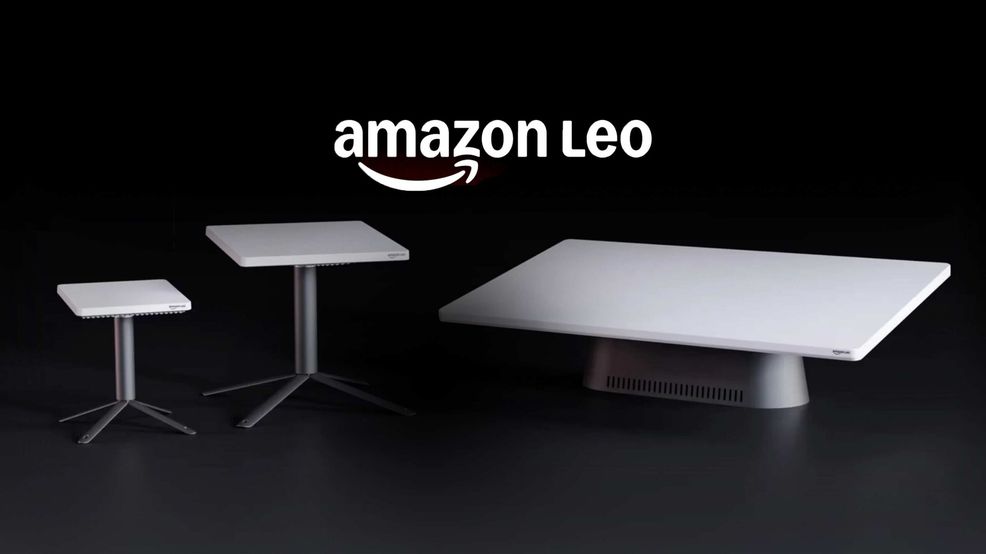
Amazon has shown off the largest antenna for Leo, its Starlink competitor that’s supposed to launch next year, and it’s starting to roll out service to select enterprise clients like JetBlue Airlines in the U.S.
This new antenna is geared towards business and government users, but the company says that it can reach peak downloads of 1Gbps and uploads of 400Mbps. It can also directly connect to Amazon Web Services and various other cloud networks. It also has a massive 20-by-30-inch footprint.
Leo’s previously announced Pro and Nano antennas are 11 and 7 inches, respectively. The larger can hit 400Mbps down, and the smaller will only go up to 100Mbps. Still, if they work in areas as remote as Starlink can both of these will be solid updates for most people.
As a point of comparison, Starlink’s antenna can hit up to 400Mbps, but most of its advertised plans are closer to 100-200Mbps, which seems to be the sweet spot for most people. The most expensive Starlink plan averages out between 135 and 310Mbps according to its website. However, the company has said it’s working on a new dish that can hit 1Gbps, according to The Verge.
Overall, it will be great to see what happens in Canada, and we can hope that Leo launches here alongside the U.S. next year. The Canadian-led Telesat is still at least a year away from even getting low-earth orbit satellites into the sky and won’t be offering service until 2027 at the earliest, but it doesn’t have a concrete date when it will start offering service. It also may work with existing carriers instead of offering its own service to compete with Leo and Starlink.
For added context, Amazon has over 150 satellites in orbit, and SpaceX has over 8,000, so it will take a long time for another company to build a footprint of low-earth orbit satellites as large as Starlink’s. That said, if you only wanted to cover Canada, you would need significantly less.
We’ve also mentioned Terrestar, another Canadian satellite company before, but that one is aiming to offer service to mobile phones, so it won’t be competing with Leo and Telesat for home internet customers. Instead, it is hoping to work with a Canadian carrier to compete against Rogers/Starlink’s recently launched satellite cell service.
 News
News  News
News  Deals
Deals  News
News 