


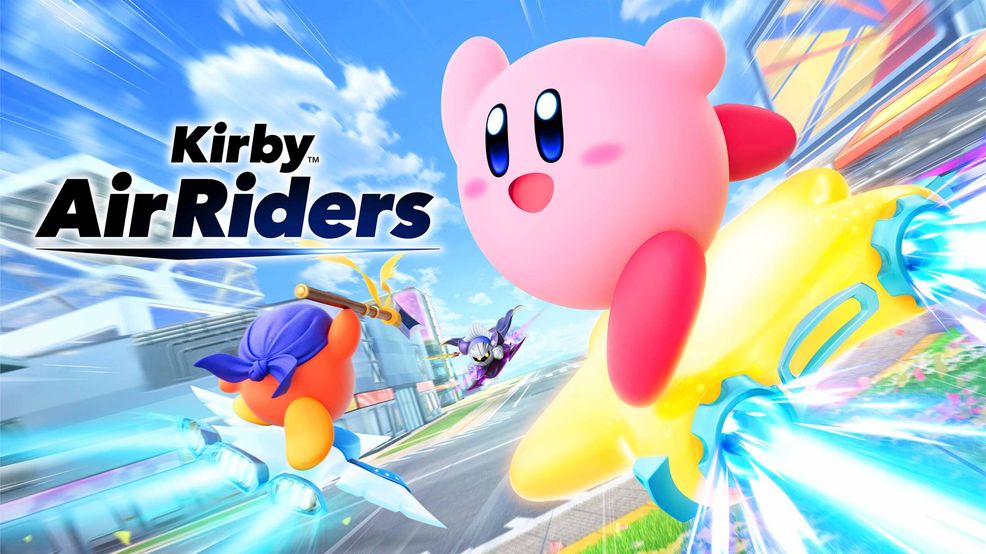
Perhaps the most surprising part of Nintendo’s major Switch 2 Direct in April was Kirby Air Riders. After all, few could have predicted that the “One More Thing” would be a sequel to a generally forgotten, if cult classic, 2003 GameCube game that got lukewarm reviews. That Air Riders would come in the same year as Mario Kart World was all the more unexpected.
But that’s one of the fun things about Nintendo: the Japanese gaming giant will throw these kinds of curveballs at us. And in the case of Kirby Air Riders, it’s a swerve that pays off quite well. At first glance, it might seem like a basic and clunky racer, but spend enough time with it and you’ll be won over by its ample charm, surprising amount of depth and robust suite of content.
Mechanical simplicity, magnificent gameplay loop
Right away, you can tell that Kirby Air Riders hails from director Masahiro Sakurai, the legendary creator of both Kirby and Super Smash Bros. That’s because it does look and feel like Kirby while also having more than a few similarities to Smash Bros., be it the wonderfully colourful UI, nine customizable CPU levels or the dramatic music and message that accompanies the constant stream of unlockables you earn by achieving all kinds of racing Milestones. Even as someone who’d never played the original Kirby Air Ride, I’ve felt right at home in Air Riders thanks to these loving Smash parallels, a series I’ve spent thousands of hours playing.
For others who aren’t as familiar with Air Ride, the sequel (largely) features the original’s single-button control scheme. This means that your Air Ride vehicle — simply called a “machine” here — automatically accelerates at all times, so your focus moment-to-moment is on steering with the analogue stick and holding down the B button to “drift.” I use quotation marks there because, unlike in other games, you don’t “drift,” per se. Instead, holding it down slows your moving machine so it can recharge its engine to maintain speed. (You’ll also sometimes press Y to activate a character’s super move, like a flurry of sword slashes as Kirby or King Dedede’s rocket-propelled hammer, but otherwise, you’re mostly only using the analogue stick and B button.)
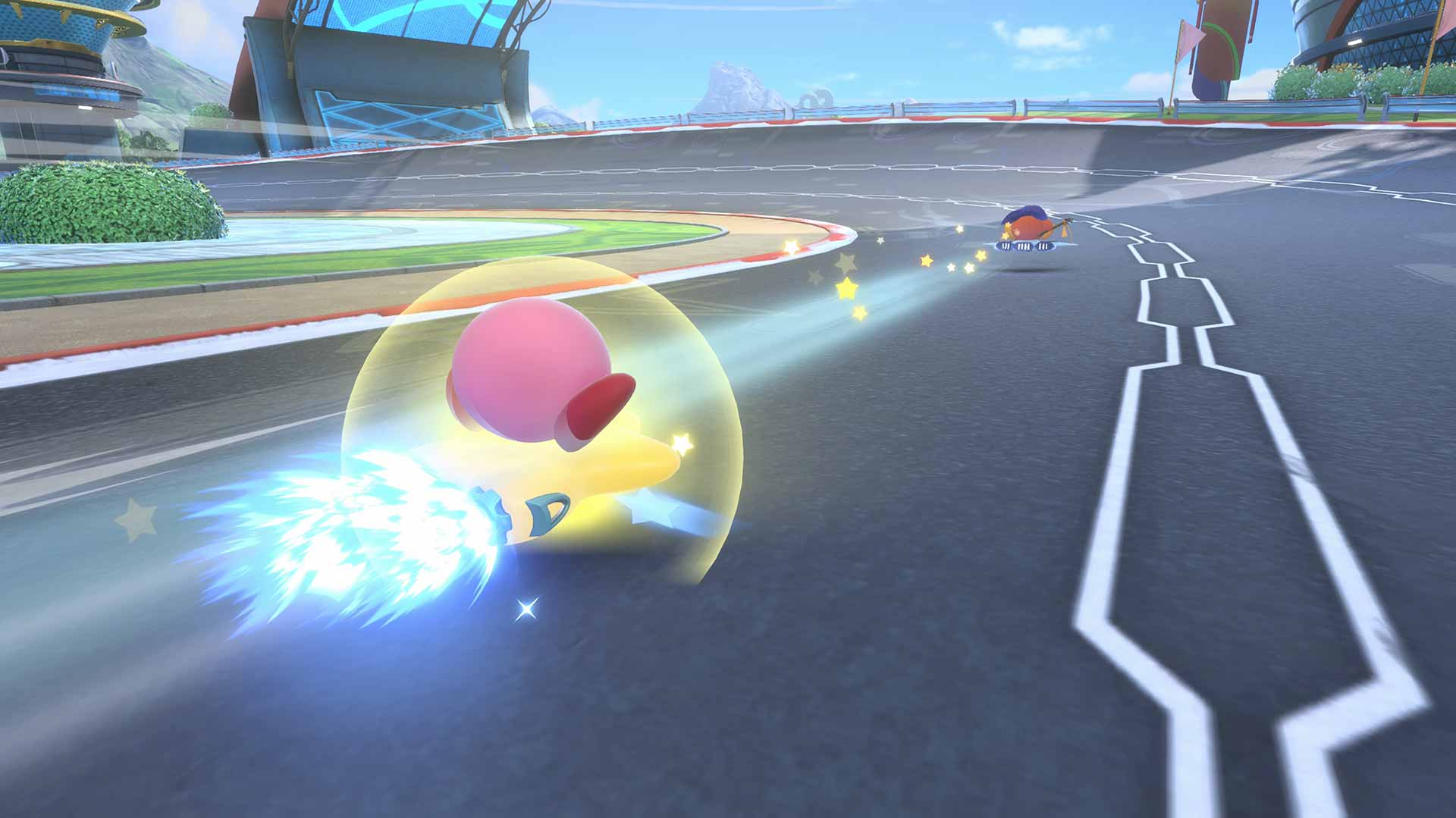
In other words, there’s a level of strategy involved in when to use the B button beyond just getting around sharp corners. Sometimes, quick taps will be sufficient to clear a bend, while more zig-zig paths require long presses. These contextual use cases extend to the Copy Abilities, which are Air Riders‘ version of items that every character can use. (It wouldn’t be fair if only Kirby could do it, after all!) But where several of the items in Mario Kart are luck-based, there’s often a lot more intentionality and versatility behind each of them in Air Riders.
This is because Air Riders challenges you to use Copy Abilities not only to thwart other racers, but to better navigate the track and even fight NPCs. That last point is especially interesting, as recognizable Kirby enemies like Waddle Dee and Blade Knight will litter the track, and some of them will provide Copy Abilities, while others will just be fodder for you to take out in exchange for a brief speed boost.
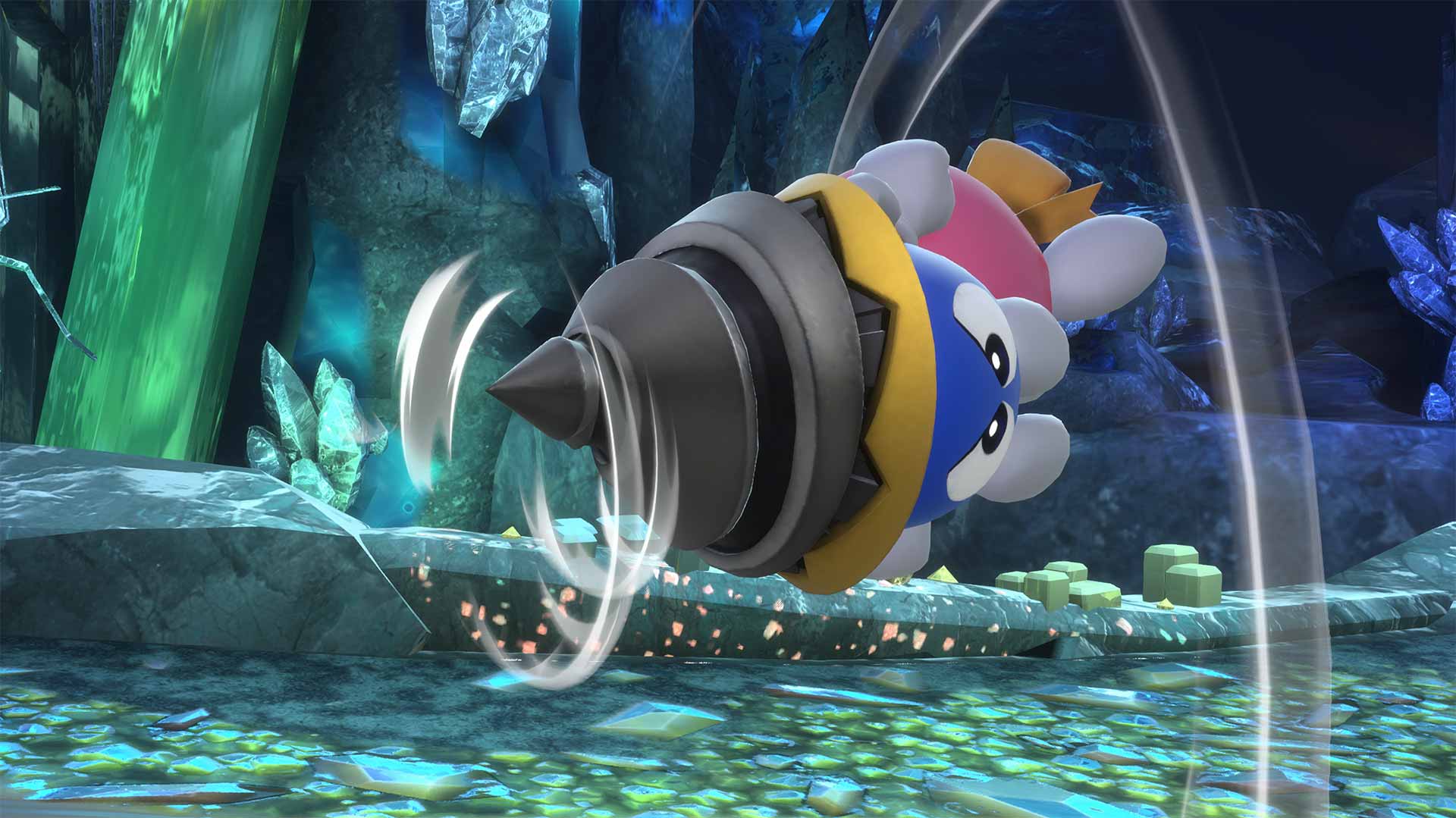
In this way, it’s absolutely thrilling to get a Copy Ability and decide on the fly how to make the most of its limited uses. On a basic level, there are proximity-based abilities like Sword or Fighter that activate automatically when you get near an opponent. But for something more nuanced, you might use the Drill either defensively to burrow underground to avoid track hazards or offensively to spring up and jab enemies. Similarly, Flash can shoot you forward in a lightning-fast energy wave to deftly navigate corners or even stun an opponent. Then there’s something like Plasma, which automatically charges to increase power levels and projectile range accordingly, so pressing B early on might only dispel a few small beams at a nearby enemy, while a prolonged discharge results in a giant homing ball to hit a more distant foe.
And because individual Copy Abilities are clearly tied to NPC enemies on the stage, you actually have some control over which you wish to obtain, versus the completely randomized item systems of other kart racers. As a result, I found myself actually putting some thought into the Copy Abilities I would use, something I never really found myself doing in, say, Mario Kart.
Then we have the 28 different machines, which are all worthwhile in their own ways. While the default Warp Star is all-around balanced in its stats, pretty much every other machine has its own uniquely compelling gimmick. While terrible for aerial mobility, the big-wheeled Chariot can turn corners in a breeze. Conversely, the Tank is an offensive and defensive beast but trucks along at a glacial pace, making it handier in arena-based modes. Want to mess with enemies? The Vampire Star can suck away their weapons and abilities. Then there’s something like the Swerve Star, which repeatedly accelerates fast only to stop on a dime, thus presenting the ultimate challenge in mastering the one-two-one-two rhythm of boosting and steering like some sort of vehicular slingshot. Picking the right machine proves downright essential depending on the given game mode. (More on those in a bit.)
That eclectic variety extends to the tracks themselves. Mount Amberfalls brings a cozy autumnal feel that belies the surprising amount of verticality, especially as you’re barreling down a steep waterfall and hopping between small boulder platforms as you go. Contrasting nicely with that naturistic setting is Steamgust Forge, a giant steampunk city that has you zigging and zagging up thin metallic pipes in a sweltering factory in one moment to soaring across the clouds between giant blimps in a fearsome windstorm in the next. And for something even more outlandish, Cyberion Highway is a Tron-esque digital world that has everything from paths that materialize and disappear in dazzling techno lightshows to different routes that either embiggen or shrink you. Best of all, there are nearly 30 tracks in total, many of which you can unlock as you play, and they all feel like exhilarating rollercoasters unto themselves.
A delicious buffet
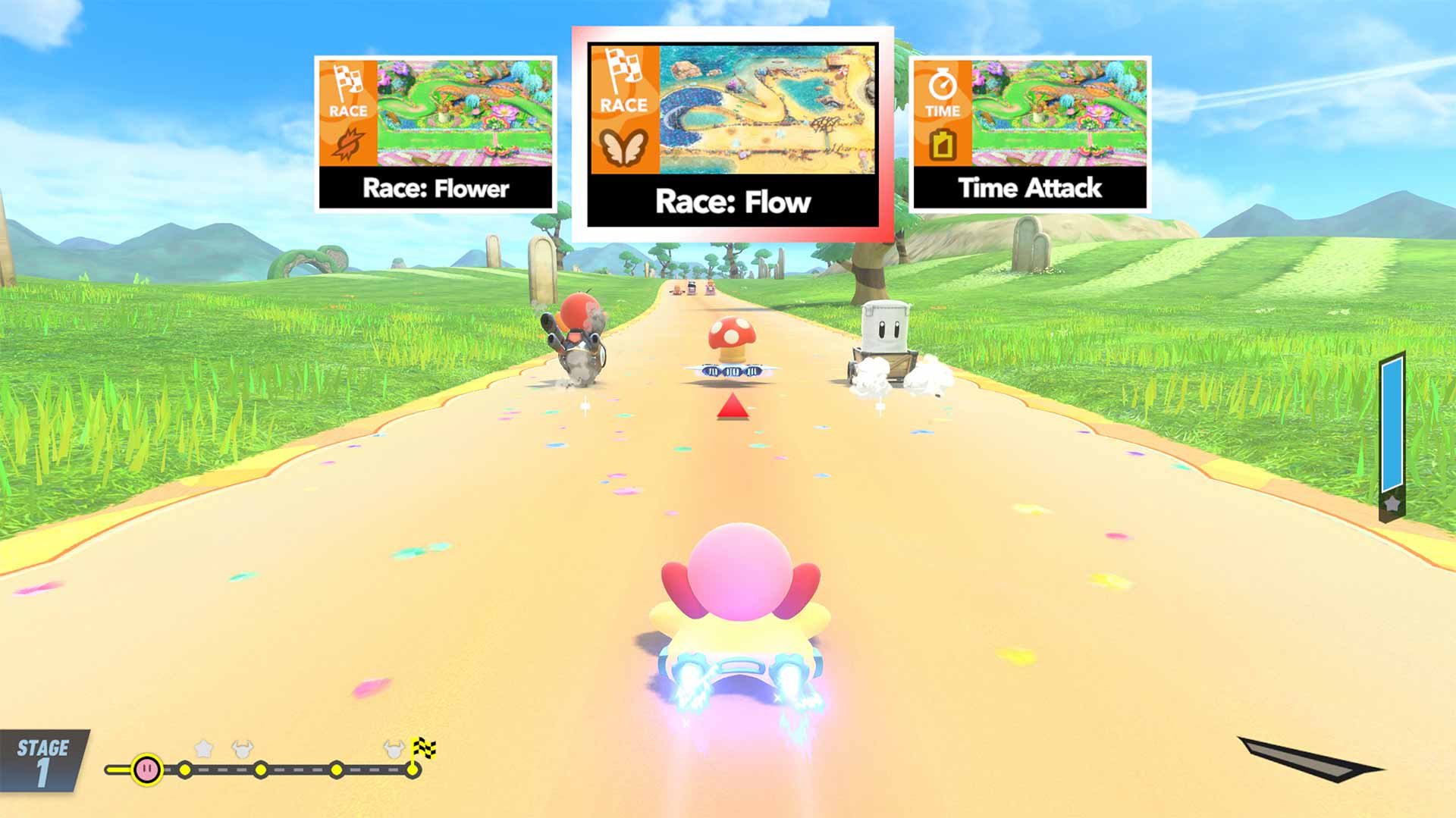
Everything I mentioned above would be enough to make Air Riders a worthy kart racer, but it’s through the game’s mind-bogglingly vast amount of content that all of the mechanics and stages really come to life. From a single-player perspective, the highlight is Road Trip, a surprisingly robust campaign that brings to mind how Smash Bros. Ultimate‘s World of Light campaign would constantly reinvent the wheel with new mechanics, game types, and other gimmicks.
In Road Trip, you pick a character and machine and ride along a straight path, switching between three lanes to choose which items, game types and enemies to encounter. And while I’ve made multiple comparisons to Smash Bros. by now, Road Trip is actually where Air Riders reminds me more of another Nintendo property, and it’s not Mario Kart. No, Air Riders gives me many of the same delights as Mario Party because it throws in a simply wild number of minigames that cleverly shake up the moment-to-moment gameplay experience.
Besides standard Air Ride races, you’ll switch between a wide array of modes that includes Gourmet Race (traverse an arena to collect the most food), Kirby Melee (defeat more enemies than opposing racers), Target Flight (glide your vehicle like a dart onto targets on a board to score the highest points), Sky Dive (position yourself and alternate between hovering and tumbling to hit the most points), Treasure Hunt (find a key in an arena to unlock a treasure chest) and Button Rush (drive over more switches than your opponent). It’s honestly quite impressive just how much Sakurai and his team have pushed the limits of what you can actually do within the confines of a “kart racer” beyond just variations of traditional races.
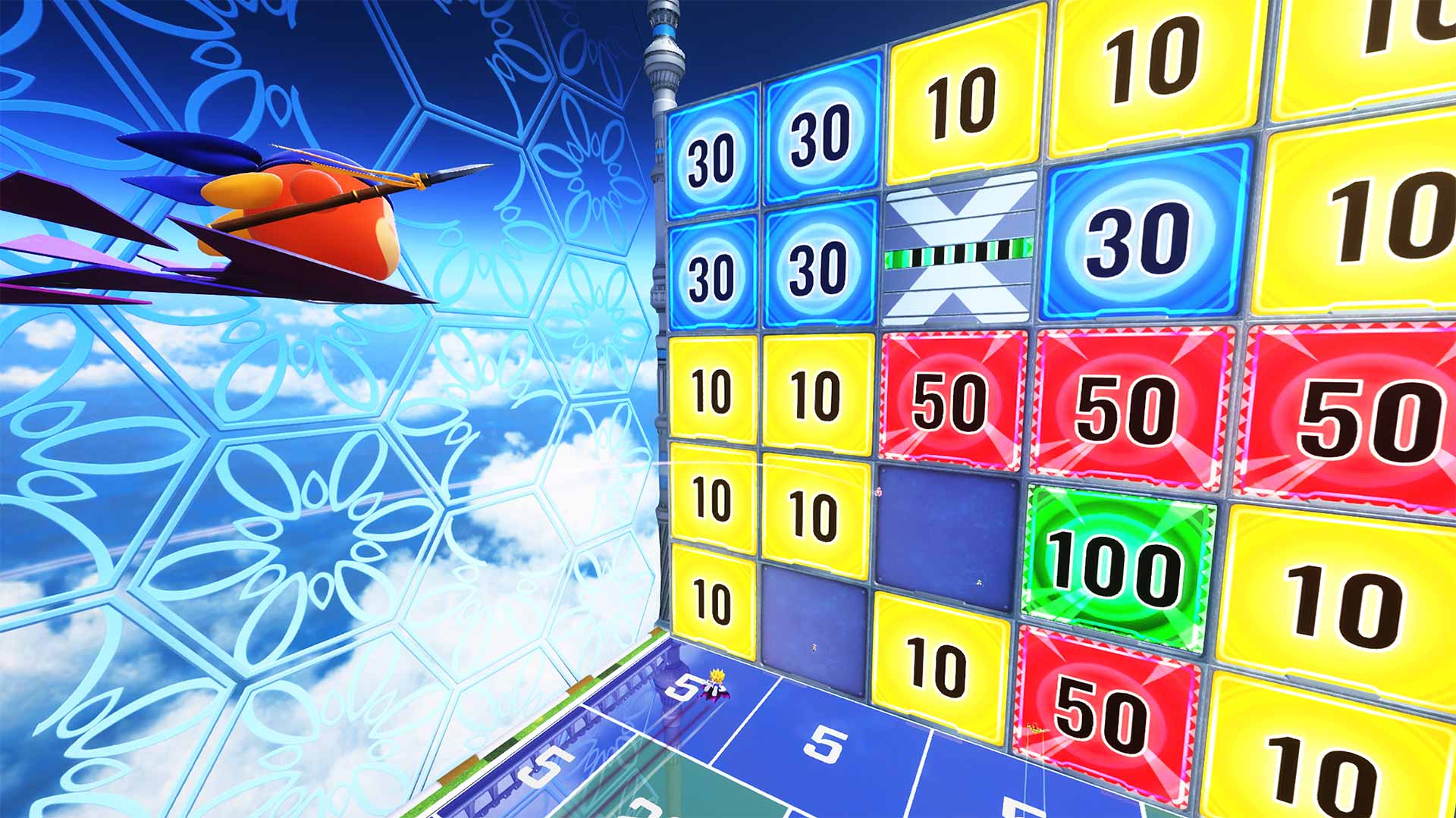
Road Trip also includes roguelite-esque upgrades that you can collect to improve rider stats like HP, Copy Ability power and gliding. Between this and the variety of machines, you’ll constantly want to be experimenting with different “builds” to suit the given challenge, like bolstering your gliding prowess for Sky Dive and Target Flight. All the while, you’ll be unlocking cutscenes that feed into a larger narrative about a mysterious machine named Zorah. Like Smash Bros.‘ World of Light, Road Trip makes the most of what could have been a limited framework to deliver an unexpectedly varied and ultimately worthwhile campaign.
Road Trip is also a great way to prepare you for the other main highlight of the experience, City Trial. Returning from Air Ride, this mode drops up to 16 players in a giant floating city called Skyah and tasks you with collecting as many power-ups as possible for your machine within five minutes. Throughout this frantic dash, little events will arise to shake things up and reward extra buffs, like impromptu “Short Races” or a mini-boss (like the spikey eyeball cloud known as Kracko) to defeat. And by the end of this, you’ll have to take all your power-ups into one of the aforementioned minigame types to determine the winner.
But unlike Road Trip, you don’t necessarily know what’s coming, so you might want to try to pick a more well-rounded machine or one you’re more comfortable with before the end of the five minutes. It’s an intriguing risk-reward element that I hadn’t anticipated. Making a choice isn’t always easy, though, since other players can destroy your ride, forcing you to make a mad dash for the nearest unoccupied alternative, thus forcing you to make the most of your new whip. And sometimes, you might even find your machine a tad unwieldy if you haphazardly pick up too many power-ups, like an abundance of speed-boosting ones. Once again, Air Riders has a layer of strategy that you don’t typically see in kart racers.
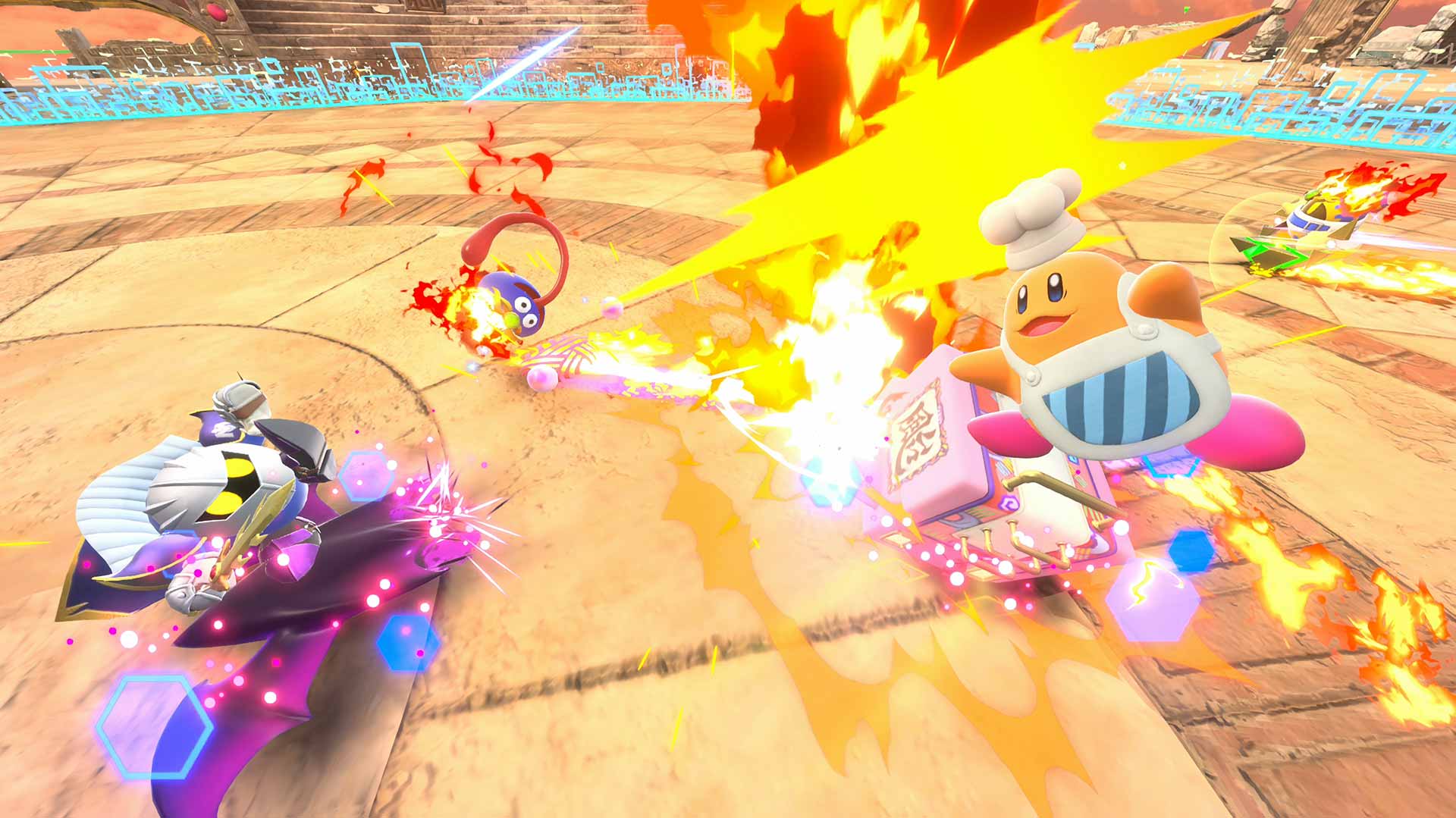
But while Air Riders can be a wondrously chaotic experience in the best way, it can also be janky. In particular, invisible walls actually prevent you from falling off the track. This, coupled with the lack of a traditional drift mechanic, does mean that it can feel clunky when turning particularly tight corners at high speeds. In that sense, it’s looser and not as technically precise as a Mario Kart.
It’s also the main reason why one of the returning game modes, Top Ride, doesn’t work for me. Bizarrely, it transports you onto a small course that’s displayed in a bird’s-eye view. That’s troublesome because while the breakneck pace of Air Riders works well in a full-sized 3D stage, it’s beyond clunky within the confines of a tiny isometric one, making you fight with the limited controls just to turn a corner. But if anything, that’s the beauty of Air Riders having so many modes. If you want to just ride solo, there’s Road Trip, while standard Air Ride, City Trial, Top Ride and more are all available to you both online and offline. You’re really spoiled for choice.
One heck of a(n Air) Ride
I went into Kirby Air Riders a bit puzzled at why it even exists, and came out absolutely in love with it. With an unorthodox control scheme that paves the way for a deceptive amount of depth, an utterly inventive and robust suite of machines, Copy Abilities and tracks, and a mind-boggling amount of game modes and minigames, this is a fantastic package all around. Sure, it’s sometimes janky, but it’s in service of a signature brand of gloriously fun chaos. There’s really nothing like Kirby Air Riders, and it’s quickly become one of my favourite racing games to date.
Kirby Air Riders is now available exclusively on Nintendo Switch 2.
Image credit: Nintendo
 Features
  Features
  Features
  Features