


There have been a lot of roguelike games over the past few years. From action-centric titles like Hades and Returnal to the deckbuilder Slay the Spire and Vancouver-made rhythm game Crypt of the Necrodancer, we’ve seen kinds of games in the subgenre. Heck, we even got an award-winning procedurally generated riff on poker last year, Balatro, from a single anonymous developer from Saskatchewan.
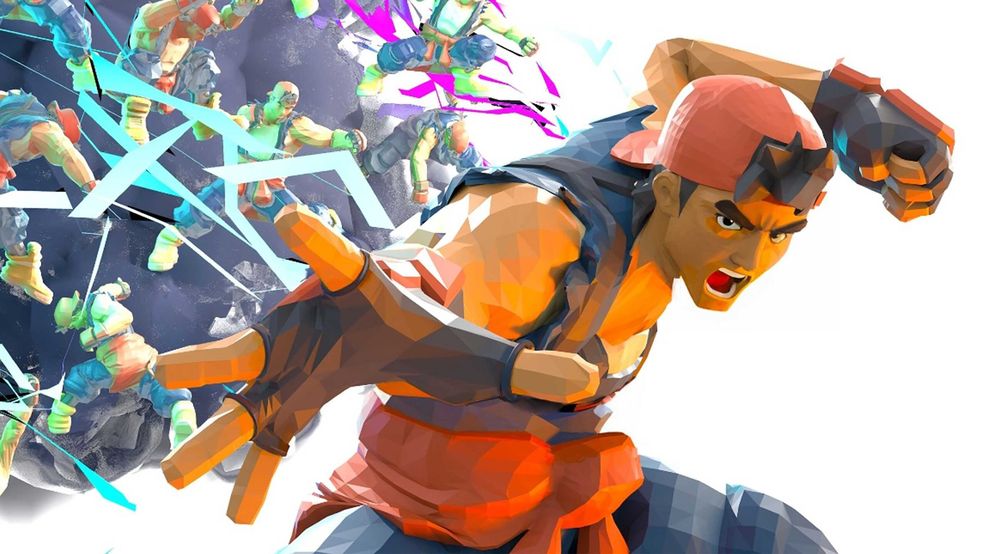
But even with the sheer variety of these experiences, there’s one independent Canadian developer that’s been toiling away since last year on a particularly novel spin on the subgenre. Enter Poly Fighter, a single-player roguelike fighting game from a new Montreal-based team called HeartLoop.
For co-founder and creative director Osama Dorias, a self-described avid fan of fighters and roguelikes, Poly Fighter presents the opportunity to make his dream game that brings together the best of both of those worlds.
“I’ve always loved fighting games, and I used to play fighting games since Street Fighter II. I was 12 years old and I played with my little brother in the arcades. I fell in love with them since. My house is like a shrine to fighting games,” he says over video call, lifting up a Hit Box arcade fighting stick in between.
But as he notes, his relationship to the genre has evolved over time.
“As I’m getting older, have family, have responsibilities, my play habits shifted. They went from learning some combos and getting good to [playing] more of the single-player modes, because that’s all I have time for,” he says. “So I shifted more to playing all of the single-player content in fighting games, and then dabbling in the multiplayer. And I thought I was an anomaly, but people I talked to said, ‘No, actually, this is the majority now.'”
All the while, he found himself sinking countless hours into roguelikes like Slay the Spire and Balatro. Then an idea dawned on him: how about a roguelike fighter?
“Since the advent of roguelikes, I don’t know how many times I’ve Googled ‘roguelike fighting game.’ I wanted one forever, and all I found was Reddit threads of other people asking for it. So it just made sense. It’s like, ‘if I’m looking for this, and I know that it’s shifting towards that, and there’s nobody who has done it?'” he says. While he notes that some games have elements of this, like Killer Instinct‘s “really good” Shadow Lords mode, none have shipped as a full-fledged “roguelike fighting game.”

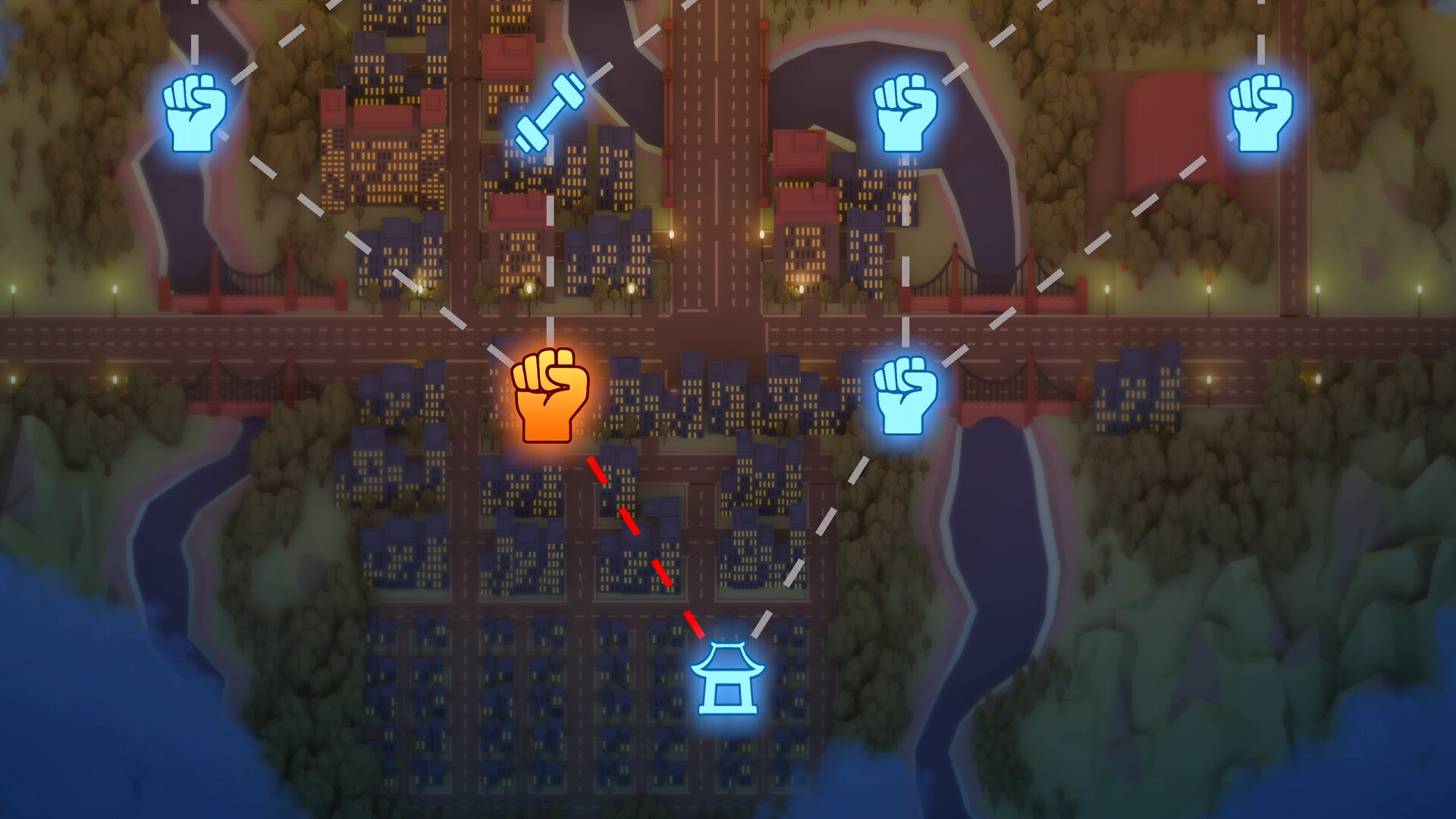
It’s a fascinating concept, and it’s one that leads to all kinds of design philosophies that mix and match staples of both fighters and roguelikes. It’s here where Dorias’ keen mind as a developer — one whose prolific career includes stints at the likes of Ubisoft, Warner Bros. and Blizzard — quickly becomes apparent. Essentially, each run of Poly Fighter‘s campaign has you fighting off against various characters and learning all kinds of different moves from them, leading to thousands of possible synergies.
“So what you want is when you see [a move], you’re like, ‘Oh, okay, this is part of a kit. I wonder what else fits in it,’ he says. “So you could get into the theorycrafting. ‘Ah, I have a projectile. It’s a delayed projectile. If I use this at that [moment] — Oh, I could knock you into it! And then you’ll be stunned in the air. And I could follow up with this thing…” It’s that kind of theorycrafting that ends up being extremely fun.”
While that’s an example of a simpler roguelike upgrade, he says others can even create a bit of genre-blending. “Ah, I have the perk that lets me double up my projectiles and the one that makes them bigger and the ones that makes them slower. Oh, I just played a bullet hell character in a fighting game!’ he says.
“It’s more [about] different pieces that come together. So we’re approaching it with fighting and fundamentals matter. Like, you could approach it as somebody who just has seen fighting games on the side, and you’ll learn, with time, while picking it up, how to play fighting games. But if you’re already good at roguelikes, then the synergies from roguelikes will help you along the way.”
Planning over 40 characters
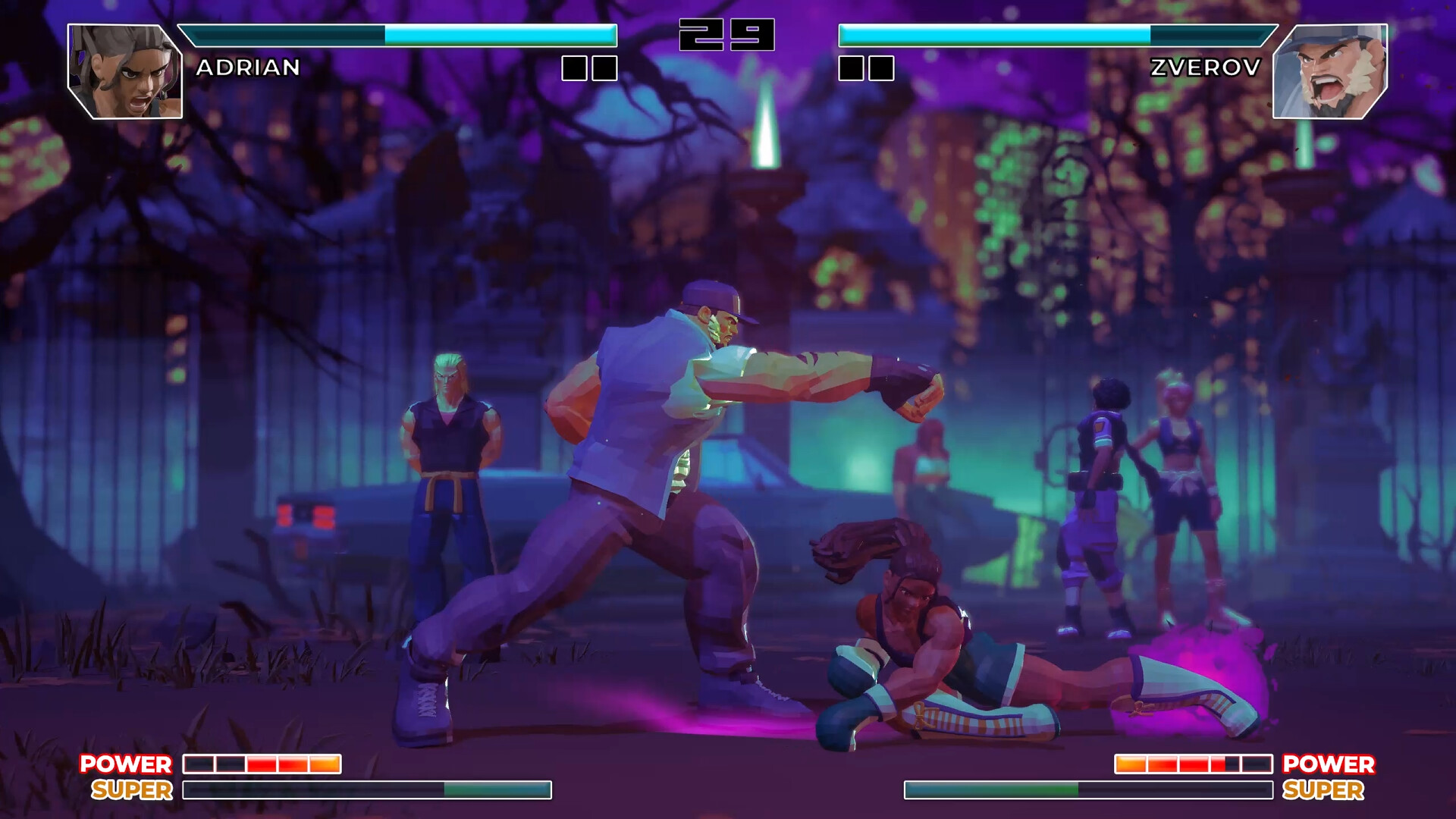
As we talk, Dorias shows me some gameplay footage of Poly Fighter. Even in this early build, the game looks remarkably polished, with a lovingly nostalgic Virtua Fighter-esque aesthetic and snappily animated strings of attacks. And impressively, HeartLoop is planning over 40 characters — a sizeable roster for any team, especially for an indie studio’s debut title.
But watching Dorias go through the demo, it’s also easy to see how the team’s charm and creativity have yielded so many fighters. Uniting the roster, Dorias says, is a broader design philosophy surrounding “underdog vs. underground,” a mix of everyday characters who work a day job and others who are part of an illicit fighting ring.
While Dorias notes that several of the characters aren’t yet finished, he teases a bunch of them. The first, Adrian, is a fast-paced mail carrier whose delivery speed is matched by her wind-based attacks, while the next, Mackenzie, is an influencer who uses flashy attacks in her pursuit of more likes on social media. Then there are even more playful examples, such as Imani, a mall security guard who teaches herself ninjutsu to better perform her job.
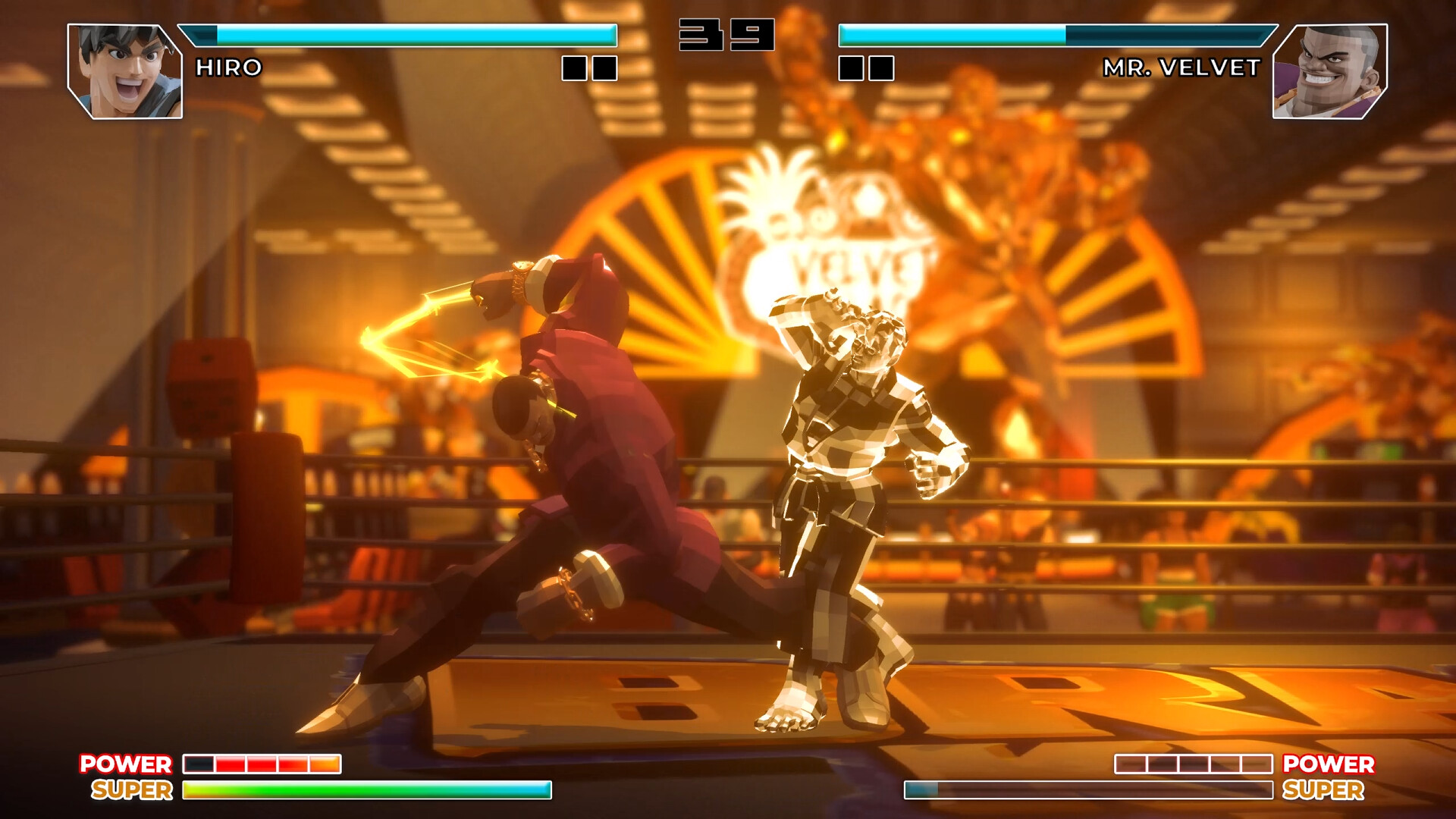
But it’s the inclusion of one “guest” character that draws a big laugh from us: a tall man wearing a baseball cap who is clearly based on the creative director himself. Amusingly, HeartLoop’s art director wanted to base characters on team members, and after Dorias jokingly suggested one based on himself named “Mr. Polyester,” he ended up in the game. I watch him fight against Hakim, a bespectacled samurai, and Dorias quickly singles him as an example of the variety of Poly Fighter‘s cast.
“We’re not a weapons-based fighter, but we can steal moves from different opponents. They work in the sense that they’re all imaginary […] And if you’re someone else, and you steal it, you get an energy sword just for the attack, you get a hammer just for the attack. And there’s precedent for this; like, Hagger pulls a pipe out of nowhere in Marvel vs Capcom 3. So we’re still gonna have weapon-based attacks that just spawn from thin air à la Looney Tunes. And this is the fun of the game.”
Something else that makes the game stand out is its status as a single-player-only experience in a genre that is regularly synonymous with multiplayer. As HeartLoop co-founder and strategy and product director Elaine Gusella tells it, the team did initially play around with different versus mode concepts, but ultimately realized its strengths lay in the roguelike-focused single-player.
“Obviously, there were smaller playtests along the way to really find the format that this thing really should exist in. And the more we validated with people, and the more we talked about it, the clearer it became that, ‘Hey, this is where the real fun is,’ she says. “As Osama was saying, there hasn’t been a fighting game that came out as a roguelike. And actually, this is where the fun is. And if we try to do everything around it, it would just take away from it. So we decided to refocus and really invest in building this core, and we’re very happy with how it’s turning out.”
Single-player opens up new options for a fighting game
Of course, there are also unique benefits to focusing on a single-player experience. Because HeartLoop only has to worry about player vs. CPU matches, the approach to balancing characters is decidedly different.
“Balancing is less important, but it is important. It’s less important in the sense that we’re okay with broken builds. We just don’t want them to be plentiful and easy to get to. Like, a combination of multiple things that now you’re broken? That feels good, and that’s a roguelike thing that you don’t want in a multiplayer game,” he says with a laugh. “But in a single-player game, we could embrace that move.”
The single-player-only structure also helps HeartLoop make the game more approachable to all kinds of players. Dorias says Marvel vs. Capcom 3, which was praised for welcoming in newcomers through optional simpler control schemes, was a big inspiration for the “feel” of the game in areas like the “ease of use” of combos.

“The main thing is, we want the combos themselves, like light into medium into heavy, to be pretty brainless — they will generally work no matter which character you have. So the player does feel like, ‘Ah, just learn how to do this and you will do a combo and it’ll come out. And the expression of, ‘Can I chain these together?’ becomes a mastery layer,” he says. “But the hard things are still hard to do, so you have room to expand. So if you have, for example, a light attack and a medium and a command medium that can chain together, but it’s tighter, but then [do] the heavy [attack], that’s not a thing we would expect a person to pick up and even try. They’re going to do light, medium, heavy, and that’s fine.”
That said, he hopes that players from all different backgrounds — be they in fighters, roguelikes, or neither — will still get something out of the game as they play.
“It’s really like the game is a teaching tool, because learning is what’s fun, and because there’s so many different things that interact in different ways, you’re constantly learning. You’re constantly trying to combine these things and theorycrafting and trying to get that build, but then in the next act, everyone gets harder, and you’re getting new [abilities],” he says.
“So you’re like, “Okay, now I have to look at [my build] again and make these interesting decisions on what to do. But throughout, the input is easy — the input never gets hard. That’s the goal. So everyone could still just press the buttons and the combos come out.”
For Gusella, this is how the fighter and roguelike genres really coalesce.
“We get asked that question all the time of like, ‘So doesn’t like the roguelike progression take away from the fun of becoming masterful and good at the fighting game?’ No! If you do understand the controls, that timing is still important. This is where we have a lot of work on the balance,” she says.
“It’s figuring out how, yes, progression will show you a build that’s becoming more and more impressive, but practicing and becoming better at the game makes a difference. So we do see from playtesting, the fighting game enthusiasts do have a bit of an easier time. But the entry is just a lot more approachable than traditional fighting games.”
Punching above
Clearly, then, a lot of work is going into finding that balance between approachability and mechanical depth, and HeartLoop says it will continue to refine that as it holds more playtests with fans. In fact, Dorias says the entire team is “community-minded,” with him and Gusella, specifically, being able to both draw from their years of experience teaching at Quebec’s Dawson College, while the latter also serves as a coordinator for the Montreal-based non-profit Pixelles, which supports women and other underrepresented genders in the gaming space.
But arguably HeartLoop’s greatest challenge lies in the broader gaming landscape beyond even Poly Fighter itself. As Dorias explains, Heartloop was founded during “arguably the hardest time ever to start a studio,” a reference to widespread industry issues surrounding the likes of mass layoffs, discoverability and funding.
“Some change has to happen. The ways before definitely weren’t working, but now it shows that it’s not working,” he says. “We have to make games more ethically and smarter and less with greed as the underlying motivator that is causing the higher-ups to make bad decisions that are short-term, that are putting us in this mess.”
“We’re being conscious about what we do and our growth, and it’s a little scary, but it’s also amazing, because we have this opportunity to build the type of studio that we’ve always wanted to have,” adds Gusella, noting that HeartLoop can draw from both positive and negative past experiences.
Ultimately, Dorias says that has him feeling hopeful for HeartLoop, Poly Fighter and the larger gaming industry in Canada and abroad.
“There’s a lot of optimism that yes, we’re happy to be working together. We’re happy for the opportunities that we have. We are watching out to make sure that we take care of each other, and hopefully, if we’re blessed with some level of success, we want to lead by example and show people a good way to do things and help as much as we can in every way we can.”
Poly Fighter doesn’t yet have a release date, but you can sign up to take part in Steam playtests through this form. The next playtest is now live from December 10 to 14. You can also wishlist the game on Steam.
Image credit: HeartLoop
 Features
  Gaming
  Features
  Features