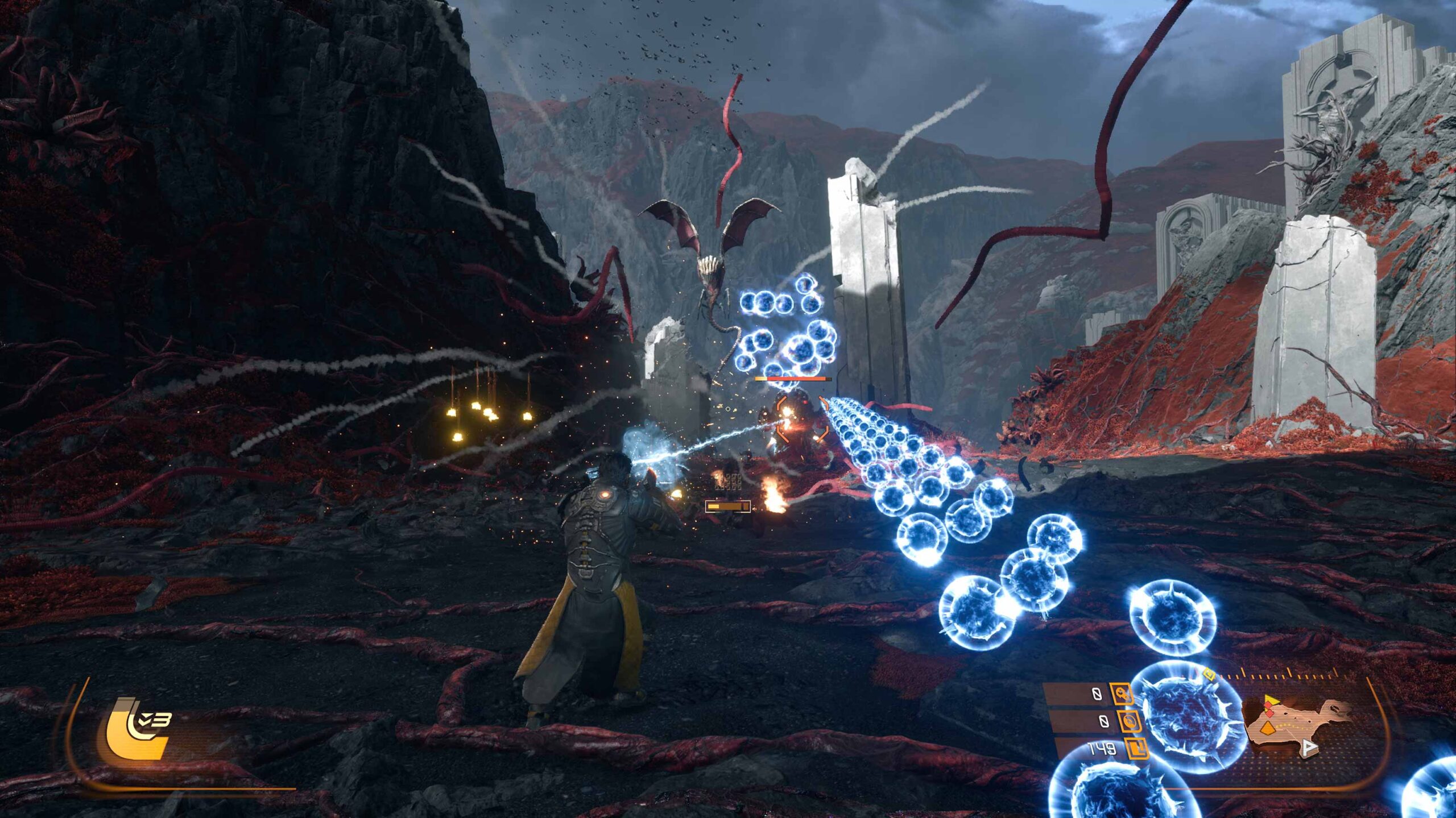
I really wanted to love Returnal.
After all, Housemarque’s 2021 sci-fi third-person shooter is, by all accounts, a great game. It effectively translates the Finnish developer’s signature riff on arcade-style classic “bullet hell” gameplay into a fully 3D action experience and layers on a delectably spooky atmosphere and tantalizing abstract narrative about a tortured astronaut caught in a time loop. I recognize all of those strengths and completely understand why it’s often viewed as one of the PS5’s best games.
For me, however, Returnal was just overly punishing to the point where I found myself not enjoying the experience at times. In particular, the roguelike framework of having to fight the same gruelling, multi-phase bosses again and again over exceedingly long runs really began to grate on me, as much as I admired everything else about the game. I ultimately never finished it, which bummed me out.
I say all of this to provide context for how I feel about Housemarque’s spiritual successor to Returnal, Saros. After playing through the entire game, I’m absolutely blown away. It retains everything that was great about its predecessor while making meaningful changes across the board to afford players more flexibility in both their combat arsenal and difficulty management as a whole. The end result is one of my favourite PS5 games so far, and I can’t stop thinking about it.
A total Eclipse of the heart
On paper, the premise of Saros is quite similar to Returnal‘s. In Housemarque’s latest, you play as Arjun Devraj (Rahul Kohli), a defiant employee of the clandestine megacorporation Soltari who is sent to investigate the mysterious off-world colony known as Carcosa.
But right off the bat, Saros creates significant intrigue by throwing you into a nightmarish sequence of Arjun waking up in a hellish, bone-filled wasteland and hearing a woman named Nitya (Shunori Ramanthan) telling him to find her. Where Selene in Returnal had a more ambiguous and slowly unfolding journey, you quickly understand what motivates Arjun in Saros.
This creates a remarkably strong hook throughout the game, as you’re driven to learn more about who Nitya really is and what happened between her and Arjun. It also injects bits of narrative into each and every run, as you uncover more not only about Arjun’s checkered past, but also how he and Nitya factor into the wider alien world of Carcosa and its surprisingly deep and techno-religious lore, especially amid the ominous Eclipse that’s hovering above you at all times. To say too much more would get into spoiler territory, but suffice it to say that Saros tells an unexpectedly powerful tale of regret, hubris and corruption which, by the time the credits rolled, had me reevaluating Arjun’s entire journey as something unexpectedly introspective.
Come back stronger
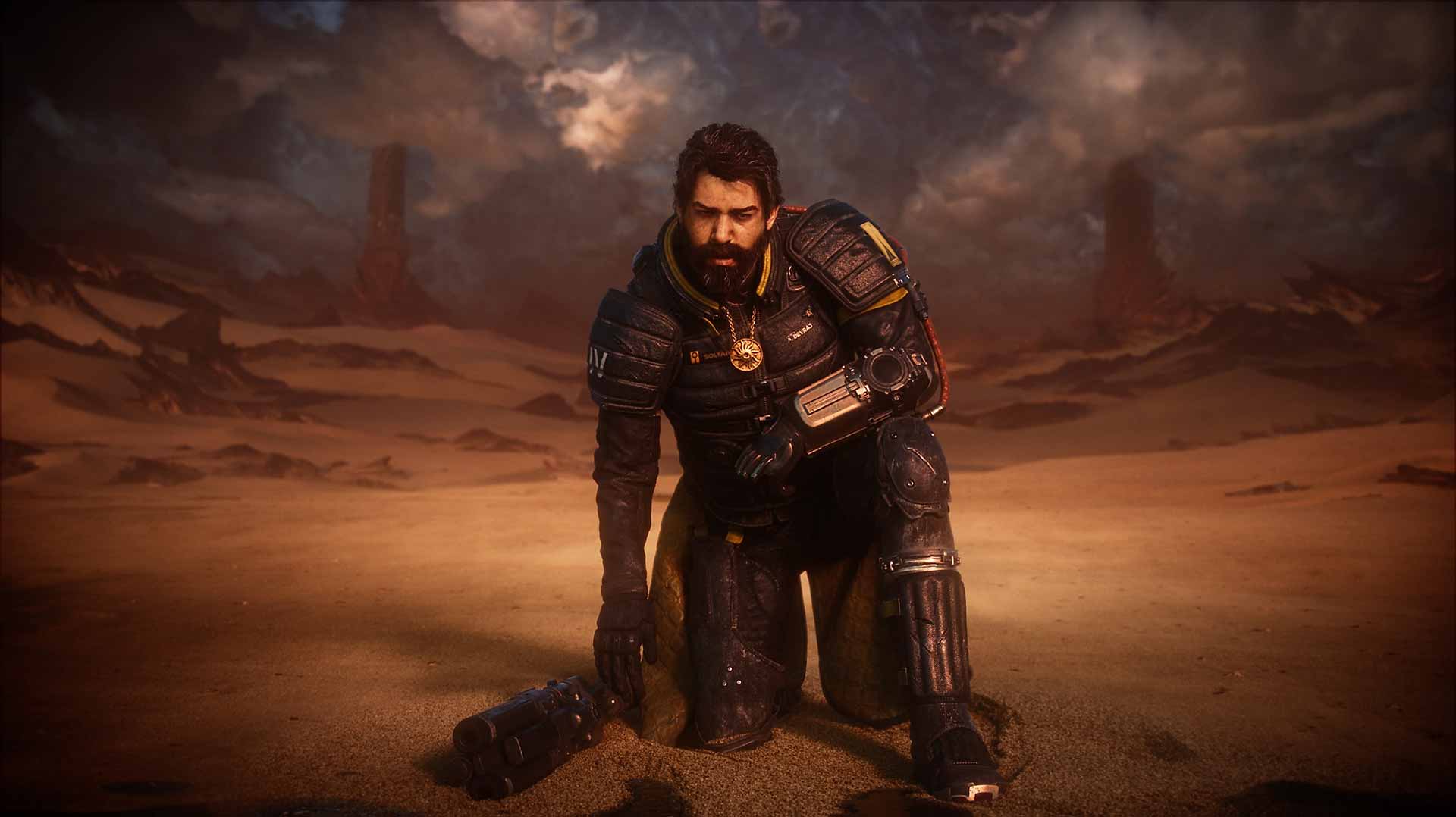
But Saros‘ biggest success lies in how thoughtfully it builds upon the foundation of Returnal. At its core, the gameplay loop is fundamentally the same. You engage in what Housemarque calls “bullet ballet,” a series of increasingly intricate and colourful patterns of enemy fire that you must avoid while letting loose your own dizzying array of shots. And outside of that, you’ll be exploring eerie biomes that change in between runs in a roguelike structure, especially through the world-altering Eclipse that makes enemies stronger and covers the planet in haunting apocalyptic yellow hues.
That all worked well in Returnal, albeit with some major pain points. In particular, runs were aggravatingly long, lasting anywhere between one to three hours, and that feeling was only exacerbated by the deliberately challenging enemies and environmental hazards. This is what single-handedly led me to put down the game, as I grew tired of repeatedly dying and having to restart significant chunks of gameplay. To make matters worse, there was no way of saving your progress mid-run at launch, although one was eventually added several months later.
Thankfully, Housemarque recognized how some players were put off by how gruelling Returnal could be, and so Saros, quite brilliantly, makes everything far more manageable while maintaining the core challenge of the gameplay. Yes, enemies are still plentiful and hard-hitting, healing items are still infrequent, and weapon drops and other temporary upgrades are still randomized — all of which constantly keeps you on your toes. But Housemarque has mercifully made runs themselves significantly shorter, now averaging out to around 30 minutes per biome. You can still go through multiple biomes in a single run if you’re skillful enough, but this tighter segmented approach makes the game infinitely more enjoyable for those like me who found Returnal‘s runs far too bloated.
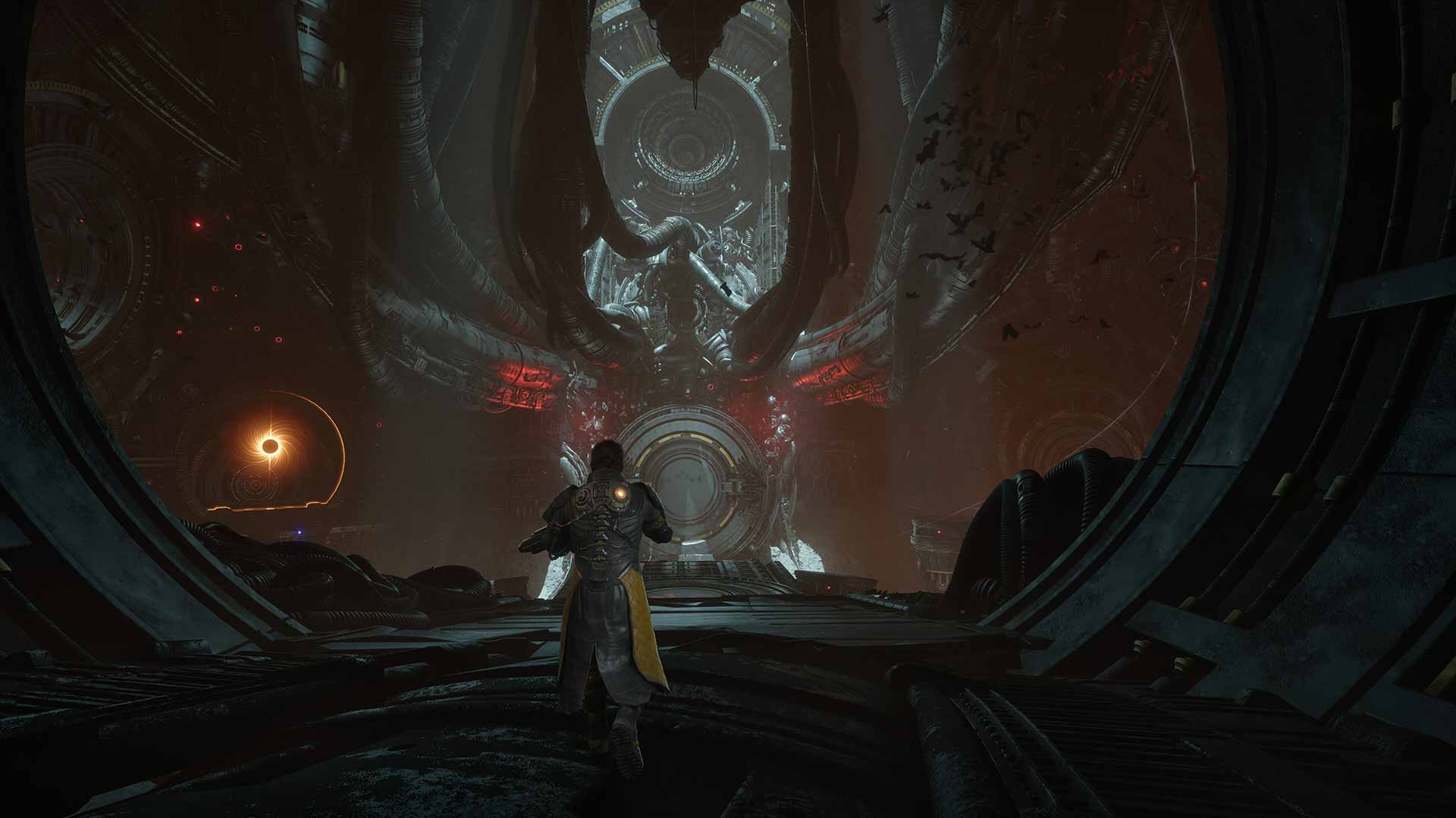
What’s more, runs feel exponentially more meaningful this time around thanks to a new progression system. As you explore Carcosa, you’ll obtain Lucenite, a resource that can be used to buy permanent upgrades between runs at the Passage, a Carcosan temple that Arjun and his crew have turned into a makeshift base. These enhancements range from basic buffs like increased health, Lucenite drops, and shields to passive abilities like the truly game-changing Second Chance to revive once upon death, and a key at the start of every run to unlock one randomized door or chest of your choice.
Housemarque calls this the “Come Back Stronger” system, and it really does live up to that name. In Returnal, death regularly felt like a setback, pushing me closer and closer to eventually giving up. In Saros, death regularly felt like progress. Not only do the shorter runs allow me to actually see the end in sight and, therefore, have a more reachable goal to work towards, but the ability to effectively “level up” Arjun with permanent stat and ability upgrades meant that I’d get just that little bit more powerful each time I ventured out into Carcosa.
There’s also an ingenious approach to difficulty scaling through two types of Carcosan Modifiers. Protection Modifiers reduce challenge in ways such as increasing your attack power, reducing incurred damage or restoring your health once you reach a boss, while Trial Modifiers enhance difficulty with effects like more aggressive enemies, disabling Second Chance or limiting Lucenite or other resource drops. Crucially, though, these Modifiers are smartly balanced because they operate like a scale, affording you only a few points to tip in either direction. And, more importantly, this system is entirely optional, so there needn’t be any concerns that the core challenge of Saros has been diluted.
Bullet paradise
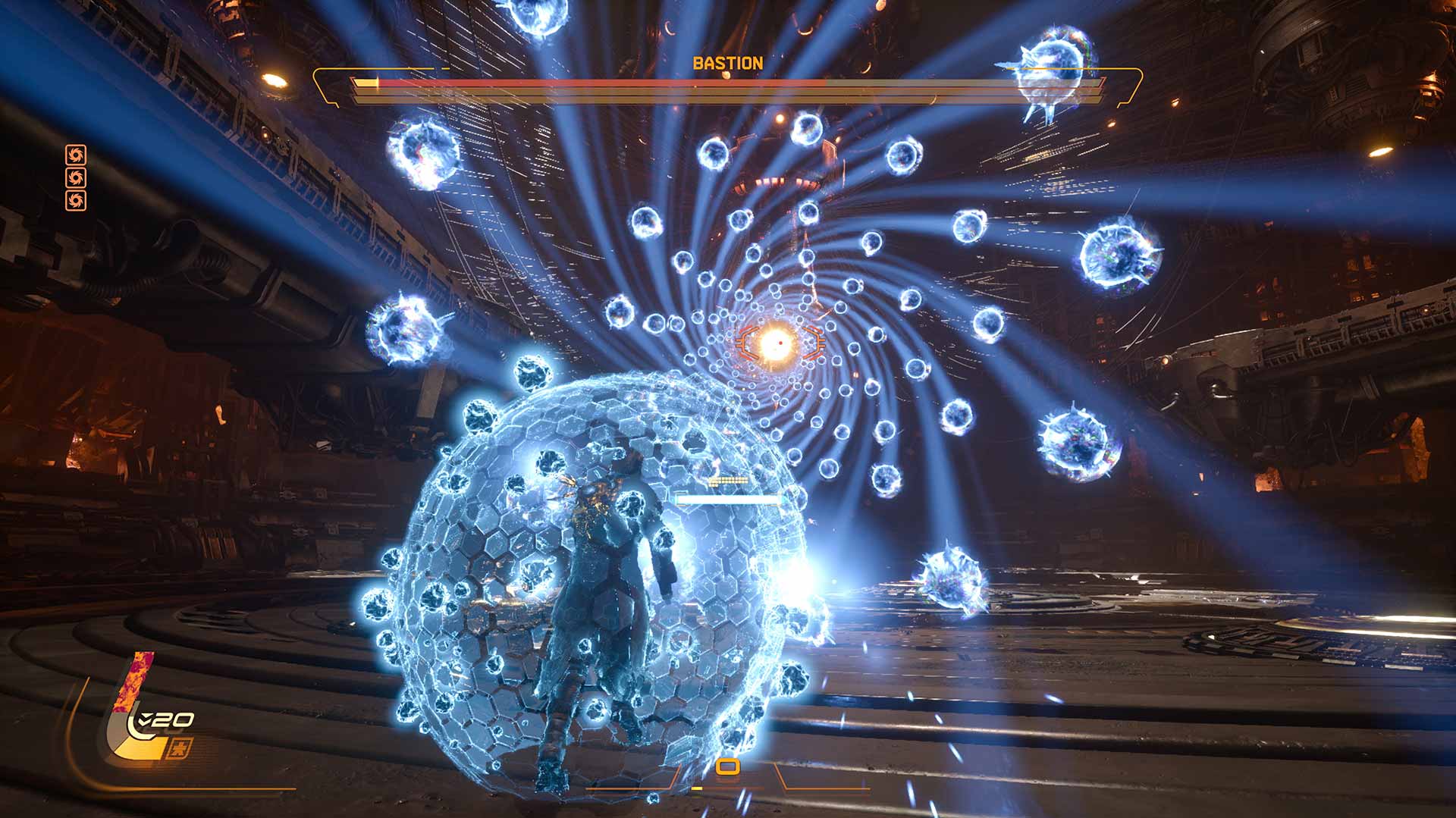
Ultimately, what all of these new features do is provide options, allowing each player’s run to feel markedly distinct, from the types of upgrades and settings they pursue to the weapons and other boons they choose along the way. That’s most welcome, because it allows you to better appreciate just how much of an absolute blast the combat can be. Indeed, there’s a visceral, frenetic thrill to running, dashing and jumping between mesmerizing, brightly coloured bullet patterns while peppering enemies with your own high-powered weaponry. When you really sink your teeth into it, Saros creates a flow state that’s truly irresistible.
While I do wish the foundations of the guns were a little more original (many of them are basically just sci-fi variants of standard firearms like pistols, rifles and shotguns), they certainly become much more interesting through the alternate fire system. Following in the steps of its predecessor, Saros features an exceptionally clever use case for the DualSense Adaptive Triggers in which pulling back halfway will unlock a secondary shot type, while fully pulling back switches to your Power Weapon. For alternate fire, this could mean shifting from rapid-fire assault rifle bullets to more precise single shots or, my personal favourite, the Bombardier mod on a shotgun that launches explosive shells.
But it’s Power Weapons that add the most dynamic wrinkle to combat, as they can range from a straightforward Prominence missile to a series of turret-like Dispiritor homing energy blasts. To recharge them, you have to use your shield to absorb blue projectiles — a feat that’s not always easy to accomplish in between other coloured attacks that will break your barrier. At the same time, you’ll eventually unlock a parry attack that lets you reflect red-coded shots, and together, they lend a compelling rock-paper-scissors rhythm to Saros’ combat that rewards precise timing and punishes spamming.
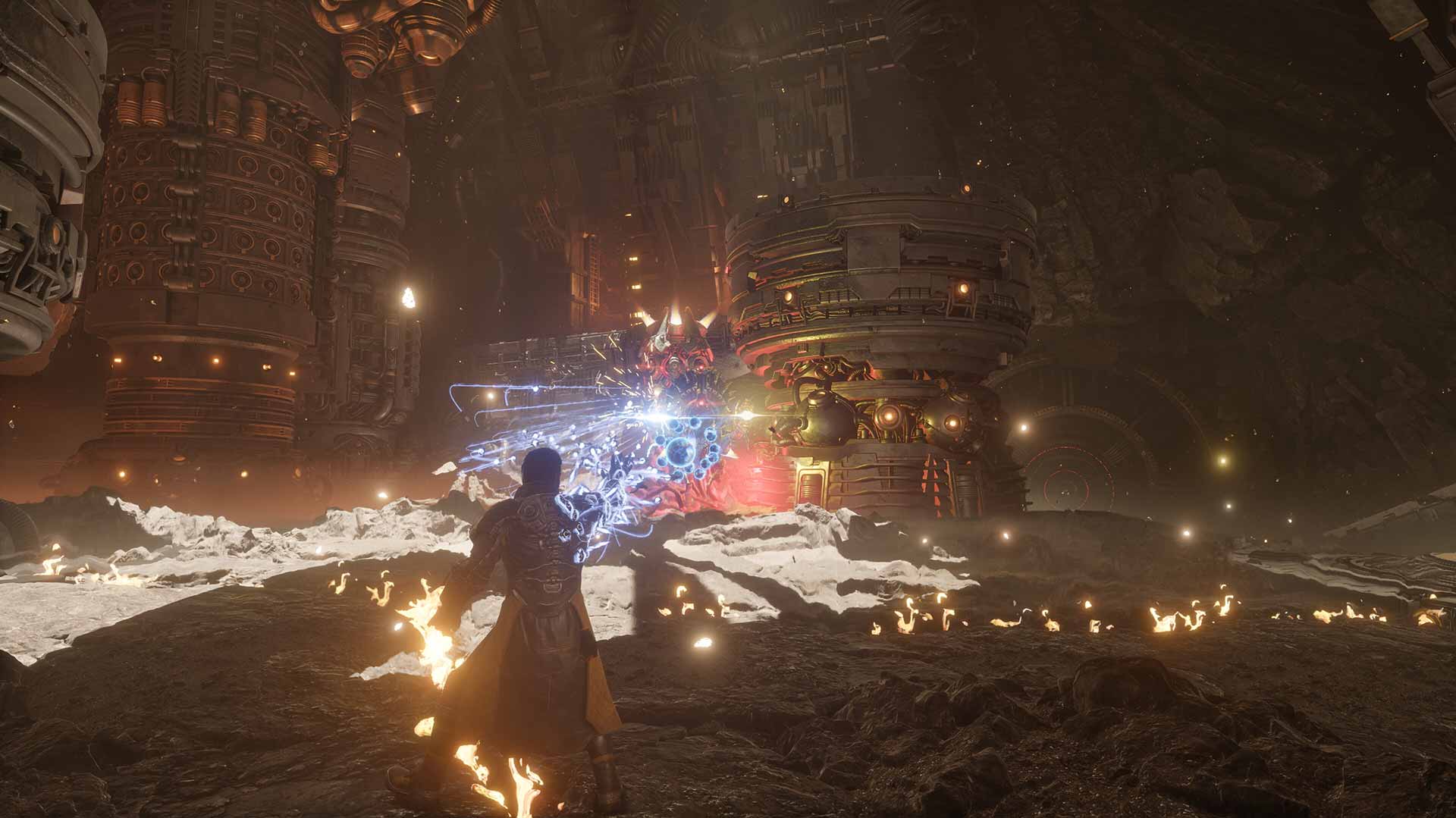
I also appreciated just how many micro decisions the roguelike structure challenged me to make with my gear. Often, I’d find versions of my preferred weapons that were either lower-levelled or carrying less desirable mods, so I’d have to weigh the benefits of each. Do I keep a weaker Dispiritor because its homing projectiles would free me up to concentrate more on bobbing, weaving and shooting, or do I go with Prominence for more powerful explosives that require more precision and dexterity? That’s the sort of thought process Saros would routinely encourage.
There’s also a surprising amount of variety to the room types, both in the kinds of things you’ll find in them (including some that are locked behind abilities like a grappling hook that you can later unlock upon revisiting) and how well-paced and spread out the number of enemy encounters are within them. This creates a constant sense of discovery and reward should you go down optional paths through the beautifully rendered dank forests, sweltering factories and menacing alien buildings, especially while the Eclipse is out and you net more Lucenite. All the while, you’ll occasionally come across audio files and text logs that flesh out the supporting cast and the history of Carcosa in often chilling ways and only entice you even further.
And best of all, Housemarque understands that there can be too much of a good thing, and so your frequent returns to the Passage afford you the opportunity to take a breather in between all of the intensity. Here, you can engage in many optional conversations with Arjun’s crew, like his steely commander Bouchard (Canadian actress Jane Perry, who also played Selene in Returnal) and the distrusting technician Kayle (Adriyan Rae). Returning to see just how increasingly fearful and on edge they become over the course of the narrative only adds greater weight to each of your runs, pushing me even more to lead Arjun to the end of his harrowing journey.
An unforgettable experience
Saros is the ultimate pleasant surprise. As someone who fell off hard with Returnal due to its punishing difficulty, I wasn’t sure Housemarque’s latest would be for me. But thanks to masterful game design that greatly enhances approachability while preserving challenge, a deeper and more character-driven narrative, and thrilling and diverse roguelike-infused gunplay, I’ve come away utterly enamoured with Saros. This is easily one of the PS5’s very best games and an early contender for Game of the Year.
Saros will launch exclusively on PS5 on April 30.
Image credit: PlayStation
MobileSyrup may earn a commission from purchases made via our links, which helps fund the journalism we provide free on our website. These links do not influence our editorial content. Support us here.