


Electric vehicle (EV) charging data platform Paren released its first Canadian-dedicated State of the Industry report for Canadian EV fast charging in Q4 2025.
Paren, established in 2024, began producing quarterly State of the Industry reports for the U.S. market in 2025, centring on deployment, utilization, pricing, and reliability — or, as Paren puts it, “core indicators of whether infrastructure is scaling sustainably across a graphically and operationally complex market.”
According to Paren, 2025 marked a ‘scaling’ year for Canada’s fast-charging network, despite a decline in EV sales.
Paren’s report says Canada added 1,925 new DC fast charging (DCFC) ports in 2025, representing a 28 per cent year-over-year (YoY) increase. This means that Canada now has 8,804 total ports. The report notes that deployment still remains concentrated in British Columbia, Quebec, and Ontario.
These numbers roughly align with data from Natural Resources Canada, which shows a total of 2,701 charging stations with a combined 8,262 DC fast charging ports across the country.
The report notes that expansion also broadened the national corridor coverage in both the Prairies and Atlantic Canada.
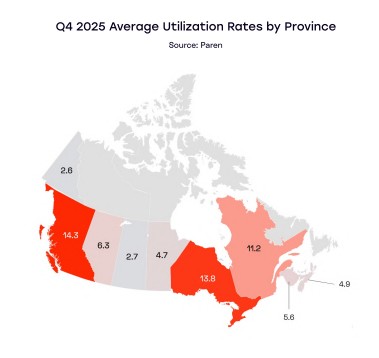
Image Credit: Paren
Paren also reported that utilization rose from 11.6 per cent in Q3 to 11.9 per cent in Q4, which the company notes confirms that the new capacity was absorbed, indicating new demand for these chargers.
In the report, the company noted that Vancouver utilized the new fast-charging stations the most in Q4, with a utilization rate of 29.8 per cent. Toronto comes in at a close second, with a rate of 20.8 per cent. The lowest was Winnipeg, with a rate of only 10.1 per cent.
Interestingly, Paren noted that lower scores in areas like Calgary, Edmonton, and Winnipeg reflect higher levels of single-family housing and lower EV adoption, which enable more home-based charging.
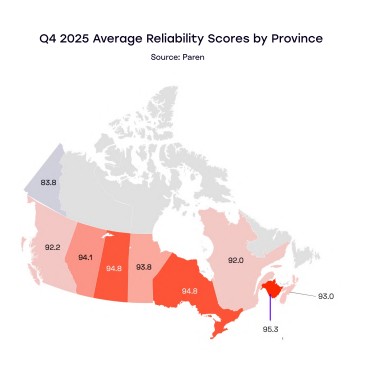
Image credit: Paren
In terms of reliability, Paren used a score-based system that incorporates successful charging attempts (with and without retries), failed attempts, and station downtime over a defined period. Using this system, Ontario and Saskatchewan ranked highest with a score of 94.8, with Manitoba just a few points behind at 93.8. Alberta finished with a score of 94.1, while British Columbia concluded with a score of 92.2, and Quebec finished with 92.0. The Yukon Territories finished with the lowest reliability score, at 83.8.
In terms of pricing, Paren notes that the national average was $0.42/kWh in Q4, although prices varied by province, ranging from $0.40/kWh to $0.65/kWh. The prices were the highest in Alberta and Saskatchewan, averaging $0.65/kWh. The least expensive was in the Yukon Territory, where the price was $0.37/kWh, while Quebec was close behind at $0.38/kWh.
 Gaming
  News
News  News
News  News
News 