


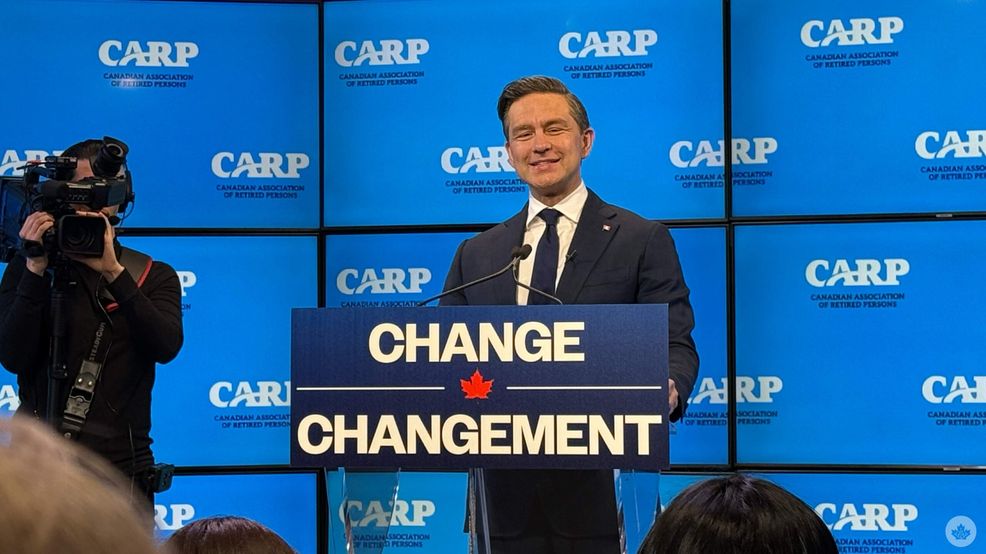
ZoomerMedia held a Conservative press conference today for the members of the Canadian Association of Retired Persons (CARP) and MobileSyrup was able to ask Pierre Poilievre about his party’s plan to connect all Canadians to the internet.
When it was my turn, I asked Poilievre how the Conservatives plan to connect remote Canadians now that Starlink is out of the picture due to the ongoing U.S. trade war. In his answer, he also let it slip that he didn’t have a concrete plan to drive down telecom prices.
He started by saying “Starlink isn’t the only satellite company around,” but he didn’t mention what his government would use to replace it. There is a Canadian company called TeleSat with ambitions to launch low-earth orbit satellites to offer internet speeds similar to Starlink’s for remote users, but they have yet to launch any, and they have been delayed a few times. Beyond that, there were plans in the past for the company to be more of a B2B player in the satellite internet space. This is a similar strategy to the one the other Canadian player, Galaxy Broadband, is also abiding by.
There are other players around the world who are also in a place to maybe compete with Starlink, but most are sitting in the early stages of development with only a few satellites in the sky. Starlink, by comparison, has been sending satellites to space since 2018 and currently sits at over 7,000 units in action.
Moving past satellites, Poilievre also said that the Conservative government would use “massive incentives” to get the existing Canadian telecoms to increase service in remote communities. That proposal sounds very similar to the existing Liberal plan, which has gotten many communities connected, but it has happened very slowly and there is little reporting from the communities regarding how successful this plan has been for the people that live there months or years after the service is installed.
Finally, to cap off his proposal, he said, “We also favour more competition among our telecoms. We’re going to ensure that there is [sic] more options so that our consumers can actually shop around if they’re not happy what they get from the biggest providers. Because the only way to drive down costs and drive up service is to have more competition.”
Again, there isn’t much of an answer here. While more competition would be fantastic, it’s unclear if Poilievre means more competition in areas of the country that only have one internet provider, or if he plans to create some other form of competition, like opening up the market to foreign telecoms. If he does plan to make things more competitive among the existing carriers, he’s going to have a fight on his hands. The CRTC has already mandated existing telecoms to share infrastructure for fair wholesale rates, but in reaction to that, Bell has said it would stop investing in infrastructure until the decision is revealed.
The Conservative government did stand against the Rogers-Shaw merger in 2023; however, that was when Rogers was poised to take over all of Shaw. There was no press release sent out when Freedom Mobile was spun out and sold to Videotron, which has appeared to add more competition to mobile phone plans.
All in all, I knew it was a long shot question since his campaign hasn’t touched on this issue, but it would have been nice to hear a concrete strategy for connecting Canadians rather than the political babble we were given. All that he said would be awesome if it could come true, but it seems like the strategy is a little half-baked for the time being. The Poilievre campaign plans to release a full strategy document on April 22, which could shed more light on what was said to us at the CARP event.
With all that said, the Liberals don’t seem to be in a significantly better position. In fact, it appears that the campaign promises they made in 2021 regarding connecting remote communities have also fallen through. While there has been a slow wave of remote communities being linked up to the internet, there was originally a promise to resell the spectrum to smaller players if the big three telecoms didn’t hit metrics leading up to 2025, and there has been no mention of this during the election race.
On top of that, the new Liberal party led by Mark Carney has also failed to share any campaign promises regarding telecom competition or connecting remote Canadians to high-speed internet. However, if given the opportunity, we will ask.
The federal election takes place on April 28, with advance polls closing tonight.
Disclaimer: ZoomerMedia is the parent company of MobileSyrup.
 News
News  News
News  Carriers
  News
News 