


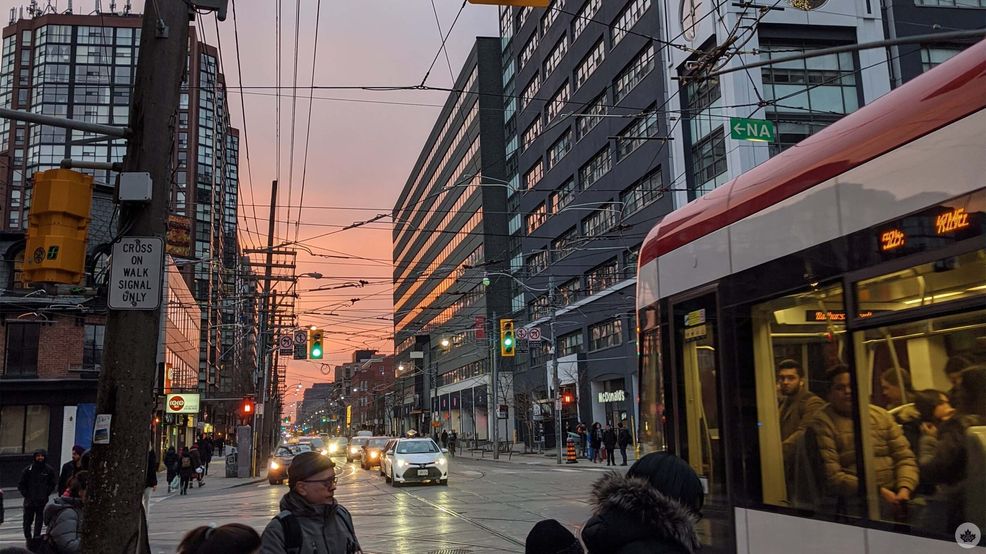
Most of us never see behind the scenes of the complicated systems keeping traffic moving in cities across Canada. Teams of overworked traffic engineers sift through data and diagnose problems with traffic lights and sort through citizen complaints. Meanwhile, cities struggle with out-of-control traffic growth.
Waterloo, Ont.-based Miovision wants to change this with a new virtual agent named Mateo, a conversational AI tool for traffic engineers. It feels more like a smart colleague than a piece of software, and it could revolutionize how cities manage traffic.
Solving a problem with AI
“It stands for the Miovision Automated Traffic Engineering Operator,” Kurtis McBride, Miovision’s CEO, explains. “We felt like because it was conversational, it might make people feel like Mateo is a part of their team.” He describes Mateo as a natural extension of how engineers already work inside Miovision’s platform, only faster and far more intuitive.
A typical day for a traffic engineer begins with a complaint from a frustrated driver. Traditionally, the engineer clicks through layers of software, forms a hypothesis about what might be happening at an intersection, checks several data points, and then deploys a fix. McBride explains how Mateo changes this pattern. “Instead of clicking through our interface, it is actually just a conversation with a large language model.”
Engineers copy a citizen complaint into Mateo. The system uses Miovision’s live intersection data to analyze conditions on the ground.
“The large language model can go into the data and diagnose it,” McBride says. “It shortens and ultimately helps you solve the problem, helps you deploy the fix.” He frames it as a direct time saver for staff already stretched thin.
How Mateo actually works
McBride describes Mateo as a blend of two different types of artificial intelligence: a Large Language Model, or LLM, and a traffic-specific AI that knows what it’s talking about.
“The large language models have read every traffic engineering book there is to read,” McBride explains. “They are the digital equivalent of the smartest PhD graduate from the best traffic engineering school in the world. But they have no idea what is happening in an actual intersection in a city that you live in.”
Miovision supplies the missing piece.
“Our data has a near-perfect representation of what is happening in the physical intersection that you live in. The combination makes you street smart as opposed to book smart.”
Miovision is a Canadian traffic-technology company based in Waterloo, and its systems already sit inside thousands of intersections across the country. Cities use the company’s sensors and signal-control hardware to collect detailed traffic data, measure delays, count vehicles and pedestrians, and flag problem areas before they turn into bottlenecks. That data feeds into Miovision’s cloud platform, which now processes information from more than seventy billion vehicle detections globally.
The company builds an internal wrapper called the Model Context Protocol, which links natural language questions to the live data Miovision already gathers from intersections. Coupled with an agentic retrieval-augmented generation (RAG) architecture, the AI’s responses are grounded in verified data, reducing the risk of inaccurate responses. Miovision also stressed that the final decisions remain with traffic engineers and municipal staff — Mateo is purely an assistive tool.
“We built this wrapper around all of our data and all of our capabilities that says, if the customer says show me data, do this. If the customer says update the timing plan, do this.” He adds. The system routes each question to whichever large language model handles that type of query best.
Mateo is live in cities right now
Miovision is already testing Mateo with early adopter cities in North America, though the company won’t say which ones yet. The first goal focuses on resolving citizen complaints through a guided conversational workflow. Engineers describe the type of complaint they receive, and Mateo responds with analysis, suggested fixes, and verification steps. McBride says the company aims to expand once the experience feels solid.
“Once we get it to the point where we are confident, maybe among three or four different customers,” McBride says. “Then we will start to expand the sphere of users.”
The virtual agent works on top of the existing Miovision infrastructure and cities don’t need to install new hardware. All of the data powering Miovision’s current interfaces also powers Mateo. Engineers don’t need to click through interfaces and graphs to sort data; now they can get it through a conversation with Mateo.
Not everyone is on board with AI
There is some hesitation among traffic engineers who may not fully trust AI or understand how it works. Comfort with AI among users is the biggest roadblock to mass adoption.
“We have some people that are using it every day, all day, for everything they do,” McBride says. “And some people that are still nervous to even crack it open and try it.” He notes that some customers have never used any large language model at all. When they see Mateo in action for the first time, he says, “It was like showing the magic.”
However, McBride expects rapid advancement over the next several years. He believes the technology will scale a traffic engineer’s abilities. He predicts broader change across city systems. Large language models will combine different types of civic context to support planning, events, and services.
“Data is only so valuable when it is turned into an insight,” he says. “What is emerging here is the ability to hold the context that you need together in a zero-cost, very efficient, integrated kind of way.”
Mateo for everyone
McBride imagines a future where residents access the same context for their own planning.
“You as an individual planning to go downtown will also be able to tap into that context to better plan your own experience,” he says.
Miovision already works with thousands of customers worldwide, and the scale shapes how the company moves forward. Insights from cities help highlight problem patterns, safety gaps, and best practices. Miovision now sees how some cities achieve lower safety risk than others, and the company begins sharing those findings.
For McBride, this direction represents a broader shift in how people interact with software.
“We want to make sure that we make technology more approachable to more people and to make it more human in the interaction,” he says. He believes the product reaches its goal when customers casually tell one another, “I do not know. Ask Mateo.”
 Features
  Sponsored
  Features
  Features