



You might not know it, but a lot of technology goes into the FIFA World Cup.
On the one hand, that seems kind of obvious for a global tournament featuring 48 teams, 104 matches across 16 cities in three countries and roughly seven million attendees and six billion total viewers at home. But on the other, the volume and variety of tech powering FIFA may surprise you.
Last week, I got to see this firsthand when I was invited by Lenovo to attend Canada vs. Bosnia and Herzegovina, the first of six host FIFA World Cup games hosted in Toronto and, notably, Canada’s first-ever FIFA game played on home soil. As FIFA’s official technology partner, the Chinese tech giant pulled back the curtain on some of the work it does to support the games.

First, the sheer scope of the FIFA World Cup means that Lenovo has to approach things a bit differently compared to the other sports it’s involved with, like F1 and the NHL’s Carolina Hurricanes.
“As you know, the FIFA World Cup services over six billion viewers, and so, there’s a lot of eyeballs on us. So, it’s very very different. This has been a global partnership of ours that’s a number of years in the making,” explains Colin McIsaac, Lenovo’s vice president and general manager of North America commercial sales, in a media roundtable. “We launched the partnership, and then we got straight to work identifying over seven or eight technology streams that we absolutely had to get right.”
On a base level, that means Lenovo’s responsible for creating the servers for advanced analytics, providing mobile devices and tablets for teams in partnership with Motorola, and using tools like Referee View AI Stabilizer to real-time video with 50 per cent less jitter in high motion scenarios. But beyond that, Lenovo is leaning into its AI infrastructure to bolster even more assets in perhaps less expected ways.
FIFA AI Pro. (Image credit: Lenovo)
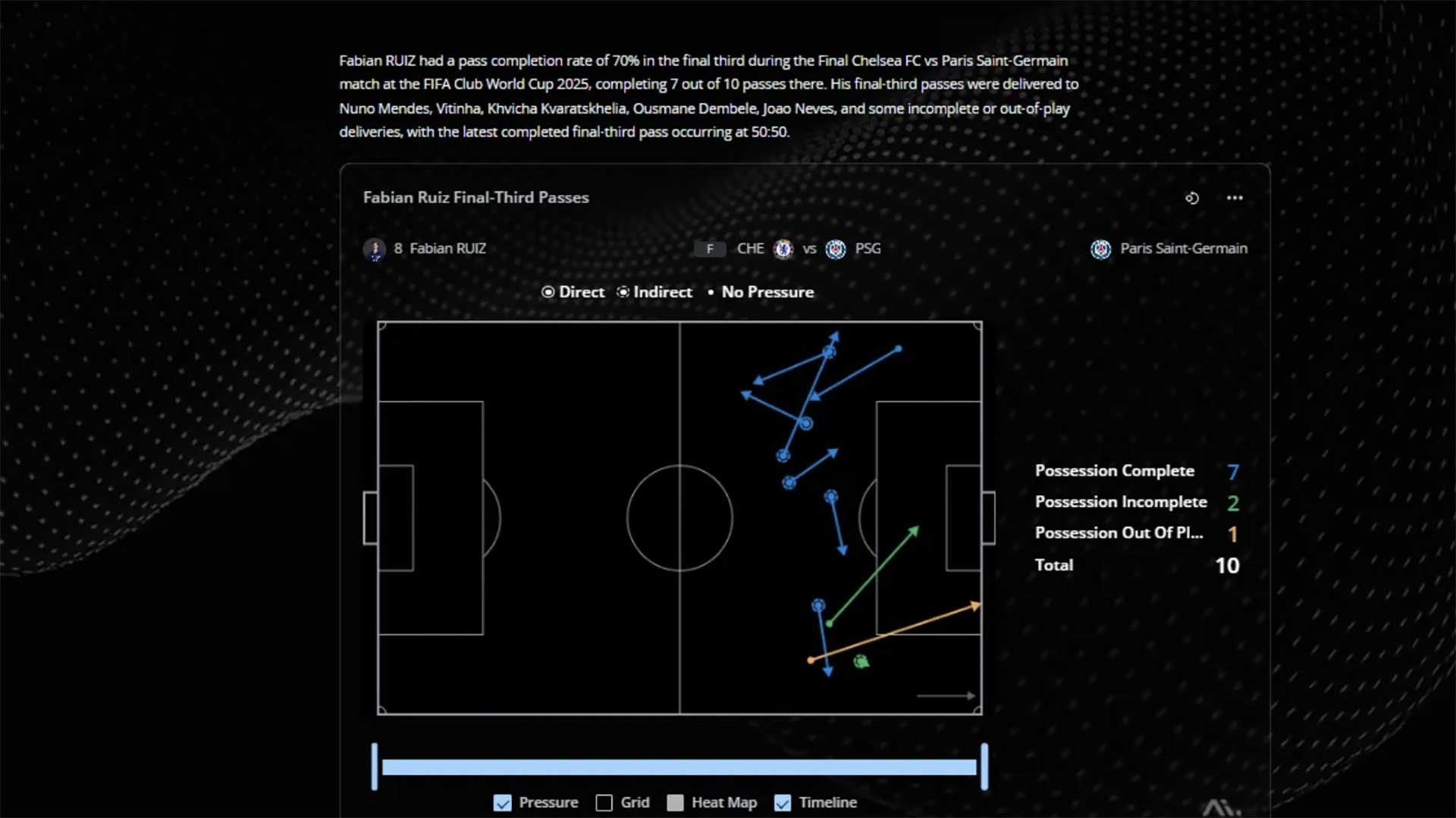
One of these that McIsaac singles out is FIFA AI Pro, an intelligent performance agent. As McIsaac explains, FIFA has “millions and millions of data points from time immemorial,” given that the World Cup began in 1930. Therefore, Lenovo has created a language model built on its AI Factory platform that can zero in on up to 2,000 key data points that can be shared in the form of detailed reports, graphs and animations to FIFA and its member associations a few hours after matches.
“[It’s] almost democratizing information, FIFA’s information, [so] coaches can make better on-field decisions because they have access to it, they can change tactics mid-game based on the information that Lenovo and FIFA are providing as part of our AI tool. It’s changing the nature of this game — and other sports, quite frankly — which is really exciting,” says McIsaac.
Another key piece of Lenovo tech that is being used in the World Cup is its 3D Avatar system, which uses AI to digitally reconstruct players. As McIsaac explains, all 1,248 players in this year’s World Cup have been scanned before the tournament by high-powered cameras in rigs not unlike the ones you may have famously seen used to bring celebrities like Conan O’Brien into video games like Hideo Kojima’s Death Stranding. The scanned FIFA data was then used to create virtual recreations of players so the Video Assistant Referees (VARS) can review replays that are accurate to each player’s unique dimensions. This works in conjunction with sensors within the soccer balls themselves to bring latency from 40 seconds to five seconds.

Lenovo is producing the 3D Avatars. (Image credit: Lenovo)
“[We’re] leveraging that data to not only provide a better fan experience but also to assist on-field decisions around things like offsides. Because everybody — casual and more sophisticated fans — wants to talk about offsides,” says McIsaac. “So now, instead of that three-minute delay in the game where somebody has to review, maybe we can enhance that and speed it up, and we’re doing that with our avatars.”
Lenovo is quick to stress that these are “enhancing” referees, not taking away from them, given that humans still have to interpret the data. What’s more, the company notes that these digital twins can help monitoring officials maintain consistency across the 16 World Cup stadiums that are built differently.
But of course, it’s one thing for Lenovo to tout this technology — it’s another to hear what an actual FIFA player has to say about it.
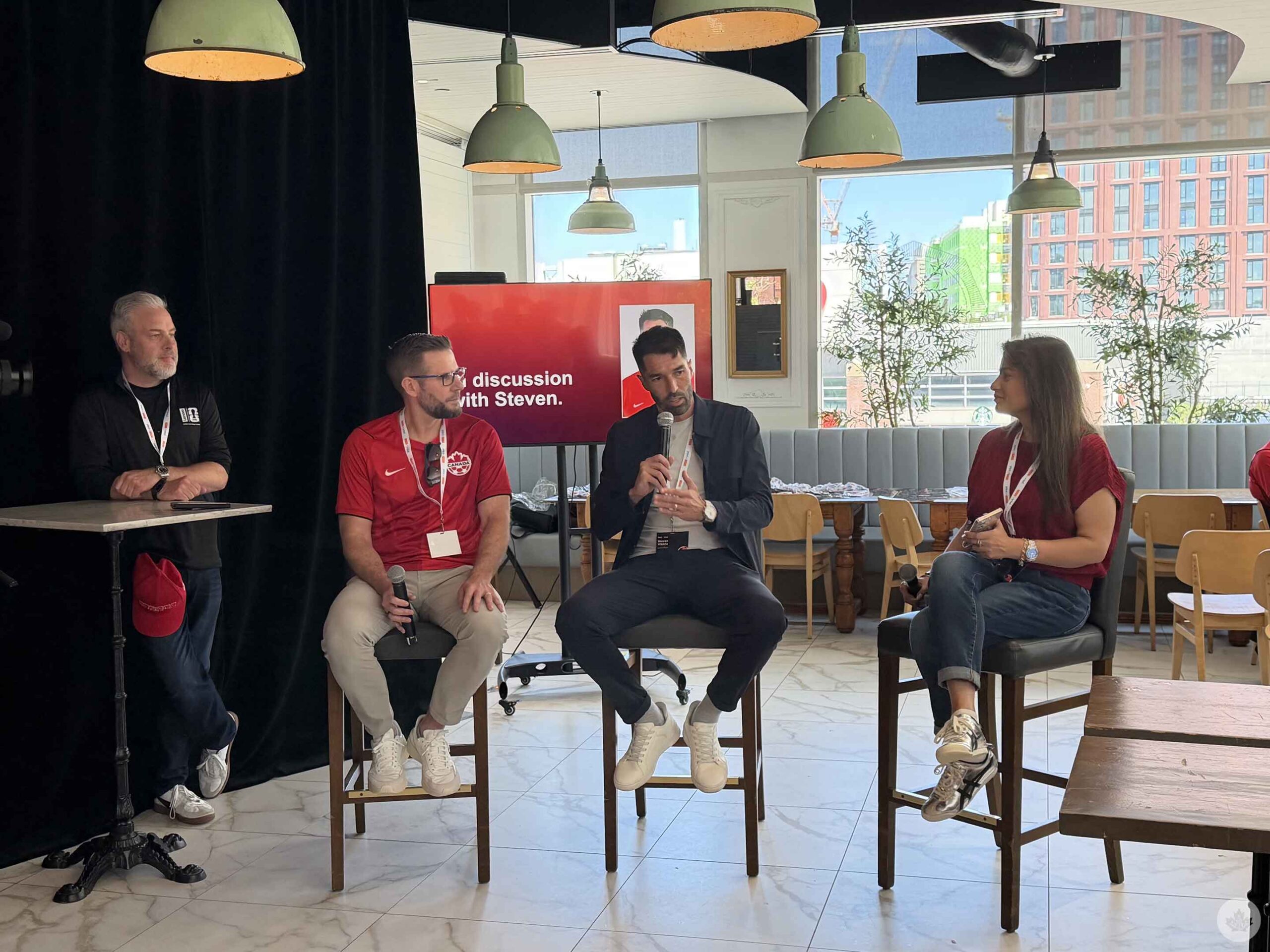
Colin McIsaac (second from left) and other Lenovo reps speak with Canadian former soccer player Steven Vitória (second from right).
And so, McIsaac sat down for a brief chat with Toronto-born Steven Vitória, who played professionally for various Portuguese soccer teams and Canada’s national team. While Vitória is retired now, instead serving as assistant manager for Indonesia’s national team, he told McIsaac that he wishes all of this technology was around when he was playing.
“We have so much data now, and we can’t take it for granted,” he said.
Last-minute World Cup tickets can still be purchased through FIFA’s website. In total, six games are being hosted in Toronto between June 12 and July 2, while seven are being held in Vancouver from June 13 to July 7.
Update: 19/06/2026 at 4:28 p.m. ET — Removed an incorrect mention that Lenovo has partnered with the Olympics and added a clarification that AI Pro data is available a few hours after a match.
 Features
  Sponsored
  Features
  Features