One of the oldest and most iconic video games is making a big comeback thanks to two Canadian teams.
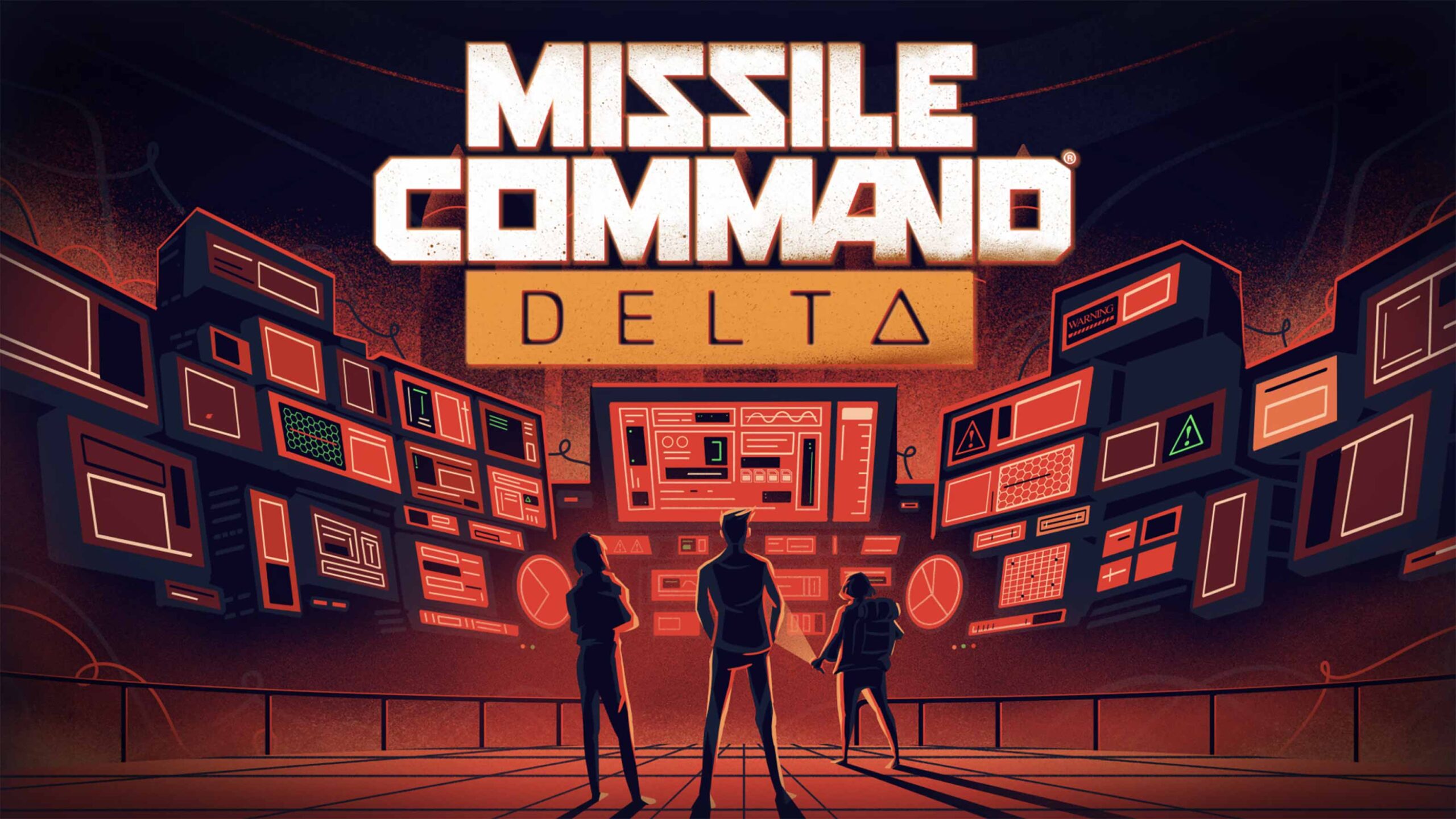
Missile Command Delta is a new take on Atari’s 1980 arcade shoot ’em up Missile Command from Toronto-based developers Mighty Yell and 13AM Games. The teams are best known for the ’90s-set adventure game The Big Con and the Godzilla-inspired beat ’em up Dawn of the Monsters, respectively — both acclaimed works, no doubt, but also pretty different from Missile Command. So that begs the question: how did the two Toronto developers end up working on the storied Atari property?
“We got approached by Atari years ago about potentially working together on some stuff, and I was like, ‘Hey, while I have you, what are you guys doing with all them old games?'” explains Dave Proctor, Mighty Yell creative director, with a laugh. He says he and 13AM lead designer Tom McCall have been thinking about the game for years.
“I’ve always loved Missile Command. Back when Tom and I were in school, I was really obsessed with this video about how Missile Command tells its story through its mechanics — the way it tells you very much about who you are and what the story is,” says Proctor. “You never win Missile Command, you just delay total nuclear annihilation, which is really thematic with how the creator wanted that to feel. So I’ve always been really interested in it.”
He says that interest has had him thinking a lot about different ways to make a new Missile Command.
“And I was like, ‘Oh, what if Missile Command was a card game?’ And then my brain just opened wide and I remember staring off into the distance thinking, ‘Ah, there’s a lot of cool stuff that you can do.’ And I remember when I pitched it to Tom, in the middle of the call him just looking off, and he’s like, ‘Oh, there’s a lot of cool stuff you can do!'” says Proctor.
“And the other thing is that Missile Command does have a story, but I was curious: who are the people? Like, there is an alien menace in the original Missile Command, and I was curious who the people in the bunker are. So I wanted to tell that story; I wanted to crack that open and make it feel a little bit like an ’80s sci-fi movie.”

Clearly, Proctor had a lot of ideas, and after a pitch to Atari, he was given the go-ahead to act on them. However, he also knew that Mighty Yell would need some assistance with the game, and thankfully, he didn’t have to look far. Enter fellow Toronto developer 13AM Games, which Proctor actually co-founded in 2014 before moving on to Mighty Yell a few years later. Specifically, he says he would have tried to contract hire McCall to help out with Missile Command‘s signature mix of “tactical strategy and deep political narrative intrigue” anyway, so it only made sense to bring on more of the 13AM team.
From there, Proctor sent over the “initial design direction” to 13AM and McCall took over as the lead designer.
“It was a fun challenge for me,” admits McCall. “Because the kind of box that I got into was it needed to be turn-based, needed to revolve around some sort of deck-building or card aspect, and it needed to — obviously — be Missile Command. So that sent me down a path of knowing the old arcade game and how it works, and — knowing it has a pretty big history with a lot of people, and there’s a lot of fans out there — wanting to make sure that we capture the essence of what made that game fun, or at least translating enough of it so it’s very recognizable to people.”
Indeed, a key change from the original Missile Command is that instead of the “shoot ’em up” style gameplay, wherein you have to react in real-time to missiles using a trackball, Delta adopts a turn-based approach. You’re still trying to stop missiles, but now, you manage a hex-based grid and have to use a deck of cards corresponding to different kinds of missiles with their own ranges and costs.

“I just started peeling back — ‘How do we do missiles on angles and things like that? That’s the hex grid, okay. Bases are where you’re going to launch your attacks from. How does that work? What’s the important thing when you’re doing turn-based on a grid? Okay, well, it turns out that range and size of the explosion matter more than a lot of other things,'” says McCall. “And eventually, we landed on the current form.”
It’s a form that Proctor, who maintained a producer role throughout development, feels is very much in line with the ethos of the original Missile Command.
“We retained that sort of reactive nature and the sort of mental map of, ‘Okay, well, what do I need to keep track of?’ When you’re playing Missile Command, everything’s happening all the time. And [Delta is] that, but it’s just turn-by-turn. So it’s just, ‘What do I need to think about?’ It just opens up that part of your brain. So that was what I think translated really well to the turn-based stuff.”
At the same time, McCall says he was trying to maintain a “balancing act” of retaining the difficulty of the original game while making it approachable for new players. “I wanted to make the core content challenging but not overly difficult,” he says.
“We ended up leaning on this kind of two-avenue approach where the core content you should be able to get through — [it’s] not overly challenging. [It] will tickle your brain, and we’ve made systems where you select your own cards so you can choose what you’re bringing to these fights, and that adds a little bit of ‘controlling your own difficulty,'” he explains. “And then we added this kind of scoring system — and I’m trying not to spoil too much — where there’s a threshold that, if you do well, good things happen, and that opens up an avenue towards some of these other secrets [that are] a little more challenging with the encounters.”

But he wants to stress that the latter content is optional, so those who just want to pursue the main path can do so without too much difficulty. That said, Delta encourages you to seek out that extra content for more of that deeper narrative that Proctor was talking about. In many ways, it’s easy to see how Delta builds upon Atari’s original ideas all those years.
For context, the inability to “beat” Missile Command was quite appropriate, given that it was released at the height of the Cold War. Indeed, many people who played that original game have noted how eerily efficient it was in tapping into the paranoia of that era. Delta, for its part, takes a rather interesting approach to that subject matter in that it’s about a modern day group of young campers who stumble across a Cold War bunker and, through that, a larger mystery.
But of course, the game is also coming out amid rising global tensions surrounding warfare — something the team naturally couldn’t have fully predicted. “What I think is interesting about it is [that] all games are political. You can never be in a complete vacuum, so no matter when we released, this game was always going to be something that is relevant. Turns out that it would be really relevant — didn’t think that would happen when we started! But hey, here we are!” Proctor says with a laugh.
A key benefit of the modern setting, according to Proctor, is the fresh perspective it provides on the themes of Missile Command.
“What’s important is the human level. There’s always going to be a big, unknowable, difficult-to-manage conflict, managed by people that are much more powerful than us. And the way that different groups of people behave within that situation would change, and we get to depict that,” he says. “You’ve got people that are sitting here 45 years after the Cold War, and they are talking about what it means to be in that situation. And that’s the story that we can tell right now.”

“It’s not necessarily about the politics of the situation — more about how your friend group would react to a situation that they find themselves in, without spoiling too much, and the kind of personal conflict that comes up, and how people handle stress and all these things that they get confronted with as the story goes on,” says McCall. “[But] there are [political] aspects of it — one of the characters has a tie to military and things like that, and it’s interesting to see how she changes throughout the story or her perspective varies compared to some of the other people.”
To better flesh out this narrative, 13AM added a first-person element in which players can explore the bunker, solve puzzles and learn more about the larger mystery. That added gameplay variety, which helps shake up the turn-based missile sequences, but it also allowed 13AM to push itself. As McCall notes, the team initially thought of a visual novel storytelling structure but eventually wanted the “fun little challenge” of making its first-ever true 3D game, given that Dawn of the Monsters only partially featured that perspective.
“Something that I tried to weave throughout the game is that the player is experiencing things at the same time the other characters are experiencing things, and that immersion and having that throughline be constant throughout the game just really keeps people engaged and makes it more believable,” he says, noting that the team even added various “cinematic moments” towards the end of development to “reinforce” all of this.
He also says he was heavily inspired by fellow Canadian-made game Inscryption, which was praised for its cryptic metafictional storytelling, to include “weird” and “unsettling” material.
“Have it be a puzzle. Have it be these brain teasers. And so, the idea of going through a decrepit bunker where the kids don’t know what’s going on, they’re encountering all this tech and stuff they’ve never really tried,” he says. “They’re trying to do things to get further in. They’re trying to figure stuff out. I think it was just a really nice sandbox to build out some of these fun little set-piece puzzles and really lay on that kind of mystery and immersion.”

It’s also not lost on Proctor and McCall how remarkable it is for two small Toronto indie studios to be reviving such a classic Atari property. “I like telling people that Missile Command is made in Canada now!” says Proctor with a laugh.
He credits the tight-knit Ontario developer scene for making something like that possible.
“It’s nice to have that kind of community and relationship and being Ontario developers — Canadian developers, for sure, but also Ontario developers — we are very aware of our own capacity and opportunities and stuff like that in a way that just makes it easier to connect than it would with other teams,” says Proctor. To that point, one of the main game developer community events in Toronto, Bonus Stage, is actually organized by 13AM Games and Indigo Doyle, the creator of the upcoming Rollergirl.
“Government stuff [like funding] is huge for us, too,” adds McCall. “Because not only does it allow us to flex creatively and do weird stuff, it also is a pretty big bargaining chip that you can use with like publishers and stuff like that. We can be like, ‘Hey, we can cover X or this.’ It’s just bringing that money and building the community, allowing us to then do weirder things and stuff like that.”
Missile Command Delta launches on PS5, Xbox Series X/S, Nintendo Switch and PC (Steam) on July 8.
Image credit: Atari
MobileSyrup may earn a commission from purchases made via our links, which helps fund the journalism we provide free on our website. These links do not influence our editorial content. Support us here.